Over the past few days, I have been utterly sick of hearing people talking about the US elections. Too bad, Bush won...live with it. I think Bush is an utter twat and buffoon, but Kerry isn't really much different as far as his foreign policies are concerned. As far as the Middle East and the whole Israel/Palestine is concerned, he is even more pro-Israeli than the Republicans. So, it's just a matter of which of the two evils was lesser. As some commentators have already pointed out, at least Bush doesn't try and sugar-coat his foreign policies...better the evil we know than the evil we don't. What I'm sure of is that despite all of the US's strong-arm policies and unilaterism, it will be all the more weaker for it. The decline of US influence will be accompanied by a paroxysm of heavy-handed acts, in the same way the decline of the British Empire was started almost a century ago with sabre-rattling.
On a personal note, not too long ago, my ultimate aim for my post-grad studies would have been to do my PhD in one of the elite universities in the US. The intense focus on the American people and society in the run-up to the elections has been relevatory for me, not to my mention my sojourn there during summer. The US is indeed the land of opportunity, but a point of conscience for me is whether to take that opportunity, if it had been created at the expense of other countries and the global environment. Considering I already disagree vehemently with the direction the US is taking, I think it's a question of principle whether it is right for me to receive from, and contribute to the US system (as a PhD student, I would be receiving money from them, but I will be contributing to American science as well). My American friends would tell me that they are against Bush as well, but as American citizens they are entitled to, whereas as a foreigner it would be hypocritical for me to benefit from the American system while opposing it. I suppose that the Democrat states, i.e. the West Coast and North-East would be considerably less revulsive to me, but even then I will only go there if I really run out of options elsewhere...
Now, if the Democrat states would just break-away and form another country, that would be a different matter...
Thursday, November 04, 2004

Tuesday, November 02, 2004
Sunday was one of the worst days of my life, when everything just went wrong at once. Newcastle Utd lost 2-1 to Bolton, for a start, but that's not the only sporting disaster.
We were supposed to play in a volleyball tournament in Kent, 3 matches in all. Jon, our skipper, told us to wait at Victoria train station at 8.30am in the morning, so I set my alarm clock for 7.30am. After hammering on the snooze button a few times, I finally dragged myself out of bed at 7.45. 45 minutes to get to Victoria station is extremely achievable, when there is plenty of buses at rush hour, but not with the dodgy bus schedules on Sunday morning.
Still, I managed to get to the station just a couple of minutes late. As I hurried over to the departures board where we were to meet, I began to wonder where everyone was. After 5 minutes, I got really worried and called Jon. 'Oi Jon, where the hell is everyone???'.'What do you mean where's everyone. It's a quarter to eight.' Brief silence. 'You muppet! The clocks went back last night!'. Another brief silence, then I went 'Oh...'. 'See you in an hour', then he put down the phone. The change from summertime to wintertime was last night, and I was so busy doing my homework that I didn't realise I had to set my clocks an hour forwards! Brilliant. So I have sacrificed an hour's sleep to arrive an hour early, and have to figure out how to spend the next hour.
As I was standing in the middle of the station mulling my stupidity, a guy who looked vaguely familiar from volleyball came up to me and said him and asked me where everyone was. With a wry smile I pointed to a clock on the station platform without saying anything, and realisation dawned on him. Silvan is a Frenchman from Bordeaux, and he's a new exchange student to UCL. I hadn't gotten around to talking to him yet although we both see each other in practise sessions. Still, I was glad to know I wasn't alone in my foolishness, although to be fair unless we watch TV or radio, it's easy not to realise such things. We decided to walk around the general area around the station to spend the time, and soon enough it was the right meeting time, so we went back.
Jon, Simon, Sven and a few others were there with a worried look on the face, puncuated briefly to laugh at me and Silvan. Apparently, no one had thought to bring the bag of volleyballs, which is a necessity at away games in order to warmup. As Alex would be travelling later on his own, there was a call to him to rush to the Sports Centre to pick up our balls, although I reminded everyone that it was unlikely to be open at this hour. We waited a while for a couple of people to turn up, but when Adam and David failed to turn up, there was no choice but to leave without them.
We arrived in Kent well before our first game against Imperial College. The whole of the University of Kent's sports hall had been taken up by volleyball, with one court for the men's games and another for the women's games. We had to borrow some balls from ULU to warm up, and shortly afterwards we began. The first set was very close, and we only managed to scrape a 27-25 win for that. I played pretty well generally, making some nice passes to Jon, who was setting, and covering well in defence. However, in the second set we allowed IC to get a lead that we never did recover from, losing that set. As we were playing best-of-three games, the final set was a cliffhanger, but we made far too many service errors and mistakes, and lost the game.
The next game was against Essex, which is the whipping boys of our league, but to avoid revisiting the pain that happened so recently, let me just say we somehow managed to lose to that lot. I didn't really play well in that game, with my weakness at passing floating serves being exposed too many times. After the game was over, we were simply shattered.
Immediately after the Essex game, we played against Reading. We beat Reading quite comfortably twice last year, but this year they were much better. Again, we managed to win the first set, but collapsed in the next two sets to lose the game. So at the end of the day, we had 3 losses, when in the whole of last year we only lost two games. And we haven't even played Kent and ULU yet, which are the strongest teams in our league.
In general, I thought I played reasonably well, even though I made my fair share of mistakes. My defensive coverage and reaction speed has never been so good, although I struggled to pass some of more nasty serves. There was too many mistakes in the attacking pipeline, with dodgy sets from Jon and spikes going far out, not to mention a ridiculous number of service errors (FIVE in one single set). In the beginning of our first game, our blockers were shutting out the opposition attacks, but later on somehow it became far too leaky. Most of our problems seemed to be psychological, especially with Nik from Athens. He is easily the best player in our team, but his attitude during matches can be completely infuriating. Playing alongside, one can't shake the impression that he's completely in contempt of having to play with us, and when things aren't going well he's the first one to take a defeatist attitude. I've played alongside him for the past two years, and have put up with this all this while, but never has it been this bad.
To put things bluntly, I think our team in general is not as good as it was last year. We had Seb the Swiss and Hadi from the States in the team, both formidable middle attackers, and in the first year we had Ryan, an exchange student from UPenn, who was actually in the US junior Olympic squad. They're all gone this year, and in their place are players nowhere as good. Last year, I wasn't as experienced as I am this year, and I felt that I definitely let the team down at times, but this time I felt that even though I could have played better, I'm indispensible to the team.
So as I collapsed on to bed that night after 13 hours out of my room, it was the most terrible feeling the world, that my world is collapsing around me (albeit only my volleyball world), and nothing I can do about it. UCL men's volleyball is staring relegation in the face.
We were supposed to play in a volleyball tournament in Kent, 3 matches in all. Jon, our skipper, told us to wait at Victoria train station at 8.30am in the morning, so I set my alarm clock for 7.30am. After hammering on the snooze button a few times, I finally dragged myself out of bed at 7.45. 45 minutes to get to Victoria station is extremely achievable, when there is plenty of buses at rush hour, but not with the dodgy bus schedules on Sunday morning.
Still, I managed to get to the station just a couple of minutes late. As I hurried over to the departures board where we were to meet, I began to wonder where everyone was. After 5 minutes, I got really worried and called Jon. 'Oi Jon, where the hell is everyone???'.'What do you mean where's everyone. It's a quarter to eight.' Brief silence. 'You muppet! The clocks went back last night!'. Another brief silence, then I went 'Oh...'. 'See you in an hour', then he put down the phone. The change from summertime to wintertime was last night, and I was so busy doing my homework that I didn't realise I had to set my clocks an hour forwards! Brilliant. So I have sacrificed an hour's sleep to arrive an hour early, and have to figure out how to spend the next hour.
As I was standing in the middle of the station mulling my stupidity, a guy who looked vaguely familiar from volleyball came up to me and said him and asked me where everyone was. With a wry smile I pointed to a clock on the station platform without saying anything, and realisation dawned on him. Silvan is a Frenchman from Bordeaux, and he's a new exchange student to UCL. I hadn't gotten around to talking to him yet although we both see each other in practise sessions. Still, I was glad to know I wasn't alone in my foolishness, although to be fair unless we watch TV or radio, it's easy not to realise such things. We decided to walk around the general area around the station to spend the time, and soon enough it was the right meeting time, so we went back.
Jon, Simon, Sven and a few others were there with a worried look on the face, puncuated briefly to laugh at me and Silvan. Apparently, no one had thought to bring the bag of volleyballs, which is a necessity at away games in order to warmup. As Alex would be travelling later on his own, there was a call to him to rush to the Sports Centre to pick up our balls, although I reminded everyone that it was unlikely to be open at this hour. We waited a while for a couple of people to turn up, but when Adam and David failed to turn up, there was no choice but to leave without them.
We arrived in Kent well before our first game against Imperial College. The whole of the University of Kent's sports hall had been taken up by volleyball, with one court for the men's games and another for the women's games. We had to borrow some balls from ULU to warm up, and shortly afterwards we began. The first set was very close, and we only managed to scrape a 27-25 win for that. I played pretty well generally, making some nice passes to Jon, who was setting, and covering well in defence. However, in the second set we allowed IC to get a lead that we never did recover from, losing that set. As we were playing best-of-three games, the final set was a cliffhanger, but we made far too many service errors and mistakes, and lost the game.
The next game was against Essex, which is the whipping boys of our league, but to avoid revisiting the pain that happened so recently, let me just say we somehow managed to lose to that lot. I didn't really play well in that game, with my weakness at passing floating serves being exposed too many times. After the game was over, we were simply shattered.
Immediately after the Essex game, we played against Reading. We beat Reading quite comfortably twice last year, but this year they were much better. Again, we managed to win the first set, but collapsed in the next two sets to lose the game. So at the end of the day, we had 3 losses, when in the whole of last year we only lost two games. And we haven't even played Kent and ULU yet, which are the strongest teams in our league.
In general, I thought I played reasonably well, even though I made my fair share of mistakes. My defensive coverage and reaction speed has never been so good, although I struggled to pass some of more nasty serves. There was too many mistakes in the attacking pipeline, with dodgy sets from Jon and spikes going far out, not to mention a ridiculous number of service errors (FIVE in one single set). In the beginning of our first game, our blockers were shutting out the opposition attacks, but later on somehow it became far too leaky. Most of our problems seemed to be psychological, especially with Nik from Athens. He is easily the best player in our team, but his attitude during matches can be completely infuriating. Playing alongside, one can't shake the impression that he's completely in contempt of having to play with us, and when things aren't going well he's the first one to take a defeatist attitude. I've played alongside him for the past two years, and have put up with this all this while, but never has it been this bad.
To put things bluntly, I think our team in general is not as good as it was last year. We had Seb the Swiss and Hadi from the States in the team, both formidable middle attackers, and in the first year we had Ryan, an exchange student from UPenn, who was actually in the US junior Olympic squad. They're all gone this year, and in their place are players nowhere as good. Last year, I wasn't as experienced as I am this year, and I felt that I definitely let the team down at times, but this time I felt that even though I could have played better, I'm indispensible to the team.
So as I collapsed on to bed that night after 13 hours out of my room, it was the most terrible feeling the world, that my world is collapsing around me (albeit only my volleyball world), and nothing I can do about it. UCL men's volleyball is staring relegation in the face.
Saturday, October 30, 2004
Courtney and Ben from my course invited me to go to their Halloween party last night (apparently they purchased 24L of alcohol for the occasion!), but I thought I've already spent too much of my recreational time this week already (a pity, for I was planning on dressing up as Dr. Horsfield a.k.a. Horsface, with bow-tie and all).
On Wednesday, when I was checking my email after getting home in the late afternoon, I saw a post on my Classical Guitar Forum message board offering a free ticket to see the great violinist Itzhak Perlman in concert. I had nothing to do that night (except for work...), so I quickly emailed the guy back and arranged to meet him before the concert. John/Sohei is a fellow guitar enthusiast working in IT, and we rendezvoused some time before the concert began, so we had a nice chat about our shared interest.
Itzhak Perlman is one of the most famous violinists in the scene today, and he's definitely the most distinctive appearance, because he's crippled from polio. When the lights were dimmed in the concert hall, the audience went silent as Perlman slowly hobbled onto the stage on a pair of crutches, while his accompanyist carried his violin for him, and handed it to him after he sat down. I shall not say any more about his playing because it's impossible to describe in words. I generally do not like the violin as a solo instrument, but Itzhak Perlman converted me that night. The second half of the concert was slightly bizarre though...the listed programme for the concert was a Debussy sonata which lasted all of 10 minutes, and after that he and his accompanyist took out a huge stack of music, and then he apparently started flipping through the stack picking out random pieces ("The next piece is called...'The Little White Donkey'"). His playing was top-notch at all times, but I would have prefered that he played something more substantial.
And on Thursday, I had dinner with a few friends, so I decided last night not to go to Courtney and Ben's party. Instead, I settled down to read a condensed version of the Maha-Bharata, the great Indian epic. As epics go, the Maha-Bharata is even full of melodrama and supernatural intervention than the Iliad (appropriately enough, since it's apparently 8 times longer than the Iliad and Odyssey combined). It's basically the story of a feud between five brothers of divine origin, the Pandavas, against their 99 cousins (all of the same father!!), the Kauravas. It IS an extremely fascinating story, and it gave me an insight into the Hindu religion and Indian psyche in general. And from what Bollywood movies I've seen, the general zeitgeist of the plots and characters definitely seem to be influenced by the Maha-Bharata!
On Wednesday, when I was checking my email after getting home in the late afternoon, I saw a post on my Classical Guitar Forum message board offering a free ticket to see the great violinist Itzhak Perlman in concert. I had nothing to do that night (except for work...), so I quickly emailed the guy back and arranged to meet him before the concert. John/Sohei is a fellow guitar enthusiast working in IT, and we rendezvoused some time before the concert began, so we had a nice chat about our shared interest.
Itzhak Perlman is one of the most famous violinists in the scene today, and he's definitely the most distinctive appearance, because he's crippled from polio. When the lights were dimmed in the concert hall, the audience went silent as Perlman slowly hobbled onto the stage on a pair of crutches, while his accompanyist carried his violin for him, and handed it to him after he sat down. I shall not say any more about his playing because it's impossible to describe in words. I generally do not like the violin as a solo instrument, but Itzhak Perlman converted me that night. The second half of the concert was slightly bizarre though...the listed programme for the concert was a Debussy sonata which lasted all of 10 minutes, and after that he and his accompanyist took out a huge stack of music, and then he apparently started flipping through the stack picking out random pieces ("The next piece is called...'The Little White Donkey'"). His playing was top-notch at all times, but I would have prefered that he played something more substantial.
And on Thursday, I had dinner with a few friends, so I decided last night not to go to Courtney and Ben's party. Instead, I settled down to read a condensed version of the Maha-Bharata, the great Indian epic. As epics go, the Maha-Bharata is even full of melodrama and supernatural intervention than the Iliad (appropriately enough, since it's apparently 8 times longer than the Iliad and Odyssey combined). It's basically the story of a feud between five brothers of divine origin, the Pandavas, against their 99 cousins (all of the same father!!), the Kauravas. It IS an extremely fascinating story, and it gave me an insight into the Hindu religion and Indian psyche in general. And from what Bollywood movies I've seen, the general zeitgeist of the plots and characters definitely seem to be influenced by the Maha-Bharata!
Tuesday, October 26, 2004
Those of you who didn't know me during childhood are probably not aware that I used to suffer from asthma and eczema (I still haven't fully recovered from the latter, and there's still some rashes under my knee joint, but nowhere as bad as it was). As asthma isn't particularly good for stamina, and eczema meant that I itched when I sweated, I wasn't particularly enthusiastic about physical activity as a child.
I remember the first time I had to run more than a hundred metres or so, when I was 13 years old in high school. I was completely out of breath after a couple of hundred metres (it didn't help that I was a rather plump child). I'm not sure at what point I start to get enthusiastic about sports, in particular football and volleyball (mostly the latter nowadays), but when I did, my perfectionist self took over and I was never satisfied with my ability. Even more startlingly, I somehow gained the determination to run long distances. It might be the knowledge that many people are capable of lasting the full 42km of a marathon at full pace, yet there I was breathless after a few hundred yards. The fact that I was so unfit probably made me determined to improve, and I intermittently started to jog during my free time.
The first few years, I didn't really do it with much determination, running distances of only a couple of km before letting my physical pain stop me (to be fair, the terrain around my house is extremely hilly). It wasn't until a couple of years ago that I realised that the trick to running isn't to run without effort, but to endure for as long as one can. When you see the marathon runners on TV, they may seem almost nonchalant, but inside they're almost certainly burning with pain.
Nevertheless, there is a lot of training which is required in order to run for any distance. Part of it is to gradually build up the stamina and muscle endurance, but equally important is the mental training. One needs to know one's body, gain comfort from the fact that the initial pain and discomfort will not get worse for many kilometres yet, and have the stoic determination to continue even as the muscles start to scream out and the lungs start to heave.
The last time I managed any consistent training was during summer last year, and I managed about 12-13km at my peak in the murderous terrain near my house. Since then, I've only managed at most a run a week or so, which isn't enough to improve, and there have been periods of indolence where I didn't run at all, so my fitness is nowhere near its best.
These days, I've actually managed at least a couple of runs a week, and in lieu of increasing my distance, I've settled for increasing my running speed. A particularly neat thing I've discovered that during rush-hours, it's actually faster for me to run home than to take the bus, which means that I'll be running quite regularly, if only to get home!
An additional source of motivation....running while listening to the LOTR soundtrack. Nothing like the entire hordes of Mordor to motivate me!
I remember the first time I had to run more than a hundred metres or so, when I was 13 years old in high school. I was completely out of breath after a couple of hundred metres (it didn't help that I was a rather plump child). I'm not sure at what point I start to get enthusiastic about sports, in particular football and volleyball (mostly the latter nowadays), but when I did, my perfectionist self took over and I was never satisfied with my ability. Even more startlingly, I somehow gained the determination to run long distances. It might be the knowledge that many people are capable of lasting the full 42km of a marathon at full pace, yet there I was breathless after a few hundred yards. The fact that I was so unfit probably made me determined to improve, and I intermittently started to jog during my free time.
The first few years, I didn't really do it with much determination, running distances of only a couple of km before letting my physical pain stop me (to be fair, the terrain around my house is extremely hilly). It wasn't until a couple of years ago that I realised that the trick to running isn't to run without effort, but to endure for as long as one can. When you see the marathon runners on TV, they may seem almost nonchalant, but inside they're almost certainly burning with pain.
Nevertheless, there is a lot of training which is required in order to run for any distance. Part of it is to gradually build up the stamina and muscle endurance, but equally important is the mental training. One needs to know one's body, gain comfort from the fact that the initial pain and discomfort will not get worse for many kilometres yet, and have the stoic determination to continue even as the muscles start to scream out and the lungs start to heave.
The last time I managed any consistent training was during summer last year, and I managed about 12-13km at my peak in the murderous terrain near my house. Since then, I've only managed at most a run a week or so, which isn't enough to improve, and there have been periods of indolence where I didn't run at all, so my fitness is nowhere near its best.
These days, I've actually managed at least a couple of runs a week, and in lieu of increasing my distance, I've settled for increasing my running speed. A particularly neat thing I've discovered that during rush-hours, it's actually faster for me to run home than to take the bus, which means that I'll be running quite regularly, if only to get home!
An additional source of motivation....running while listening to the LOTR soundtrack. Nothing like the entire hordes of Mordor to motivate me!
Saturday, October 23, 2004
On Friday, I had an appoinment with Prof. Miller, because I wanted to ask him for some advice on my post-graduate studies. Prof. Miller was my lecturer for my Electromagnetic Theory course last year, and he seems to have taken me under his mentorship after taking notice of me (I was the guy who asks most questions in his class, or any other class for that matter). He has taken genuine concern for my progress, even more so than my personal tutor. As mentioned in my previous post, I've been having some sleepless nights worrying about my post-graduate studies, so I decided to arrange a chat with Prof Miller about this.
I told him my problems with the lack of MSc's in physics at Oxford, and the only MPhil's in Cambridge were in a field I didn't like. I also told him that my options were between doing a Maths course in Oxford/Cambridge, where there much better chances of getting funding, and doing a Physics MSc in UCL, where funding was harder to come by. "Between doing an applied maths course and doing a 'wrong' physics course, I think the former might be better, although it might be challenging for you", Prof Miller said. That was a bit of an understatement, since even though a Master's in maths would be helpful to me, the thought of it is terrifying, especially the Certificate of Advanced Studies in Mathematics in Cambridge, which is reputed to break even the most brilliant of students. When I told him my thoughts on this, he said, "Yes, it's a very tough course.... the people there have the attitude (which is same as some of the mathematicians we have in UCL) that if you don't have the talent, then too bad, there's nothing they can do about it. On the other hand, I think it's not as bad as it used to be... We had a student from here do that course a few years ago... I didn't think he would be good enough to make it, but on the other hand he enjoyed the course very much and did fairly well. Anyway, I think you're good enough to do well in almost anything, and your maths ability is certainly better than mine." I was momentarily stunned by such words coming from the person who taught the most mathematically demanding course of the entire department.
Later on, after I told him about my worries about getting funding for my studies (I'm virtually certain of getting in to the Master's courses mentioned...it's the funding part which gives me sleepless nights). "I can write a note to Chris, who's head of Culham, to see if we can get you a summer studentship for next summer, and perhaps a part-time or even full-time job there, while you work on your Master's on the side, that could help solve some, although probably not all, your financial problems." (Culham is where the Joint-European Torus, one of the major fusion research facilities in the world, is located). I was hoping to get a summer internship at Culham next summer, but the possibility of actually holding a part-time or full-time job there while I'm still studying never occured to me. Even if it doesn't alleviate all my financial problems, it'll be a tremendous opportunity.
Before I left, Prof Miller pulled out a sheet, and said, 'I'll just write a note to myself about this..."Email Chris regarding summer studentships for Khee Gan etc.... are you Singaporean or Malaysian again?". People tend to mistake me for Singaporean, so I corrected him. He gave me a sly look and said, "Shall I mention that you're Chinese Malaysian?". I was taken off-guard by this and said, "Just Malaysian is fine...." "Well, most people tend to have the impression that Chinese Malaysians are better than native Malaysians...after all, you people have everything stacked against you in your country and you still do well, so I think a bit of reverse racialism is in order here". He gave me a wink.
I was rather surprised that our domestic politics had affected a foreigner's perception of me. I want to be perceived on my own merits, and I feel that the colour of my skin should have no effect on whether I am good enough to do something. I feel that the NEP (Malaysia's National Economic Policy, which stipulates affirmative actions for Malays, for all you non-Malaysians) is unfair towards non-Malays, but in this case, I think that if I were a Malay trying to gain recognition on my own merits, this incident with Prof Miller would have made me extremely disappointed. With globalisation, more and more Malaysians will have to work with foreigners, and I wonder how much such interactions will be coloured by our own domestic status quo.
I told him my problems with the lack of MSc's in physics at Oxford, and the only MPhil's in Cambridge were in a field I didn't like. I also told him that my options were between doing a Maths course in Oxford/Cambridge, where there much better chances of getting funding, and doing a Physics MSc in UCL, where funding was harder to come by. "Between doing an applied maths course and doing a 'wrong' physics course, I think the former might be better, although it might be challenging for you", Prof Miller said. That was a bit of an understatement, since even though a Master's in maths would be helpful to me, the thought of it is terrifying, especially the Certificate of Advanced Studies in Mathematics in Cambridge, which is reputed to break even the most brilliant of students. When I told him my thoughts on this, he said, "Yes, it's a very tough course.... the people there have the attitude (which is same as some of the mathematicians we have in UCL) that if you don't have the talent, then too bad, there's nothing they can do about it. On the other hand, I think it's not as bad as it used to be... We had a student from here do that course a few years ago... I didn't think he would be good enough to make it, but on the other hand he enjoyed the course very much and did fairly well. Anyway, I think you're good enough to do well in almost anything, and your maths ability is certainly better than mine." I was momentarily stunned by such words coming from the person who taught the most mathematically demanding course of the entire department.
Later on, after I told him about my worries about getting funding for my studies (I'm virtually certain of getting in to the Master's courses mentioned...it's the funding part which gives me sleepless nights). "I can write a note to Chris, who's head of Culham, to see if we can get you a summer studentship for next summer, and perhaps a part-time or even full-time job there, while you work on your Master's on the side, that could help solve some, although probably not all, your financial problems." (Culham is where the Joint-European Torus, one of the major fusion research facilities in the world, is located). I was hoping to get a summer internship at Culham next summer, but the possibility of actually holding a part-time or full-time job there while I'm still studying never occured to me. Even if it doesn't alleviate all my financial problems, it'll be a tremendous opportunity.
Before I left, Prof Miller pulled out a sheet, and said, 'I'll just write a note to myself about this..."Email Chris regarding summer studentships for Khee Gan etc.... are you Singaporean or Malaysian again?". People tend to mistake me for Singaporean, so I corrected him. He gave me a sly look and said, "Shall I mention that you're Chinese Malaysian?". I was taken off-guard by this and said, "Just Malaysian is fine...." "Well, most people tend to have the impression that Chinese Malaysians are better than native Malaysians...after all, you people have everything stacked against you in your country and you still do well, so I think a bit of reverse racialism is in order here". He gave me a wink.
I was rather surprised that our domestic politics had affected a foreigner's perception of me. I want to be perceived on my own merits, and I feel that the colour of my skin should have no effect on whether I am good enough to do something. I feel that the NEP (Malaysia's National Economic Policy, which stipulates affirmative actions for Malays, for all you non-Malaysians) is unfair towards non-Malays, but in this case, I think that if I were a Malay trying to gain recognition on my own merits, this incident with Prof Miller would have made me extremely disappointed. With globalisation, more and more Malaysians will have to work with foreigners, and I wonder how much such interactions will be coloured by our own domestic status quo.
Wednesday, October 20, 2004
It has been at least 4 days since I had a decent night's sleep. The best I could manage was about 4-5 hours a night, and this despite going to bed at 12am or 1am, and lying in bed trying to get to sleep. I'm don't fall asleep easily under the best of circumstances, but having so many days of bad sleep is really uncommon.
It was probably started off by on Saturday night, when I was trying to do the problem sheets for the very badly taught solid-state physics course. I was so frustrated by the ambiguity in the questions and the gaps in our notes that I was still steamed up when I went to bed. My mind was completely alert, and it didn't really help that I studied Spanish for about 15 minutes before the lights went off. So there I was lying in bed, with voices in Spanish reverberating through my skull while I tossed and turned. My thoughts turned to absolutely everything, from worrying how to fit all my commitments into my schedule, to my future career, to my anger at Dr. Horsfield who's teaching solid state physics (or as we've dubbed him, Dr. Horsface). I eventually jumped out of bed, turned on my laptop and started hammering out a very vitriolic petition that I intended to get everyone on Solid State Physics to sign (I still haven't printed it out yet right now).
The next day (Monday), I had FOUR straight hours of classes. The first two hours were for my Spacecraft Systems Tech course, which is mostly engineering, and taught by a very nice but slightly dull electrical engineer (who interestingly isn't even an PhD). As I was sitting about 2 feet in front of him, I had to keep my eyes open while he waffled on about circuit diagrams and preamplifiers. I somehow managed not to collapse snoring on to the table, but the next lecture was Solid State. Fortunately however, Horsface wasn't around for the week, and we had a stand-in lecturer who actually made infinitely more sense. The lecture after that was Quantum Mech, and Dr. Moores who teaches that makes us copy notes far too much too fall asleep.
The other thing which has been bugging me was the fact that my well-laid plans for my post-grad studies turned out to be not-so well-laid after all. I was hoping to do a MPhil degree in Cambridge, but the Institute of Astronomy there doesn't usually accept MPhil students, and the Dept. of Physics there offers MPhil research in subjects I'm utterly disinterested in (i.e. Solid State Physics!). Oxford doesn't do MPhil for astronomy or physics at all, so ironically the only major option I have for a Master's in physics or astronomy is in UCL itself! Oxford does offer an MSc in Applied Mathematics and Computational Mathematics, and which is something I wouldn't mind doing to boost my maths ability. Similarly, there's the Certificate of Advance Studies in Mathematics in Cambridge (CASM) which is a one year postgrad course in maths. However, from what I hear, CASM is a really frightening course and a lot of people cannot cope with the level of study in it, so that's rather intimidating. So I'm stuck in a position where I have a few options, none of which are totally appealing to me, and there's the thorny question of whether I can get a full scholarship for it as well (and the reason why a full scholarship is so important to me is the subject of another long rant).
And my finger is still buggered....I should have gone to volleyball practise, because there's no way I can avoid putting stress in it even though I'm not a setter. So I STILL haven't touched my guitar since the concert, and I still can't set properly. I have a 5-day period to rest my fingers...hope they completely recover by then.
In the mean time, wish me a good night's sleep...
It was probably started off by on Saturday night, when I was trying to do the problem sheets for the very badly taught solid-state physics course. I was so frustrated by the ambiguity in the questions and the gaps in our notes that I was still steamed up when I went to bed. My mind was completely alert, and it didn't really help that I studied Spanish for about 15 minutes before the lights went off. So there I was lying in bed, with voices in Spanish reverberating through my skull while I tossed and turned. My thoughts turned to absolutely everything, from worrying how to fit all my commitments into my schedule, to my future career, to my anger at Dr. Horsfield who's teaching solid state physics (or as we've dubbed him, Dr. Horsface). I eventually jumped out of bed, turned on my laptop and started hammering out a very vitriolic petition that I intended to get everyone on Solid State Physics to sign (I still haven't printed it out yet right now).
The next day (Monday), I had FOUR straight hours of classes. The first two hours were for my Spacecraft Systems Tech course, which is mostly engineering, and taught by a very nice but slightly dull electrical engineer (who interestingly isn't even an PhD). As I was sitting about 2 feet in front of him, I had to keep my eyes open while he waffled on about circuit diagrams and preamplifiers. I somehow managed not to collapse snoring on to the table, but the next lecture was Solid State. Fortunately however, Horsface wasn't around for the week, and we had a stand-in lecturer who actually made infinitely more sense. The lecture after that was Quantum Mech, and Dr. Moores who teaches that makes us copy notes far too much too fall asleep.
The other thing which has been bugging me was the fact that my well-laid plans for my post-grad studies turned out to be not-so well-laid after all. I was hoping to do a MPhil degree in Cambridge, but the Institute of Astronomy there doesn't usually accept MPhil students, and the Dept. of Physics there offers MPhil research in subjects I'm utterly disinterested in (i.e. Solid State Physics!). Oxford doesn't do MPhil for astronomy or physics at all, so ironically the only major option I have for a Master's in physics or astronomy is in UCL itself! Oxford does offer an MSc in Applied Mathematics and Computational Mathematics, and which is something I wouldn't mind doing to boost my maths ability. Similarly, there's the Certificate of Advance Studies in Mathematics in Cambridge (CASM) which is a one year postgrad course in maths. However, from what I hear, CASM is a really frightening course and a lot of people cannot cope with the level of study in it, so that's rather intimidating. So I'm stuck in a position where I have a few options, none of which are totally appealing to me, and there's the thorny question of whether I can get a full scholarship for it as well (and the reason why a full scholarship is so important to me is the subject of another long rant).
And my finger is still buggered....I should have gone to volleyball practise, because there's no way I can avoid putting stress in it even though I'm not a setter. So I STILL haven't touched my guitar since the concert, and I still can't set properly. I have a 5-day period to rest my fingers...hope they completely recover by then.
In the mean time, wish me a good night's sleep...
Wednesday, October 13, 2004
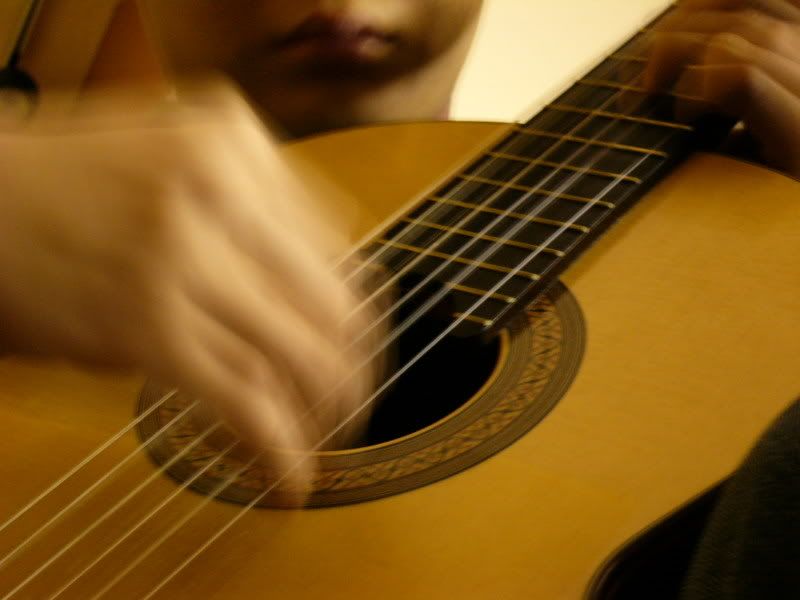
It's been over a year since I last performed in public in anything vaguely resembling a formal setting, and this was not a thought that was particularly comforting as I put on my bow tie and suit in my room just an hour and a half from the start of the performance. Just to make things more interesting, I was also carrying a finger injury from either over-practice or volleyball (not sure which), which made long stretches somewhat uncomfortable. Still, it wasn't a show-stopper, so I decided not to cancel the performance.
One might think that I would have wanted to get some last-minute practice and warmup for a couple of hours before my concert, but I've since realised that last-minute practice is a no-no, since it only makes me more nervous when I discover which parts I haven't practised sufficiently (which usually turns out to be EVERYTHING). It's a simple philosophy...the less time you have to worry, the less you will worry. And so I didn't actually sit down to warm-up until just 30 minutes before I was to go on stage, although this was partially because I had to run around getting some things sorted out like the arrangement of the things on-stage.
I was to be the first person to play in the concert organised by Neil Pickering under the banner of the British-Malaysian Society. All of us who were going to play are Malaysians, although I'm the only amateur. There was Foo Mei Yi, a RAM Master's student who was to play 8 of the Chopin Preludes on the piano after me; Jane Ng, a violinist doing her Master's at RCM, playing some music by Franck, Wienawski (?) and Prokofiev accompanied by Yuki Negishi (a non-Malaysian, this time); and Bobby Chen, an accomplished concert pianist playing pieces by Debussy, Ravel and Liszt. With such illustrious company, I had every reason to be nervous and overwhelmed.
Even when warming up, I could feel the stage fright creeping in, making my fingers go cold (despite constant visits to the hand-dryer in the restroom) and my heart race. Just before I was to go on-stage, as I waited close to the stage door, I was an absolute wreck. My attempts at calming myself down by playing some easy pieces came to nought as I couldn't even play those properly. As I walked on-stage, I was preparing for total humiliation.
The Master of Ceremonies was a short old English chap, Nigel or Neville (I didn't catch his name, but I have reason to suspect he was once the British High Comissioner to Malaysia). In normal classical concerts, there are no MCs, and even if there were they'd leave the stage the moment the performer comes on. So I was rather surprised when he stayed on-stage when I went on, and he introduced me to the audience. Somehow, that helped me settle my nerves, and while I was still nervous when I sat down to play, at least my fingers have stopped trembling and I could actually FEEL them, which was a good start. ...which didn't prevent me from flubbing the first passage of my performance.
Still, things went reasonably well for the first couple of pieces of my programme. It wasn't perfect, but the mistakes I made were pretty minor and probably unnoticeable for the uninitiated. The final piece of my performance, however, is by far the most difficult. Things were alright for the first 5 minutes or so, then I came to a section which is the most difficult of the lot, a real finger-buster. I actually managed to play it quite well, but as I came on to the final few bars consisting of truly insane block-chords flying about the fingerboard, I felt my injured finger give way, and I mentally went "OOOOOOOOWWW!". And I still had a couple of pages' worth of music to go through, and so I basically limped through the finish line.
After I finished my programme, there were still Mei Yi, Jane and Bobby to go, so I moped about the place, reading the newspapers before deciding to sneak back inside the concert hall to listen to the rest of the concert. After the encores (including a four-hand piece by Mei Yi and Bobby), we went up to stage for a group bow. The girls were handed bouquets and we, the gents, were given a bottle of fine champagne each, as well as an envelope containing (I quote) "A little token of thanks".
At the reception after the concert, I was almost immediately accosted by a Malay lady who turned out to be the assistant director of Tourism Malaysia's branch in London (which incidentally is in Trafalgar Sq). She asked me to play background music at a dinner next Tuesday. She seemed a bit too insistent on it for my taste, BUT ON THE OTHER HAND she asked me to name my fee ;-). I'm not sure if I have to mood or if my injured finger allows it, but it seems tempting.
In general, the comments I got from the audience members were extremely flattering. Lot's of comments on the musicality and sensitivity of my playing, and a lot of them seemed extremely impressed that I was doing this just as a hobby (albeit an extremely passionate one). The most flattering comment that I got was "My daughter plays the classical guitar as well, and I had no idea it could sound so good". The oddest comment was (after hearing that I intend to continue in a scientific career, "Are you going to become an academician?". Blank look from me. "You have a lot of stage presence. You're a small person, but when you're on-stage you are completely gigantic". Uhh...okay.....
One might think that I would have wanted to get some last-minute practice and warmup for a couple of hours before my concert, but I've since realised that last-minute practice is a no-no, since it only makes me more nervous when I discover which parts I haven't practised sufficiently (which usually turns out to be EVERYTHING). It's a simple philosophy...the less time you have to worry, the less you will worry. And so I didn't actually sit down to warm-up until just 30 minutes before I was to go on stage, although this was partially because I had to run around getting some things sorted out like the arrangement of the things on-stage.
I was to be the first person to play in the concert organised by Neil Pickering under the banner of the British-Malaysian Society. All of us who were going to play are Malaysians, although I'm the only amateur. There was Foo Mei Yi, a RAM Master's student who was to play 8 of the Chopin Preludes on the piano after me; Jane Ng, a violinist doing her Master's at RCM, playing some music by Franck, Wienawski (?) and Prokofiev accompanied by Yuki Negishi (a non-Malaysian, this time); and Bobby Chen, an accomplished concert pianist playing pieces by Debussy, Ravel and Liszt. With such illustrious company, I had every reason to be nervous and overwhelmed.
Even when warming up, I could feel the stage fright creeping in, making my fingers go cold (despite constant visits to the hand-dryer in the restroom) and my heart race. Just before I was to go on-stage, as I waited close to the stage door, I was an absolute wreck. My attempts at calming myself down by playing some easy pieces came to nought as I couldn't even play those properly. As I walked on-stage, I was preparing for total humiliation.
The Master of Ceremonies was a short old English chap, Nigel or Neville (I didn't catch his name, but I have reason to suspect he was once the British High Comissioner to Malaysia). In normal classical concerts, there are no MCs, and even if there were they'd leave the stage the moment the performer comes on. So I was rather surprised when he stayed on-stage when I went on, and he introduced me to the audience. Somehow, that helped me settle my nerves, and while I was still nervous when I sat down to play, at least my fingers have stopped trembling and I could actually FEEL them, which was a good start. ...which didn't prevent me from flubbing the first passage of my performance.
Still, things went reasonably well for the first couple of pieces of my programme. It wasn't perfect, but the mistakes I made were pretty minor and probably unnoticeable for the uninitiated. The final piece of my performance, however, is by far the most difficult. Things were alright for the first 5 minutes or so, then I came to a section which is the most difficult of the lot, a real finger-buster. I actually managed to play it quite well, but as I came on to the final few bars consisting of truly insane block-chords flying about the fingerboard, I felt my injured finger give way, and I mentally went "OOOOOOOOWWW!". And I still had a couple of pages' worth of music to go through, and so I basically limped through the finish line.
After I finished my programme, there were still Mei Yi, Jane and Bobby to go, so I moped about the place, reading the newspapers before deciding to sneak back inside the concert hall to listen to the rest of the concert. After the encores (including a four-hand piece by Mei Yi and Bobby), we went up to stage for a group bow. The girls were handed bouquets and we, the gents, were given a bottle of fine champagne each, as well as an envelope containing (I quote) "A little token of thanks".
At the reception after the concert, I was almost immediately accosted by a Malay lady who turned out to be the assistant director of Tourism Malaysia's branch in London (which incidentally is in Trafalgar Sq). She asked me to play background music at a dinner next Tuesday. She seemed a bit too insistent on it for my taste, BUT ON THE OTHER HAND she asked me to name my fee ;-). I'm not sure if I have to mood or if my injured finger allows it, but it seems tempting.
In general, the comments I got from the audience members were extremely flattering. Lot's of comments on the musicality and sensitivity of my playing, and a lot of them seemed extremely impressed that I was doing this just as a hobby (albeit an extremely passionate one). The most flattering comment that I got was "My daughter plays the classical guitar as well, and I had no idea it could sound so good". The oddest comment was (after hearing that I intend to continue in a scientific career, "Are you going to become an academician?". Blank look from me. "You have a lot of stage presence. You're a small person, but when you're on-stage you are completely gigantic". Uhh...okay.....
Wednesday, October 06, 2004
Tuesday, October 05, 2004
I have had experience of both public speaking and performing music in public, and between the two, I would regard public speaking as by far the easier. Even though even the most experience public speakers get nervous on-stage, I usually find that once if I have prepared for the talk once I start speaking I go on cruise-control, and it's no big deal. My trick is to regard the audience as a friend whom I want to inform or educate (although this illusion might not hold up too well when addressing a hostile debating floor!). Even without preparation, I find it easy to speak in public, simply by adopting a conversational style (although I have had my moments of using impromptu doses of rhetoric).
Performing music in public, on the other hand, is a different kettle of fish. One phenomenon which I find common to both performing and public speaking is the 'shakes' of the hand. In public speaking, shakes aren't noticeable unless its REALLY bad; when performing classical guitar, where absolutely perfect finger placement is required (especially in the left hand), shakes are a potential show-stopper. The moment before I go on-stage, not only do I get shakes, but all the heat flows out from my fingers, leaving them icy cold and stiff. This situation usually means that I make lots of mistakes and break the rhythm of my music, and this in turn makes me feel even more nervous and tenses me up even more, until in the worst-case scenario, my music turns into complete nonsense, or worse, a memory lapse occurs.
Part of the difficulty of performing in public might be traced down to lack of preparation. I have a tendency of performing music beyond my ability, or poorly prepared. In such cases, what little control I have over the music would simply disappear, and disaster will happen. Nevertheless, I have had bad performances of music that I have been playing for ages, and which I thought I was in full control of.
Music is a form of communication, and it can communicate emotions and feelings that cannot be expressed in words or any other way. When I play music, I touch a part of myself that I never express in everyday life, even to my closest friends. As I am normally so reticent and withdrawn (or at least hide away most of my innermost thoughts), it can be extremely difficult to get in touch with the inner part of my mind that guides my music when faced with an audience of dozens or even hundreds of people, all staring at me.
Tonight, I'm going to do a dry run of the recital with the residents of my hall, and it will be chance to gauge how well I am prepared, both musically and psychologically, for the concert next week. Wish me luck.
Performing music in public, on the other hand, is a different kettle of fish. One phenomenon which I find common to both performing and public speaking is the 'shakes' of the hand. In public speaking, shakes aren't noticeable unless its REALLY bad; when performing classical guitar, where absolutely perfect finger placement is required (especially in the left hand), shakes are a potential show-stopper. The moment before I go on-stage, not only do I get shakes, but all the heat flows out from my fingers, leaving them icy cold and stiff. This situation usually means that I make lots of mistakes and break the rhythm of my music, and this in turn makes me feel even more nervous and tenses me up even more, until in the worst-case scenario, my music turns into complete nonsense, or worse, a memory lapse occurs.
Part of the difficulty of performing in public might be traced down to lack of preparation. I have a tendency of performing music beyond my ability, or poorly prepared. In such cases, what little control I have over the music would simply disappear, and disaster will happen. Nevertheless, I have had bad performances of music that I have been playing for ages, and which I thought I was in full control of.
Music is a form of communication, and it can communicate emotions and feelings that cannot be expressed in words or any other way. When I play music, I touch a part of myself that I never express in everyday life, even to my closest friends. As I am normally so reticent and withdrawn (or at least hide away most of my innermost thoughts), it can be extremely difficult to get in touch with the inner part of my mind that guides my music when faced with an audience of dozens or even hundreds of people, all staring at me.
Tonight, I'm going to do a dry run of the recital with the residents of my hall, and it will be chance to gauge how well I am prepared, both musically and psychologically, for the concert next week. Wish me luck.
Saturday, October 02, 2004
Physics with space science is cool subject, especially that bit where I tell people what I study in university and get to see their eyes widen. When I started this course, I wanted to become a planetary scientist or, possibly, an astronautics engineer, but that was over two years ago. Since then I have had gotten a much larger overall view of the various fields in physics and astronomy, of things which I have not heard of before university.
Nowadays, if people ask me what I want to do for grad school, I find it much difficult to answer. I find that inspiration comes most naturally to me when I think about the big picture about the universe: cosmology, the study of the past, present and future of the universe. It is a field in which some of the biggest names in science have been made (e.g. Messrs. Einstein and Hawking), and which have completely revolutionised mankind's knowledge of his place in the grand scheme of things. When I think of the field of cosmology, I get a tingle up my spine about the unimaginable size and scale of the universe, and the insignificance of mankind. There are many outstanding problems in the field, and I feel the solution of these problems will revolutionise science in the same way Einstein or Newton did. However, I'm not really interested in the observational aspect of astronomy, which often involves cataloguing distances of faraway stars, a glorified combination of photography and librarianship (with due apologies to my astronomer readers!). It's the gigantic intellectual challenge of theoretical cosmology that excites me, but on the other hand abstract mathematics isn't my true strength, and there's another thing.....
I have often fancied myself as a humanist, as someone who looks beyond the parochiality of my individual self, family, race and nation, for the good of all mankind. It has not gone unnoticed to me that there are many problems besetting mankind right now, which I shall not even go into, but suffice to say that I want whatever thing I do to be for the benefit of mankind (or humankind, for all you feminists). Cosmology is a really pure science, in the sense that it has no direct and obvious application, although in common with all pure science, there are always spinoffs, such adding to our knowledge of science as a whole which might help other, more practical branches of science. I have no doubt of the value of cosmology to mankind in general, but I think there are more immediate ways in which I can contribute....
There is a joke about nuclear fusion reactors: it is always 30 years in the future. It is a power source of dreams: the energy of the stars, with the main raw material almost freely available in sea water, and little or none of the political and environmental problems associated with most energy sources we currently have. There is, of course, the little problem that viable commercial fusion reactors are still a few decades in the future. There are many problems with making fusion reactors, and while a lot of progress has been made over the past decades, there is still a lot of ground to be covered, with a lot of obstacles in plasma physics and engineering to be overcome. However, the promise of nuclear fusion is something that I can work for in full conscience, in the knowledge that the work I'm doing will help solve a significant chunk of the world's problems. However, fusion research is a huge field, and as an individualistic person, I have doubts about how well I can work in a huge group (OK, maybe there's the egoistic aspect about wanting to get due recognition for work done, which might not be in good supply in large group efforts). Also, the work within fusion research won't be as intrinsically interesting as in cosmology, but there will be the satisfaction about the social benefit of the work done.
There is the large dilemma between personal interest and social worth of the work done, that I'm facing here. At the moment, it looks as if I will be going into fusion research, but there will be a lot more introspection and thought before I commit.
Nowadays, if people ask me what I want to do for grad school, I find it much difficult to answer. I find that inspiration comes most naturally to me when I think about the big picture about the universe: cosmology, the study of the past, present and future of the universe. It is a field in which some of the biggest names in science have been made (e.g. Messrs. Einstein and Hawking), and which have completely revolutionised mankind's knowledge of his place in the grand scheme of things. When I think of the field of cosmology, I get a tingle up my spine about the unimaginable size and scale of the universe, and the insignificance of mankind. There are many outstanding problems in the field, and I feel the solution of these problems will revolutionise science in the same way Einstein or Newton did. However, I'm not really interested in the observational aspect of astronomy, which often involves cataloguing distances of faraway stars, a glorified combination of photography and librarianship (with due apologies to my astronomer readers!). It's the gigantic intellectual challenge of theoretical cosmology that excites me, but on the other hand abstract mathematics isn't my true strength, and there's another thing.....
I have often fancied myself as a humanist, as someone who looks beyond the parochiality of my individual self, family, race and nation, for the good of all mankind. It has not gone unnoticed to me that there are many problems besetting mankind right now, which I shall not even go into, but suffice to say that I want whatever thing I do to be for the benefit of mankind (or humankind, for all you feminists). Cosmology is a really pure science, in the sense that it has no direct and obvious application, although in common with all pure science, there are always spinoffs, such adding to our knowledge of science as a whole which might help other, more practical branches of science. I have no doubt of the value of cosmology to mankind in general, but I think there are more immediate ways in which I can contribute....
There is a joke about nuclear fusion reactors: it is always 30 years in the future. It is a power source of dreams: the energy of the stars, with the main raw material almost freely available in sea water, and little or none of the political and environmental problems associated with most energy sources we currently have. There is, of course, the little problem that viable commercial fusion reactors are still a few decades in the future. There are many problems with making fusion reactors, and while a lot of progress has been made over the past decades, there is still a lot of ground to be covered, with a lot of obstacles in plasma physics and engineering to be overcome. However, the promise of nuclear fusion is something that I can work for in full conscience, in the knowledge that the work I'm doing will help solve a significant chunk of the world's problems. However, fusion research is a huge field, and as an individualistic person, I have doubts about how well I can work in a huge group (OK, maybe there's the egoistic aspect about wanting to get due recognition for work done, which might not be in good supply in large group efforts). Also, the work within fusion research won't be as intrinsically interesting as in cosmology, but there will be the satisfaction about the social benefit of the work done.
There is the large dilemma between personal interest and social worth of the work done, that I'm facing here. At the moment, it looks as if I will be going into fusion research, but there will be a lot more introspection and thought before I commit.
Wednesday, September 29, 2004
"You look like a homeless person". Those are not the words that one normally uses to greet a friend whom one hasn't seen in nearly a year, but then most people aren't Mike Macdonald. I was waiting outside BK in Leicester Sq for him, and he had just come from Victoria, where he was just concluding the deal for the purchase of his second house in London. He asked me where I wanted to have lunch ("And no bloody Chinese food, obviously"), and I suggested Angus Steak House nearby. "No way, Angus is shite".... so I suggested that we have the lunch buffet at Chiquito, a Mexican restaurant next to Pizza Hut.
I first met Mike at the Singapore Guitar Festival over 2 years ago, and I did not notice this at the time, but he speaks in a strange mixture of a Scouse accent with a hint of Hong Kong and the occasional 'lah' tacked on to the end of his sentences. He's from Liverpool, but has been working in Singapore for the past few years as a financial analyst. He's not your average scouse though, since he can speak reasonably fluent Cantonese, which is because he once worked in HK.
He studied maths in university, and he was interested going into research in general relativity, but decided to go into market analysis rather than end up in 'Economy Class Land' (as he put it). Among other things, Mike is very clearly a genius. He did his O-levels when he was 13, and got accepted into Cambridge, but he decided to go into UMIST instead (apparently he thought Cambridge was too dull). He can play the guitar better than I can (at least that was the case the last time I heard him play, which was some time ago), yet he says that it's his THIRD instrument after recorder and piano. Not surprisingly, with brains like his, he's making loads of money, which is why I had no compunctions against getting him to buy me lunch. After all, he's only in London for a couple of weeks, and I probably won't see him again for a few months at least.
Intelligent and successful that he is, he has a tongue that is acerbic to say the very least. As PH observed when he met him, Mike is one of the best insulters that you'll ever meet. His vocabulary still consists of stuff you would expect from a working-class Liverpool background (his Scouse accent has been watered down, but having met his sister, I now know he's definitely from a working class family), like "I'm going to have to stick a mint up my arse by the time I'm done with this" when helping himself to the food at the buffet table.
Despite this, he is extremely intelligent and can still remember stuff from his university days which (presumably) he doesn't need in financial analysis. So, we were stuffing our face with ribs and chilli (I was, at any rate), and we had words like 'eigenvalues' and 'Riemann hypothesis' and 'Legendre polynomials' flying across the table. I was struggling to keep up my end of the conversation, like when he asked me about HOW we derived the Schrodinger equation.... I was even more lost when he told me how HE did it back in university.
He was always giving me advice on what to expect, and how to handle it, and a lot of it is on issues I've never even thought of. By 2pm, I had to go off to uni to register for the new term ("Oh alright...I have to bugger off that way though"). He might not be a friend I meet everyday, but talking to him never fails to be interesting.
I first met Mike at the Singapore Guitar Festival over 2 years ago, and I did not notice this at the time, but he speaks in a strange mixture of a Scouse accent with a hint of Hong Kong and the occasional 'lah' tacked on to the end of his sentences. He's from Liverpool, but has been working in Singapore for the past few years as a financial analyst. He's not your average scouse though, since he can speak reasonably fluent Cantonese, which is because he once worked in HK.
He studied maths in university, and he was interested going into research in general relativity, but decided to go into market analysis rather than end up in 'Economy Class Land' (as he put it). Among other things, Mike is very clearly a genius. He did his O-levels when he was 13, and got accepted into Cambridge, but he decided to go into UMIST instead (apparently he thought Cambridge was too dull). He can play the guitar better than I can (at least that was the case the last time I heard him play, which was some time ago), yet he says that it's his THIRD instrument after recorder and piano. Not surprisingly, with brains like his, he's making loads of money, which is why I had no compunctions against getting him to buy me lunch. After all, he's only in London for a couple of weeks, and I probably won't see him again for a few months at least.
Intelligent and successful that he is, he has a tongue that is acerbic to say the very least. As PH observed when he met him, Mike is one of the best insulters that you'll ever meet. His vocabulary still consists of stuff you would expect from a working-class Liverpool background (his Scouse accent has been watered down, but having met his sister, I now know he's definitely from a working class family), like "I'm going to have to stick a mint up my arse by the time I'm done with this" when helping himself to the food at the buffet table.
Despite this, he is extremely intelligent and can still remember stuff from his university days which (presumably) he doesn't need in financial analysis. So, we were stuffing our face with ribs and chilli (I was, at any rate), and we had words like 'eigenvalues' and 'Riemann hypothesis' and 'Legendre polynomials' flying across the table. I was struggling to keep up my end of the conversation, like when he asked me about HOW we derived the Schrodinger equation.... I was even more lost when he told me how HE did it back in university.
He was always giving me advice on what to expect, and how to handle it, and a lot of it is on issues I've never even thought of. By 2pm, I had to go off to uni to register for the new term ("Oh alright...I have to bugger off that way though"). He might not be a friend I meet everyday, but talking to him never fails to be interesting.
I am back in London now. 13 hour flights are no fun, but after the first couple of times, one tends to develop strategies to deal with the interminable passage of time. Most people seem to pick sleeping, but I am utterly incapable of sleeping continuously on anything other than a flat bed. I find the 13 hours ideal for listening to music....most of the time, I have no time to just sit down for an hour or more to listen to a full symphony, so long journeys like that are perfect for that. I spent an hour or two learning Spanish, and finished an entire book: The City and the Stars by Arthur C. Clarke. I haven't actually read any of his books in years, although I have fond memories of reading many of his books in my formative years. It was a fantastic book, and I read it from cover to cover.
Modern travel is supposed to be making the world smaller. I suppose that is true, but when 40,000 feet in the air, with entire cities and mountains on the ground seeming Liliputian, I can't help but feel that the world is still extremely vast, notwithstanding any pretensions we might have otherwise.
747s might be able to bridge the gap between continents, but it doesn't really help with the process of bridging cultures. Despite having been in London for most of the past two years, I still got culture shock and a sudden feeling of isolation. Maybe it's the knowledge that I will be a wayfarer for the next decade at least, with no place that I can confidently call home. I will regularly be going back to Malaysia during holidays etc, but nevertheless it's not going to be a place I can be settled in. I am fairly certain that I will still be in UK for my Master's but beyond that I have no idea where I will be doing my PhD, post-docs and any permanent positions I might hold (incidentally, 'permanent' is relative insomuch as scientific jobs are concerned). And to think as far as where I will settle down for a home....
Ambition is a good thing, but there are always sacrifices to made from things that most people take for granted.
Modern travel is supposed to be making the world smaller. I suppose that is true, but when 40,000 feet in the air, with entire cities and mountains on the ground seeming Liliputian, I can't help but feel that the world is still extremely vast, notwithstanding any pretensions we might have otherwise.
747s might be able to bridge the gap between continents, but it doesn't really help with the process of bridging cultures. Despite having been in London for most of the past two years, I still got culture shock and a sudden feeling of isolation. Maybe it's the knowledge that I will be a wayfarer for the next decade at least, with no place that I can confidently call home. I will regularly be going back to Malaysia during holidays etc, but nevertheless it's not going to be a place I can be settled in. I am fairly certain that I will still be in UK for my Master's but beyond that I have no idea where I will be doing my PhD, post-docs and any permanent positions I might hold (incidentally, 'permanent' is relative insomuch as scientific jobs are concerned). And to think as far as where I will settle down for a home....
Ambition is a good thing, but there are always sacrifices to made from things that most people take for granted.
Friday, September 17, 2004
A few weeks back, I was chatting online with a younger friend of mine who's still doing Form 6 in Catholic High. Wan Ru, to her credit, is one of the few friends who have ever been curious about my field of study to bombard me with questions. I knew she was very active in the the science/maths soc in CHS, so I jokingly asked her if she wanted me to give a talk about astronomy and stuff like that. To my surprise, she said that she will organise a talk by me in school. I wasn't really expecting her to say yes, since I had doubts about the level of interest that high students would have for this subject.
As the days went by, the date for the talk crystallised as she made the arrangements, but it was some time before I gotten around to actually preparing the Powerpoint presentation for it. When started making the first slides introducing myself, I had little idea of what to talk about: I had told Wan Ru that it was going to be something on 'astronomy and astrophysics and stuff like that', but I soon had the problem of having a topic that was too broad, and impossible to present in a single talk. I decided to start with a few slides talking about astronomy in antiquity, with a slide showing an Assyrian sky map and another one showing Erastothenes' calculation of Earth's circumference. As my account shifted towards Ptolemy and Copernicus, I realised that an account of the evolution of mankind's view of the universe is fascinating and should be able to keep the attention of the students. Nowadays, this subject has a name: cosmology.
The thought of giving a lecture on cosmology to a bunch of disinterested high school students is intimidating to say the least. However, as I worked on the presentation, I began to feel that it's possible to do a coherent account which should be comprehensible to high school students, especially since many of the audience would be Six Formers in science.
Today, with no small amount of trepidation, I arrived at school at around noon to prepare for the talk, which would be given at 12.30pm, during a time when both afternoon and morning sessions can come and listen (in CHS, Forms 1 and 2 study in the afternoons, while the rest are in the morning session...it's the only way everyone can fit into the classrooms; and on Friday, there's a gap between the end of the morning session and the start of the afternoon session to accommodate Friday prayers for Muslims). As the audience started filtering in while I was hooking up my laptop to the projector, it seemed that most of the students were male Six Formers, with a smattering of younger students presumably from SainsMatik (Sci/Math soc for all you non-Malay speakers).
I started my talk with a picture of my graduation class photo, to strike a rapport with the students (i.e. the fact that I was in their shoes), and talked a bit about studying physics in university and also a couple of slides about my summer in STScI (just to establish my pedigree a bit :P). I clarified the difference between astronomy and astrophysics before starting of my talk properly. Although I saw a couple of girls studying near the back while I was talking, in general, I think I managed to catch their attention fairly well, because I used lots of pictures that they probably won't see in text books...for example, in a slide about Galileo I managed to Google a couple of images of his drawings on Saturn's moons and the lunar landscape, which I could sense fascinated them. I did reckon my voice turned a bit monotonous at times, and a few times I tripped over my own words, but I think the only moment when I lost my track a bit was when I was telling them about the measured change in the fine structure constant...I wrote it out in terms of the fundamental constants was surprised that they (the 6th Formers) have not yet encountered Planck's constant and the permittivity of free space, ε0. I was pretty sure that I had encountered it before I entered university, so I floundered a bit when they all gave me blank looks. Sometimes, you lose track of what the layperson knows.
I particularly enjoyed explaining things from Edwin Hubble onwards, which I'm sure a lot of them would never have known, and it was clear they were actually paying attention to what I had to say, because I had to field a few questions, as well as the occasional comment from the loudmouths among them. It did get kind of awkward when they asked questions beyond my level, but I tried answering to the best of my knowledge.
By the time I was 16-17 I had read a lot of popular science books, but I think most of my audience have never read any, so my talk was probably a huge eye-opener for them. It was gratifying to see that they were actually fascinated by the subject, and hopefully at least a few of them will be inspired into reading more on it...even if none of them eventually end up as cosmologists.
If ever another opportunity comes up to give talks to students, I'll more than happy to do it again...
As the days went by, the date for the talk crystallised as she made the arrangements, but it was some time before I gotten around to actually preparing the Powerpoint presentation for it. When started making the first slides introducing myself, I had little idea of what to talk about: I had told Wan Ru that it was going to be something on 'astronomy and astrophysics and stuff like that', but I soon had the problem of having a topic that was too broad, and impossible to present in a single talk. I decided to start with a few slides talking about astronomy in antiquity, with a slide showing an Assyrian sky map and another one showing Erastothenes' calculation of Earth's circumference. As my account shifted towards Ptolemy and Copernicus, I realised that an account of the evolution of mankind's view of the universe is fascinating and should be able to keep the attention of the students. Nowadays, this subject has a name: cosmology.
The thought of giving a lecture on cosmology to a bunch of disinterested high school students is intimidating to say the least. However, as I worked on the presentation, I began to feel that it's possible to do a coherent account which should be comprehensible to high school students, especially since many of the audience would be Six Formers in science.
Today, with no small amount of trepidation, I arrived at school at around noon to prepare for the talk, which would be given at 12.30pm, during a time when both afternoon and morning sessions can come and listen (in CHS, Forms 1 and 2 study in the afternoons, while the rest are in the morning session...it's the only way everyone can fit into the classrooms; and on Friday, there's a gap between the end of the morning session and the start of the afternoon session to accommodate Friday prayers for Muslims). As the audience started filtering in while I was hooking up my laptop to the projector, it seemed that most of the students were male Six Formers, with a smattering of younger students presumably from SainsMatik (Sci/Math soc for all you non-Malay speakers).
I started my talk with a picture of my graduation class photo, to strike a rapport with the students (i.e. the fact that I was in their shoes), and talked a bit about studying physics in university and also a couple of slides about my summer in STScI (just to establish my pedigree a bit :P). I clarified the difference between astronomy and astrophysics before starting of my talk properly. Although I saw a couple of girls studying near the back while I was talking, in general, I think I managed to catch their attention fairly well, because I used lots of pictures that they probably won't see in text books...for example, in a slide about Galileo I managed to Google a couple of images of his drawings on Saturn's moons and the lunar landscape, which I could sense fascinated them. I did reckon my voice turned a bit monotonous at times, and a few times I tripped over my own words, but I think the only moment when I lost my track a bit was when I was telling them about the measured change in the fine structure constant...I wrote it out in terms of the fundamental constants was surprised that they (the 6th Formers) have not yet encountered Planck's constant and the permittivity of free space, ε0. I was pretty sure that I had encountered it before I entered university, so I floundered a bit when they all gave me blank looks. Sometimes, you lose track of what the layperson knows.
I particularly enjoyed explaining things from Edwin Hubble onwards, which I'm sure a lot of them would never have known, and it was clear they were actually paying attention to what I had to say, because I had to field a few questions, as well as the occasional comment from the loudmouths among them. It did get kind of awkward when they asked questions beyond my level, but I tried answering to the best of my knowledge.
By the time I was 16-17 I had read a lot of popular science books, but I think most of my audience have never read any, so my talk was probably a huge eye-opener for them. It was gratifying to see that they were actually fascinated by the subject, and hopefully at least a few of them will be inspired into reading more on it...even if none of them eventually end up as cosmologists.
If ever another opportunity comes up to give talks to students, I'll more than happy to do it again...
Sunday, September 12, 2004
Two more weeks of my summer holiday left, before I have to fly back to the festering sore that is London. I've been doing the usual holiday activities, or rather, the usual holiday non-activities, e.g. lazing about and sleeping. As in last summer, I have a bunch of things that I've planned out to do in summer, but again I'm too darn lazy to do it.
Sooner of later though, I'll HAVE to push myself to do some things. I jokingly asked a friend still studying in Catholic High if she wanted me to give a talk for the Sixth-Formers' Society, and to my surprised (and alarm), she promptly said yes and has already pencilled me in to talk to a bunch of students this coming Friday. I have virtually no idea what to talk about. At this point, I think I'll introduce myself and my studies (physics/astronomy undergrads are rather scarce in Malaysia, let alone those studying abroad), and carry on to try and give a flavour of astronomical research. I'm not sure how to make my experiences in STScI fit in though. I've started creating the Powerpoint presentation a few days ago, but so far I'm still at the 'Hello' stages. Any suggestions and/or ideas are most welcomed.
I also have a couple of articles to write. I promised an article on nuclear fusion for Nexus News back in London, which was originally intended to be due late last month, but now I managed to ask it to be put into the next issue instead, which gives me a couple months' breathing space. Still, it might not be too good to procrastinate to badly on that. It will involve considerable amounts of research to get the thing written up.
Another one is something I want to try and sell to New Straits Times...I managed to get an interview with Stephen Beckwith, the director of STScI, while I was there, there are some very interesting material that I think can be written into an article for the general public. First however, I need to get the interview transcribed out of the very cheap digital voice recorder that I used for the interview...so cheap in fact, that it does not have a fast-forward or skip function, so that every time I want to hear something, I have to play the whole thing from the beginning, which is EXTREMELY annoying. Hence, I haven't really transcribed much of the interview yet. And there's the little matter of trying to sell the article to NST....
And there's the little matter of my recital in October. Still need a lot of practise to get up to scratch, but here I am sitting on my arse. Joy...
Sooner of later though, I'll HAVE to push myself to do some things. I jokingly asked a friend still studying in Catholic High if she wanted me to give a talk for the Sixth-Formers' Society, and to my surprised (and alarm), she promptly said yes and has already pencilled me in to talk to a bunch of students this coming Friday. I have virtually no idea what to talk about. At this point, I think I'll introduce myself and my studies (physics/astronomy undergrads are rather scarce in Malaysia, let alone those studying abroad), and carry on to try and give a flavour of astronomical research. I'm not sure how to make my experiences in STScI fit in though. I've started creating the Powerpoint presentation a few days ago, but so far I'm still at the 'Hello' stages. Any suggestions and/or ideas are most welcomed.
I also have a couple of articles to write. I promised an article on nuclear fusion for Nexus News back in London, which was originally intended to be due late last month, but now I managed to ask it to be put into the next issue instead, which gives me a couple months' breathing space. Still, it might not be too good to procrastinate to badly on that. It will involve considerable amounts of research to get the thing written up.
Another one is something I want to try and sell to New Straits Times...I managed to get an interview with Stephen Beckwith, the director of STScI, while I was there, there are some very interesting material that I think can be written into an article for the general public. First however, I need to get the interview transcribed out of the very cheap digital voice recorder that I used for the interview...so cheap in fact, that it does not have a fast-forward or skip function, so that every time I want to hear something, I have to play the whole thing from the beginning, which is EXTREMELY annoying. Hence, I haven't really transcribed much of the interview yet. And there's the little matter of trying to sell the article to NST....
And there's the little matter of my recital in October. Still need a lot of practise to get up to scratch, but here I am sitting on my arse. Joy...
Wednesday, September 08, 2004
I've been reading a lot lately, which is something I haven't done in a very long time. Apart from occasionally going out with friends, I've been putting aside a few things I'm supposed to do (including a talk I'm supposed to give at my old secondary school next Friday, and my guitar practice), partially out of sheer laziness, and been reading like my life depends on it.
I've just finished Sophie's World by Jostein Gaarder, which is an excellent book. It's a mystery novel/ history of philosophy rolled into one, and while it started out rather slowly, around the middle it starts to get extremely interesting and hard to put down. It basically starts out with a girl living in a small Norwegian town, Sophie, who starts to get mysterious postcards and a correspondence course in philosophy through the mail. She rapidly learns that reality isn't what she thinks it is, and you start to wonder if reality isn't what you think it is either. A lot of the book is like an introductory course in the history of Western philosophy, but as the book is targeted at teenagers and children, it is presented in fairly simple terms, which is a good thing, as I have forgotten most of what I know on the subject (the Heraclituses and Anaxigorases and Anaximeneses started to get rather jumbled up in one's mind). It's a book I'd heartily recommend to anyone.
As a scientist, I'm glad to note that a lot of the questions and answers that have occupied philosophy for millenia have either been resolved or rendered irrelevant. 'Natural philosophy' no longer belongs in the realms of philosophy, but to science. Still, I found that philosophy has a great role to play in aesthetics (not in the usual sense of the word, but study of man's perception of nature as a whole), ethics, logic and lots more.
I'm curious as to how the term 'romantic' became synonymous with love, when it refers to an entire worldview of an artist partaking in the act of creation, and the idealisation of rusticity and country life (presumably in reaction to the Industrial Revolution). Funny how things get twisted over the years. As musician, I am certainly a Romantic. When I'm absorbed in a piece of music, whether as a performer or listener, I cease to exist as a person, instead living in the universe weaved within the notes. Sadly to say, this experience isn't something that occurs very often, which makes it all the more precious.
Speaking of music, it's official....I'm performing in a recital on the 12th of October, in London. If you're interested in going there, let me know as you need to RSVP for tickets in advance. Tickets are £6 for students.
I've just finished Sophie's World by Jostein Gaarder, which is an excellent book. It's a mystery novel/ history of philosophy rolled into one, and while it started out rather slowly, around the middle it starts to get extremely interesting and hard to put down. It basically starts out with a girl living in a small Norwegian town, Sophie, who starts to get mysterious postcards and a correspondence course in philosophy through the mail. She rapidly learns that reality isn't what she thinks it is, and you start to wonder if reality isn't what you think it is either. A lot of the book is like an introductory course in the history of Western philosophy, but as the book is targeted at teenagers and children, it is presented in fairly simple terms, which is a good thing, as I have forgotten most of what I know on the subject (the Heraclituses and Anaxigorases and Anaximeneses started to get rather jumbled up in one's mind). It's a book I'd heartily recommend to anyone.
As a scientist, I'm glad to note that a lot of the questions and answers that have occupied philosophy for millenia have either been resolved or rendered irrelevant. 'Natural philosophy' no longer belongs in the realms of philosophy, but to science. Still, I found that philosophy has a great role to play in aesthetics (not in the usual sense of the word, but study of man's perception of nature as a whole), ethics, logic and lots more.
I'm curious as to how the term 'romantic' became synonymous with love, when it refers to an entire worldview of an artist partaking in the act of creation, and the idealisation of rusticity and country life (presumably in reaction to the Industrial Revolution). Funny how things get twisted over the years. As musician, I am certainly a Romantic. When I'm absorbed in a piece of music, whether as a performer or listener, I cease to exist as a person, instead living in the universe weaved within the notes. Sadly to say, this experience isn't something that occurs very often, which makes it all the more precious.
Speaking of music, it's official....I'm performing in a recital on the 12th of October, in London. If you're interested in going there, let me know as you need to RSVP for tickets in advance. Tickets are £6 for students.
Saturday, August 28, 2004
Well, so here I am back home, after a 24 hour epic journey which involved pushing my luggage trolley at full speed through a very crowded Heathrow Terminal 3, where I had to check in for my connecting flight between London and KL. Still, the pertinent point is that I'm back home in one piece, not to mention that my luggage managed to avoid an unwanted round-the-world odyssey that I feared would happen. Physically, I may be in one piece, but considering I have had little more than 3 hours of sleep in the past 24 hours, mentally I'm not quite together.
The past 10 weeks in the States have been, probably, the happiest time in my life. Not because of the US as a nation...staying there has opened my mind, and dispelled a lot of illusions I might have had about the country prior to going there. It's a great country to live in...if you can tolerate the fact that the high quality of living is built on the back of the downtrodden both within the country and (mostly) without. It was also not because of Baltimore as a city...it's a pretty dull city to be honest, and apparently the 2nd most dangerous city in the US. The Hopkins campus is pretty pleasant, but I can't imagine living there all year.
Here's the reasons those 10 weeks will be a long-cherished memory (in no particular order): Rafael, Esteban, Miguel, Gara, Bess, Marie, Raquel, Scott, Bonnie, Cheri, Olaide, Tom and Mel. I will never forget the fun that we've had in that time. It's probably the first time I've met so many people of my age group whom I can both get along with and share a common passion in science.
I also loved the freedom that I got from earning my own money, and having the freedom to lead my own life. When I'm in London, I'm fairly stingy because it's my parents' money I'm spending, so having my own paycheque was liberating. I traveled quite a lot, to DC, NYC, and Philadelphia, and all that opened my eyes immensely and well as being great fun in the company of my friends.
It's been great. Adios STScI SSP 2004.
The past 10 weeks in the States have been, probably, the happiest time in my life. Not because of the US as a nation...staying there has opened my mind, and dispelled a lot of illusions I might have had about the country prior to going there. It's a great country to live in...if you can tolerate the fact that the high quality of living is built on the back of the downtrodden both within the country and (mostly) without. It was also not because of Baltimore as a city...it's a pretty dull city to be honest, and apparently the 2nd most dangerous city in the US. The Hopkins campus is pretty pleasant, but I can't imagine living there all year.
Here's the reasons those 10 weeks will be a long-cherished memory (in no particular order): Rafael, Esteban, Miguel, Gara, Bess, Marie, Raquel, Scott, Bonnie, Cheri, Olaide, Tom and Mel. I will never forget the fun that we've had in that time. It's probably the first time I've met so many people of my age group whom I can both get along with and share a common passion in science.
I also loved the freedom that I got from earning my own money, and having the freedom to lead my own life. When I'm in London, I'm fairly stingy because it's my parents' money I'm spending, so having my own paycheque was liberating. I traveled quite a lot, to DC, NYC, and Philadelphia, and all that opened my eyes immensely and well as being great fun in the company of my friends.
It's been great. Adios STScI SSP 2004.
Saturday, August 14, 2004
I cannot recall ever having to make sacrifices in my life. It has always been easy for me to do what I want to do, without having to encounter too many obstacles or give up things I hold dear. I have been blessed as far as my talents and abilities are concerned, and have never had to worry about financial matters. It was always something that I've taken for granted...maybe I've kidded myself what 'sacrifices' I've made are admirable and something to be proud of. As I've gotten to know some of my colleagues at the Institute better, I've had a better perspective on such things.
Most of us in the STScI summer program of 2004 are either physicists or astronomers, but there are a few exceptions. Raquel Shida might confuse you a bit if you ever met her. She looks every bit the average Japanese girl, but if you try to speak to her in Japanese (as I did), she would give you a confused look. That's because she isn't Japanese, but a Brazillian. In the same way I'm ethnic Chinese but Malaysia, she's ethnic Japanese but of Brazillian nationality. Her project is pure astronomy, mostly data reduction, and she's totally commited to her work, more so than anyone else...she is almost always in the office, late into the nights and in the weekends. But she's not an astronomy or physics student...she's a third year ARCHITECTURE student. But she's a very avid amateur astronomer. For scientists, one important sign of achievement is the amount of papers published, and Raquel has TWENTY FOUR papers listed to her name in the NASA abstract retrieval service. She has been observing variable stars, and writing papers on her observations. She's obviously as passionate about astronomy as most of us, if not more, yet she isn't doing a related subject. When we asked her about it, she said that she wasn't sure about of being to make a living as an astronomer when she was first applying for university, and decided to go for something safe instead. But it seems that now, she has decided to go for her interest, and she'll be wanting to do a physics or astronomy degree after she finishes the current degree.
Melanie, or Mel is from UCL as well! However, she's 3 years my senior, and she just graduated and is going to do a PhD in Cambridge this upcoming academic year. She seemed like just a typical bubbly girl around our age, except that she isn't our age. She's 27 years old this year, and her path to astronomy was not easy. She did a degree in accountacy at first, before realising that she hated it. After graduating, she had to work for a couple of years to earn money before going into a degree course in UCL. She said she couldn't bear the thought of slaving away for 30 years in accountancy, even if the money was good, so she'd rather earn less as an astronomer but be happy. It must have been difficult to take the plunge and do something new at the age when most other people are starting their working careers. I do not know if I would have had the courage to do the same in her place.
I have had a privileged life, and I shouldn't complain when little problems and setbacks turn up in life. I've already had a good hand of cards dealt to me from the start.
Most of us in the STScI summer program of 2004 are either physicists or astronomers, but there are a few exceptions. Raquel Shida might confuse you a bit if you ever met her. She looks every bit the average Japanese girl, but if you try to speak to her in Japanese (as I did), she would give you a confused look. That's because she isn't Japanese, but a Brazillian. In the same way I'm ethnic Chinese but Malaysia, she's ethnic Japanese but of Brazillian nationality. Her project is pure astronomy, mostly data reduction, and she's totally commited to her work, more so than anyone else...she is almost always in the office, late into the nights and in the weekends. But she's not an astronomy or physics student...she's a third year ARCHITECTURE student. But she's a very avid amateur astronomer. For scientists, one important sign of achievement is the amount of papers published, and Raquel has TWENTY FOUR papers listed to her name in the NASA abstract retrieval service. She has been observing variable stars, and writing papers on her observations. She's obviously as passionate about astronomy as most of us, if not more, yet she isn't doing a related subject. When we asked her about it, she said that she wasn't sure about of being to make a living as an astronomer when she was first applying for university, and decided to go for something safe instead. But it seems that now, she has decided to go for her interest, and she'll be wanting to do a physics or astronomy degree after she finishes the current degree.
Melanie, or Mel is from UCL as well! However, she's 3 years my senior, and she just graduated and is going to do a PhD in Cambridge this upcoming academic year. She seemed like just a typical bubbly girl around our age, except that she isn't our age. She's 27 years old this year, and her path to astronomy was not easy. She did a degree in accountacy at first, before realising that she hated it. After graduating, she had to work for a couple of years to earn money before going into a degree course in UCL. She said she couldn't bear the thought of slaving away for 30 years in accountancy, even if the money was good, so she'd rather earn less as an astronomer but be happy. It must have been difficult to take the plunge and do something new at the age when most other people are starting their working careers. I do not know if I would have had the courage to do the same in her place.
I have had a privileged life, and I shouldn't complain when little problems and setbacks turn up in life. I've already had a good hand of cards dealt to me from the start.
Sunday, August 08, 2004
Sometimes, I wonder why I am such a loner...over the past few weeks, I got reminders why I prefer things to be like this.
Usually, our weekends have been the chance for us to travel to nearby cities or attractions, and to take a break from the hard work during the week. This weekend, we hired a few cars so we could have some freedom: we visited the Six Flags amusement park 40 minutes away from Baltimore, and on Sunday we drove all the two hours up to Philadelphia. Six Flags was pretty fun, although it would have been a bit nicer without all the queuing, and Philadephia is a reasonably nice although slightly dull historical city, but that's not the point of this post...
I always find it's easy to get along with people when your interactions are for short periods of time: it's when you hang out with them that friction and conflicts start to develop, and maybe you will see sides of them you will not normally see or realise....in fact, you will see sides of yourself that you will not normally see.
In our excursions, the infamous laid-back Hispanic attitude starts to get irritating...when we're walking in a group, within a few minutes those of us constrained to speak English will soon realise that the Colombians, Spaniards and Brazillian are lagging 50m behind us, walking in their own leisurely pace and jabbering away in Spanish (Raquel doesn't really speak Spanish, but Portuguese is so similar to Spanish that they can actually understand each other). I don't know about the others, but I've found this extremely irritating, because we can be walking along one moment, and realise that we can't see where they have disappeared to, and after 5-10 minutes of frantic back-tracking, we'll find them busy taking pictures of something or other(this is a trait that I would have attributed to the Japanese, but I've since learned that Hispanics are like this also). They can at least have the courtesy to inform us that they want to stop for a moment!
Hispanics eat their dinner at 10-11pm at night, so even though when they're out with they'll concede to eating dinner at normal hours, their behaviour is as if they don't emphatise with our hunger...we can be desperately walking around looking for a restaurant, and they'll still be dragging along in the characteristic manner. There are also times when some of us want to do something different from the rest of the group, and we end up splitting up. This seems trivial, but it's not so nice sight-seeing when you have to plan your itinerary around rendezvous with the other guys at a specific time and place (since we're mostly foreigners, there are only 3 mobile phones out of the 15 interns). And I hope this isn't developing into a theme, but it often seems like the Hispanics are the ones who want to split off to do something else.
Apart from that, it seems like my temper gets on short fuse whenever things don't go smoothly, which is usually the case in trips. Little things that I don't normally notice start to irritate a part of me...the rational part knows its insignificant and of no consequence, but another part just starts getting really indignant and feels like yelling out. Today at Philadelphia, I was walking with the group (or rather, in the general direction, since the first and last person in the group was like 50m apart as usual) . As I was walking up a flight of stone steps outside a building, Matthias suddenly squirted water at me and made my entire shirt wet. I was startled, and I yelled, 'F***king hell!'. Normally, I would have then just laughed and chased after him, but I fumed and shouted 'YOU F***KING SON OF A BITCH!!!'. Everyone was completely shocked at my reaction (including a bunch of old ladies who were sitting nearby). Part of me was just out of control, while the calmer part couldn't assert itself.
There is also a more gradual build-up of irritation towards certain people in the group from probably insignificant little things, and sometime I might just lose it at them.
I guess that usually being a sociopath means that I avoid such friction with people. I think that I prefer having a small number of good friends rather than a large number of less intimate ones...it's much easier to iron out differences in opinion, and when you know someone better you're more likely to wave off little disagreements. Apart from that, I would like my friends to know me more intimately...I think that apart from the public 'face' that I project, there's a lot more to me that I don't show.
With this internship, one good thing is that we all share a passion for astronomy and science, which is something few people I've met prior to this have, so in this respect I've been able to be open about myself in a way I never did before. However, I think there's more to me than a love for science, and I think none of my colleagues know that side of me.
p.s. I might have complained about the Hispanics, but that's a bit unfair because cliques always form whenever a few people with the same language or nationality happen to get together. I find that Hispanics are very easy-going, with a great sense of humour and always ready for a laugh, and Esteban, Rafael, Miguel and Gara are always great friends.
Usually, our weekends have been the chance for us to travel to nearby cities or attractions, and to take a break from the hard work during the week. This weekend, we hired a few cars so we could have some freedom: we visited the Six Flags amusement park 40 minutes away from Baltimore, and on Sunday we drove all the two hours up to Philadelphia. Six Flags was pretty fun, although it would have been a bit nicer without all the queuing, and Philadephia is a reasonably nice although slightly dull historical city, but that's not the point of this post...
I always find it's easy to get along with people when your interactions are for short periods of time: it's when you hang out with them that friction and conflicts start to develop, and maybe you will see sides of them you will not normally see or realise....in fact, you will see sides of yourself that you will not normally see.
In our excursions, the infamous laid-back Hispanic attitude starts to get irritating...when we're walking in a group, within a few minutes those of us constrained to speak English will soon realise that the Colombians, Spaniards and Brazillian are lagging 50m behind us, walking in their own leisurely pace and jabbering away in Spanish (Raquel doesn't really speak Spanish, but Portuguese is so similar to Spanish that they can actually understand each other). I don't know about the others, but I've found this extremely irritating, because we can be walking along one moment, and realise that we can't see where they have disappeared to, and after 5-10 minutes of frantic back-tracking, we'll find them busy taking pictures of something or other(this is a trait that I would have attributed to the Japanese, but I've since learned that Hispanics are like this also). They can at least have the courtesy to inform us that they want to stop for a moment!
Hispanics eat their dinner at 10-11pm at night, so even though when they're out with they'll concede to eating dinner at normal hours, their behaviour is as if they don't emphatise with our hunger...we can be desperately walking around looking for a restaurant, and they'll still be dragging along in the characteristic manner. There are also times when some of us want to do something different from the rest of the group, and we end up splitting up. This seems trivial, but it's not so nice sight-seeing when you have to plan your itinerary around rendezvous with the other guys at a specific time and place (since we're mostly foreigners, there are only 3 mobile phones out of the 15 interns). And I hope this isn't developing into a theme, but it often seems like the Hispanics are the ones who want to split off to do something else.
Apart from that, it seems like my temper gets on short fuse whenever things don't go smoothly, which is usually the case in trips. Little things that I don't normally notice start to irritate a part of me...the rational part knows its insignificant and of no consequence, but another part just starts getting really indignant and feels like yelling out. Today at Philadelphia, I was walking with the group (or rather, in the general direction, since the first and last person in the group was like 50m apart as usual) . As I was walking up a flight of stone steps outside a building, Matthias suddenly squirted water at me and made my entire shirt wet. I was startled, and I yelled, 'F***king hell!'. Normally, I would have then just laughed and chased after him, but I fumed and shouted 'YOU F***KING SON OF A BITCH!!!'. Everyone was completely shocked at my reaction (including a bunch of old ladies who were sitting nearby). Part of me was just out of control, while the calmer part couldn't assert itself.
There is also a more gradual build-up of irritation towards certain people in the group from probably insignificant little things, and sometime I might just lose it at them.
I guess that usually being a sociopath means that I avoid such friction with people. I think that I prefer having a small number of good friends rather than a large number of less intimate ones...it's much easier to iron out differences in opinion, and when you know someone better you're more likely to wave off little disagreements. Apart from that, I would like my friends to know me more intimately...I think that apart from the public 'face' that I project, there's a lot more to me that I don't show.
With this internship, one good thing is that we all share a passion for astronomy and science, which is something few people I've met prior to this have, so in this respect I've been able to be open about myself in a way I never did before. However, I think there's more to me than a love for science, and I think none of my colleagues know that side of me.
p.s. I might have complained about the Hispanics, but that's a bit unfair because cliques always form whenever a few people with the same language or nationality happen to get together. I find that Hispanics are very easy-going, with a great sense of humour and always ready for a laugh, and Esteban, Rafael, Miguel and Gara are always great friends.
Friday, July 30, 2004
Matthias Wapler exasperates the hell out of me sometimes. On the coach to NYC, as we settled down for the journey, he pulled out a book: Differential Geometry for Theoretical Physicists. All I could do was shake my head, speechless. Fine, he's a Berliner. Fine, he's about to start his PhD in string theory in the University of Waterloo near Canada. And fine, he did his undergraduate degree in Imperial College, THE ENEMY. All this I could forgive with my infinite well of mercy, but pulling out a maths textbook on a tour is pushing the limits.
Even as he lay in the bottom bunk of the tiny hostel room we were sharing in our first night in NYC, 1am in the morning (or night?), he was reading the damn textbook! I got the top bunk because Matt had dislocated his kneecap in a roller-blading accident a couple of weeks ago, and it was stifling in the non-air conditioned room. Outside was the street, and there were vehicles constantly rumbling by or people talking at (what seemed to me) the top of their voices. At least there was a police station a few buildings down across the street, which was a good thing, but that wasn't going to help me sleep. Eventually, a fitful slumber overtook me, as the city that never sleeps carried on outside.
The next morning, after we met up with the others outside the hostel (the Hispanic guys were, as usual, 30 minutes late), we went to grab breakfast at a little deli nearby. It was one of those little delis with a serving counter and a row of counter-style seats along the opposite wall. I sat at the edge of our group, and neat-looking, dark-haired man in shirtsleeves asked me, "Excuse me, but where are you guys from?". It's difficult not to notice that we're not from around, what with the Hispanics talking very loudly in Spanish. "We're from all over, but I'm from Malaysia", I answered. His eyes lit up and he said, "I was there for a couple of months last year", and he said that he was backpacking in the region. He then asked us what we were doing there, so I told them that we were summer students visiting from Baltimore. "Oh, are you guys working in Hopkins?" "No, we're at the Space Telescope Science Institute, which is in the area". His eyes lit up again and he said, "I'm a mathematician", and it was then that he showed me the book he was reading, which was by Kurt Godel, but the title was so abstruse I don't recall it. We chatted a couple of minutes more, and it turns out that he's a PhD student doing pure maths in Columbia University. An interesting encounter....
After we left, we walked a couple of blocks to the intersection with 5th avenue, where the Flatiron building was located. The Flatiron building is so-called because with its triangular shape, it resembles a really tall iron (the thing for ironing clothes, not the metal). After satiating our collective photographic needs, we took the subway to Grand Central Station, where Bonnie, Matthias and I had already visited the day before, but the rest haven't.
Inside the large hall of the station, I noticed Tom seating down at a corner rummaging through his things. Tom has one of those large SLR digital cameras, and out of all of us he's the resident photo-maniac, so for him not to go exercising his camera shutters was unusual. A few minutes later, he walked to us (or what remained of the group, as everyone seemed to have dispersed in search of photo opportunities), and solemnly announced, "I've lost my credit card". He had to go through the entire process of calling up his bank to cancel his card (and this was Sunday), while me and a couple of others went to round up the stragglers.
After leaving the station, we decided to walk to the United Nations Headquarters at the East River bank. Outside the blue-coloured building stood hundreds of empty flagpoles (we later learned that the member nations' flags are only displayed on weekedays). We went through the usual security checks and entered the building, and we decided to take the guided tour through the building. After a rather long wait, we were ushered into the tour by a Chinese lady. We were shown the Security Council, Trusteeship Council and General Assembly rooms (which were all empty for the weekend), and along the way the lady gave talked a bit on the role of the UN, its structure, history etc. It was very interesting to actually go into the Security Council and General Assembly rooms, where global politics happen everyday, and I found the guide's spiel pretty informative as well.
Walking away from the UN, we bumped into a street market stretching along 3rd Avenue, where traffic was sealed off and there were stalls selling food and miscellaneous junk. After a considerable amount of procrastination thanks to the Hispanics' insistence of taking pictures of everything, we grabbed a quick lunch at the foodstalls there, before Matthias, Bonnie and I peeled off to visit the Empire State Building.
The others were staying 4 nights in NYC: they left Baltimore on Friday evening, and they're only departing for it on Tuesday evening. Bonnie, Matthias and I are less eager to spend money and time in NYC, so we only came on Saturday morning and are leaving Monday evening. As the others were planning to visit Empire State Building only on Tuesday morning, it was decided to split the group so that Bonnie, Matthias and I could visit Empire State, before having a rendezvous at the west shore of the island for an evening cruise.
The Empire State Building looms over everything else in mid-town NYC, and it's currently the tallest building in Manhattan after the WTC towers were destroyed. The lobby downstairs had a very 1920s art-deco interior, reminding everyone as to the age of the building, a remarkable 73 years. We spent the next hour or so in queues before we finally got into the lift to the 87th floor observation deck. The observation deck is outdoors, and the railings at the edges were swarming with tourists eager to get a vantage point. The view of the entire island of Manhattan and beyond was simply stunning, and it's difficult to get a better appreciation of the size and density of the city in any other way. The entire island is simply packed with buildings, with numerous skyscrapers reaching for the sky. There's not much more I can do but to point you to my pictures.
At 6pm, we met up with the others at Pier 87 next to river, where we took a boat ride around the south end of the island and back. The cruise was crowded with people, but everyone was told to keep seated, so everyone had good views. Again, what I can say would make no justice to the sights of Manhattan by sunset. However, there was a guide giving a talk about some of the landmarks, and he also told us a bit about the history of New York city as the gateway for millions of immigrants from other lands seeking a new life. As we steamed by the Statue of Liberty, he gave us an account of the typical experiences of the immigrants arriving by sea at the city. As the light faded and the boat sailed back towards its pier with the Statue of Liberty getting smaller behind us, he concluded, "From everywhere, there has been someone who has passed through into New York City, and that's what makes it the greatest city in the world". Even though I'm a Londoner, I'm inclined to agree.
By the time we docked, it was past 9pm. There was this diner in Times Sq that Bonnie wanted to take us, but it was a considerably longer walk than the distance on the map suggested. We finally arrived at the Stardust Cafe, and we had to wait a while longer before they could seat the nine of us. The reason the restaurant was unusual was because the waiters and waitresses would take turn to sing through a microphone. Apparently this is was where wanna-be Broadway actors and actresses worked while awaiting their big break.
After dinner, it was almost 11pm, and Miguel wanted to take us to a jazz club, and we walked a considerable distance before he realised that he had completely misread the map and was taking us the wrong direction. We went to a subway station to try and take a train there, but we had to wait for over half and hour before the train arrived. By this time, Matthias and Raquel were saying that they weretired and wanted to return to the hostel, and I decided to retire as well...
To be continued...
Even as he lay in the bottom bunk of the tiny hostel room we were sharing in our first night in NYC, 1am in the morning (or night?), he was reading the damn textbook! I got the top bunk because Matt had dislocated his kneecap in a roller-blading accident a couple of weeks ago, and it was stifling in the non-air conditioned room. Outside was the street, and there were vehicles constantly rumbling by or people talking at (what seemed to me) the top of their voices. At least there was a police station a few buildings down across the street, which was a good thing, but that wasn't going to help me sleep. Eventually, a fitful slumber overtook me, as the city that never sleeps carried on outside.
The next morning, after we met up with the others outside the hostel (the Hispanic guys were, as usual, 30 minutes late), we went to grab breakfast at a little deli nearby. It was one of those little delis with a serving counter and a row of counter-style seats along the opposite wall. I sat at the edge of our group, and neat-looking, dark-haired man in shirtsleeves asked me, "Excuse me, but where are you guys from?". It's difficult not to notice that we're not from around, what with the Hispanics talking very loudly in Spanish. "We're from all over, but I'm from Malaysia", I answered. His eyes lit up and he said, "I was there for a couple of months last year", and he said that he was backpacking in the region. He then asked us what we were doing there, so I told them that we were summer students visiting from Baltimore. "Oh, are you guys working in Hopkins?" "No, we're at the Space Telescope Science Institute, which is in the area". His eyes lit up again and he said, "I'm a mathematician", and it was then that he showed me the book he was reading, which was by Kurt Godel, but the title was so abstruse I don't recall it. We chatted a couple of minutes more, and it turns out that he's a PhD student doing pure maths in Columbia University. An interesting encounter....
After we left, we walked a couple of blocks to the intersection with 5th avenue, where the Flatiron building was located. The Flatiron building is so-called because with its triangular shape, it resembles a really tall iron (the thing for ironing clothes, not the metal). After satiating our collective photographic needs, we took the subway to Grand Central Station, where Bonnie, Matthias and I had already visited the day before, but the rest haven't.
Inside the large hall of the station, I noticed Tom seating down at a corner rummaging through his things. Tom has one of those large SLR digital cameras, and out of all of us he's the resident photo-maniac, so for him not to go exercising his camera shutters was unusual. A few minutes later, he walked to us (or what remained of the group, as everyone seemed to have dispersed in search of photo opportunities), and solemnly announced, "I've lost my credit card". He had to go through the entire process of calling up his bank to cancel his card (and this was Sunday), while me and a couple of others went to round up the stragglers.
After leaving the station, we decided to walk to the United Nations Headquarters at the East River bank. Outside the blue-coloured building stood hundreds of empty flagpoles (we later learned that the member nations' flags are only displayed on weekedays). We went through the usual security checks and entered the building, and we decided to take the guided tour through the building. After a rather long wait, we were ushered into the tour by a Chinese lady. We were shown the Security Council, Trusteeship Council and General Assembly rooms (which were all empty for the weekend), and along the way the lady gave talked a bit on the role of the UN, its structure, history etc. It was very interesting to actually go into the Security Council and General Assembly rooms, where global politics happen everyday, and I found the guide's spiel pretty informative as well.
Walking away from the UN, we bumped into a street market stretching along 3rd Avenue, where traffic was sealed off and there were stalls selling food and miscellaneous junk. After a considerable amount of procrastination thanks to the Hispanics' insistence of taking pictures of everything, we grabbed a quick lunch at the foodstalls there, before Matthias, Bonnie and I peeled off to visit the Empire State Building.
The others were staying 4 nights in NYC: they left Baltimore on Friday evening, and they're only departing for it on Tuesday evening. Bonnie, Matthias and I are less eager to spend money and time in NYC, so we only came on Saturday morning and are leaving Monday evening. As the others were planning to visit Empire State Building only on Tuesday morning, it was decided to split the group so that Bonnie, Matthias and I could visit Empire State, before having a rendezvous at the west shore of the island for an evening cruise.
The Empire State Building looms over everything else in mid-town NYC, and it's currently the tallest building in Manhattan after the WTC towers were destroyed. The lobby downstairs had a very 1920s art-deco interior, reminding everyone as to the age of the building, a remarkable 73 years. We spent the next hour or so in queues before we finally got into the lift to the 87th floor observation deck. The observation deck is outdoors, and the railings at the edges were swarming with tourists eager to get a vantage point. The view of the entire island of Manhattan and beyond was simply stunning, and it's difficult to get a better appreciation of the size and density of the city in any other way. The entire island is simply packed with buildings, with numerous skyscrapers reaching for the sky. There's not much more I can do but to point you to my pictures.
At 6pm, we met up with the others at Pier 87 next to river, where we took a boat ride around the south end of the island and back. The cruise was crowded with people, but everyone was told to keep seated, so everyone had good views. Again, what I can say would make no justice to the sights of Manhattan by sunset. However, there was a guide giving a talk about some of the landmarks, and he also told us a bit about the history of New York city as the gateway for millions of immigrants from other lands seeking a new life. As we steamed by the Statue of Liberty, he gave us an account of the typical experiences of the immigrants arriving by sea at the city. As the light faded and the boat sailed back towards its pier with the Statue of Liberty getting smaller behind us, he concluded, "From everywhere, there has been someone who has passed through into New York City, and that's what makes it the greatest city in the world". Even though I'm a Londoner, I'm inclined to agree.
By the time we docked, it was past 9pm. There was this diner in Times Sq that Bonnie wanted to take us, but it was a considerably longer walk than the distance on the map suggested. We finally arrived at the Stardust Cafe, and we had to wait a while longer before they could seat the nine of us. The reason the restaurant was unusual was because the waiters and waitresses would take turn to sing through a microphone. Apparently this is was where wanna-be Broadway actors and actresses worked while awaiting their big break.
After dinner, it was almost 11pm, and Miguel wanted to take us to a jazz club, and we walked a considerable distance before he realised that he had completely misread the map and was taking us the wrong direction. We went to a subway station to try and take a train there, but we had to wait for over half and hour before the train arrived. By this time, Matthias and Raquel were saying that they weretired and wanted to return to the hostel, and I decided to retire as well...
To be continued...
Wednesday, July 28, 2004
Manhattan island lies like a giant scar on the confluence of the Hudson and East rivers, with its very earth covered with spires and conurbations. The multitudes scurry like insignificant ants under the shadows of its edifices, a riot of colour and noise.
I sat next to the half-empty bus next to Bonnie, my head buried in my book as I tried to while away the four-hour ride from Baltimore to NYC. Suddenly, Bonnie nudged me and said, 'Look, there's downtown'. I looked up at the window and before me, across the Hudson River, stretched the skyscrapers of southern Manhattan across my entire field of view. It's a HUGE city...that's the first thing that struck me. The bus slowed down at the entrance to the Lincoln tunnel, which goes under the river to the city.
After half-an-hour, we were buried in the NYC traffic. The streets look gritty and crowded with people. Eventually, we managed to crawl our way through. At around 1pm, Bonnie, Matthias and I were dropped off at the intersection in Broadway and 32nd St. The other interns had arrived last night, but the three of us weren't too eager to spend money for an extra night at the hostel, and elected to leave on Saturday morning instead. As we walked the dozen blocks or so towards the hostel, we walked by the poor inner city, which was crowded with new immigrants. I saw Africans whose accents showed that they were obviously newly arrived to the States, walked by Indian jewellery shops. The area was dirty and crowded, but there was a bustle to it that I've never experienced before, At one point, I whispered to Bonnie and Matthias that they seemed to be the only white people around. We got to our hostel at Chelsea borough without incident, and after checking in we set off to try and rendezvous with the others. Gara had told us that they'll be visiting the museums around Central Park in the afternoon.
The NY subway is absolutely filthy. There was rubbish strewn about and puddles of what I hope were water at the staircase and entrance, but at least the trains were air-conditioned. It was $2 a ride, which was an absolute bargain compared with the London Tube. After a brief ride, we emerged from the station a couple of blocks from Central Park. Central Park is a huge rectangular chunk of greenery embedded inside Manhattan, the only sizeable park on the island. A lot of the museums, including the Natural History Museum and Natural History Museum seemed to be in or around Central Park. As the sheer size of Central Park and Manhattan in general hit us, we tried to send a text message to Gara (she had her Spanish phone and was roaming here) from Bonnie's phone, but with no luck. We wandered through Central Park, with what seemed like half of the city's denizens apparently deciding to either go jogging or cycling there that afternoon.
Bonnie asked us if we wanted to go to a section of Central Park called Strawberry Fields. Both Matthias and I had never heard of it, and Bonnie was aghast, 'WHAT DO YOU MEAN you've never heard of Strawberry Fields? The Beatles have a song by that name...'. Well, we're physicists after all (later, it'll transpire that Tom had never heard of Strawberry Fields either). It turns out that there's a plaque dedicated to John Lennon there as well, and there was a busker sitting nearby screeching out Beatles songs, strumming along with his ancient-looking guitar. We continued to wind our way across the park, and as we approached the Metropolitan Museum of Art, the crowds started to thicken. Esteban had mentioned really wanting to visit the Met, so we decided to try out luck there. When we went into the lobby, the hordes of tourists and $7 entrance fee suggested that going in to look for them was pointless. It became obvious that trying to find them in the vastness of the city was utterly pointless, so we started to plot out our own sightseeing plans.
After sitting at the steps of the Met to recover out breath, we decided to make our way down to Midtown, taking the subway to Grand Central Station, a large and imposing neo-Classical building to my untrained eyes. Across the street loomed the Chrysler building, which was the tallest building in the world before the Empire State Building (apparently all the tallest buildings in the world were in NYC for about a century before Sears Tower in Chicago came up). We made our way through the bustle of the city to Rockefeller Centre, where the plaza was decked out with flags of the countries of the world, with the Rockefeller building looming over everything. In the plaza, there would be a skating rink during winter, and there were some garish golden statues and a self-congratulatory plaque with Rockefeller's philosophy.
A couple of blocks away was the cathedral of St. Patrick, probably the largest and most notable churches in the Big Apple. St Patrick is of course the patron saint of Ireland, and a lot of New Yorkers are of Irish descent. Outside the cathedral, we glimpsed inside the magnificent and ornate interior, where a crowd was beginning to gather, presumably for Saturday evening Mass. As Bonnie puzzled over the map for our next destination, I noticed one thing about NYC traffic: most of the vehicles seem to yellow taxis. Later, as we walked by a few parking garages, the fact that most of them accept credit cards made it clear why most New Yorkers prefer not to drive.
At around 6pm, after some wandering, we found ourself in the riot of bilboards and people that was Times Sq, where many of the theatres were located. The amount of traffic and people there was almost disorienting. After standing there like dummies for a while, we decided to get dinner, and Bonnie suggested TGI Friday's nearby. The food was overpriced, this being NYC, and fatty, this being the USA, but we filled ourselves up after a hard day's sightseeing.
After dinner, Gara still hadn't responded to any of Bonnie's messages or calls, so we had to figure out how to spend the evening before hopefully meeting up with the others at the hostel. It turned out that there was a comedy club at the basement below where the restaurant we ate, and since the entrance fee was only 10 bucks, we decided to go for it. There was a series of standup comedians scheduled to do their act, and the first guy was the quasi-MC. He came up on stage and started to ask the audience about where they were from, what they were doing in NYC etc, and then proceeded to make fun of everyone, before introducing the other comedians to do their act. The humour was definitely adult, and there was no holding back as far as expletives and sexual content was concerned. I was mildly surprised at all the f-words being thrown about, and the couple of times when the comedian thrust his hips back and forth when talking about sex. There was this guy who came up and started making political jokes about Bush, and when he didn't get his expected audience response, he started to flounder very obviously, and I didn't find him very funny, but felt sorry for him. My favorites were this black guy who did a few hilarious skits about his Mexican neighbour, Indian tourists being detained by police and his girlfriend's cat which was apparently permanently on heat. The other good one was this bloke with huge sideburns and manic, staring, eyes, and he was so absolutely wound up that it was totally hilarious.
When the show ended, it was 10.30pm. We got out into Times Sq, and the place was still crowded. We found out that Virgin Megastore there closed only at 2am, so we went in there and hung out for a while. At around midnight, we decided to return to the hostel and try and leave a note for our missing comrades. As we walked towards the entrance of the hostel after taking the subway, I spied from afar a lanky red figure which looked extremely familiar. Esteban!
The other interns were outside the hostel entrance, and we rushed together and started swapping stories. Apparently they were about to start knocking at our doors, and for most of the day we seemed to be one step ahead or behind each other. They were at the Natural History Museum around the same time we were outside, and they even ate at the TGI Friday's while the three of us were downstairs watching the comedy show!
The Hispanic guys, nutters that they are, wanted to drag us out again for clubbing, but most of us were so exhausted that we decided against it. So, apart from Miguel, Rafa and Esteban who merrily went out again, the rest of us retired for the night....
To be continued....
...and the pics from the trip are here , in the meantime...
I sat next to the half-empty bus next to Bonnie, my head buried in my book as I tried to while away the four-hour ride from Baltimore to NYC. Suddenly, Bonnie nudged me and said, 'Look, there's downtown'. I looked up at the window and before me, across the Hudson River, stretched the skyscrapers of southern Manhattan across my entire field of view. It's a HUGE city...that's the first thing that struck me. The bus slowed down at the entrance to the Lincoln tunnel, which goes under the river to the city.
After half-an-hour, we were buried in the NYC traffic. The streets look gritty and crowded with people. Eventually, we managed to crawl our way through. At around 1pm, Bonnie, Matthias and I were dropped off at the intersection in Broadway and 32nd St. The other interns had arrived last night, but the three of us weren't too eager to spend money for an extra night at the hostel, and elected to leave on Saturday morning instead. As we walked the dozen blocks or so towards the hostel, we walked by the poor inner city, which was crowded with new immigrants. I saw Africans whose accents showed that they were obviously newly arrived to the States, walked by Indian jewellery shops. The area was dirty and crowded, but there was a bustle to it that I've never experienced before, At one point, I whispered to Bonnie and Matthias that they seemed to be the only white people around. We got to our hostel at Chelsea borough without incident, and after checking in we set off to try and rendezvous with the others. Gara had told us that they'll be visiting the museums around Central Park in the afternoon.
The NY subway is absolutely filthy. There was rubbish strewn about and puddles of what I hope were water at the staircase and entrance, but at least the trains were air-conditioned. It was $2 a ride, which was an absolute bargain compared with the London Tube. After a brief ride, we emerged from the station a couple of blocks from Central Park. Central Park is a huge rectangular chunk of greenery embedded inside Manhattan, the only sizeable park on the island. A lot of the museums, including the Natural History Museum and Natural History Museum seemed to be in or around Central Park. As the sheer size of Central Park and Manhattan in general hit us, we tried to send a text message to Gara (she had her Spanish phone and was roaming here) from Bonnie's phone, but with no luck. We wandered through Central Park, with what seemed like half of the city's denizens apparently deciding to either go jogging or cycling there that afternoon.
Bonnie asked us if we wanted to go to a section of Central Park called Strawberry Fields. Both Matthias and I had never heard of it, and Bonnie was aghast, 'WHAT DO YOU MEAN you've never heard of Strawberry Fields? The Beatles have a song by that name...'. Well, we're physicists after all (later, it'll transpire that Tom had never heard of Strawberry Fields either). It turns out that there's a plaque dedicated to John Lennon there as well, and there was a busker sitting nearby screeching out Beatles songs, strumming along with his ancient-looking guitar. We continued to wind our way across the park, and as we approached the Metropolitan Museum of Art, the crowds started to thicken. Esteban had mentioned really wanting to visit the Met, so we decided to try out luck there. When we went into the lobby, the hordes of tourists and $7 entrance fee suggested that going in to look for them was pointless. It became obvious that trying to find them in the vastness of the city was utterly pointless, so we started to plot out our own sightseeing plans.
After sitting at the steps of the Met to recover out breath, we decided to make our way down to Midtown, taking the subway to Grand Central Station, a large and imposing neo-Classical building to my untrained eyes. Across the street loomed the Chrysler building, which was the tallest building in the world before the Empire State Building (apparently all the tallest buildings in the world were in NYC for about a century before Sears Tower in Chicago came up). We made our way through the bustle of the city to Rockefeller Centre, where the plaza was decked out with flags of the countries of the world, with the Rockefeller building looming over everything. In the plaza, there would be a skating rink during winter, and there were some garish golden statues and a self-congratulatory plaque with Rockefeller's philosophy.
A couple of blocks away was the cathedral of St. Patrick, probably the largest and most notable churches in the Big Apple. St Patrick is of course the patron saint of Ireland, and a lot of New Yorkers are of Irish descent. Outside the cathedral, we glimpsed inside the magnificent and ornate interior, where a crowd was beginning to gather, presumably for Saturday evening Mass. As Bonnie puzzled over the map for our next destination, I noticed one thing about NYC traffic: most of the vehicles seem to yellow taxis. Later, as we walked by a few parking garages, the fact that most of them accept credit cards made it clear why most New Yorkers prefer not to drive.
At around 6pm, after some wandering, we found ourself in the riot of bilboards and people that was Times Sq, where many of the theatres were located. The amount of traffic and people there was almost disorienting. After standing there like dummies for a while, we decided to get dinner, and Bonnie suggested TGI Friday's nearby. The food was overpriced, this being NYC, and fatty, this being the USA, but we filled ourselves up after a hard day's sightseeing.
After dinner, Gara still hadn't responded to any of Bonnie's messages or calls, so we had to figure out how to spend the evening before hopefully meeting up with the others at the hostel. It turned out that there was a comedy club at the basement below where the restaurant we ate, and since the entrance fee was only 10 bucks, we decided to go for it. There was a series of standup comedians scheduled to do their act, and the first guy was the quasi-MC. He came up on stage and started to ask the audience about where they were from, what they were doing in NYC etc, and then proceeded to make fun of everyone, before introducing the other comedians to do their act. The humour was definitely adult, and there was no holding back as far as expletives and sexual content was concerned. I was mildly surprised at all the f-words being thrown about, and the couple of times when the comedian thrust his hips back and forth when talking about sex. There was this guy who came up and started making political jokes about Bush, and when he didn't get his expected audience response, he started to flounder very obviously, and I didn't find him very funny, but felt sorry for him. My favorites were this black guy who did a few hilarious skits about his Mexican neighbour, Indian tourists being detained by police and his girlfriend's cat which was apparently permanently on heat. The other good one was this bloke with huge sideburns and manic, staring, eyes, and he was so absolutely wound up that it was totally hilarious.
When the show ended, it was 10.30pm. We got out into Times Sq, and the place was still crowded. We found out that Virgin Megastore there closed only at 2am, so we went in there and hung out for a while. At around midnight, we decided to return to the hostel and try and leave a note for our missing comrades. As we walked towards the entrance of the hostel after taking the subway, I spied from afar a lanky red figure which looked extremely familiar. Esteban!
The other interns were outside the hostel entrance, and we rushed together and started swapping stories. Apparently they were about to start knocking at our doors, and for most of the day we seemed to be one step ahead or behind each other. They were at the Natural History Museum around the same time we were outside, and they even ate at the TGI Friday's while the three of us were downstairs watching the comedy show!
The Hispanic guys, nutters that they are, wanted to drag us out again for clubbing, but most of us were so exhausted that we decided against it. So, apart from Miguel, Rafa and Esteban who merrily went out again, the rest of us retired for the night....
To be continued....
...and the pics from the trip are here , in the meantime...
Subscribe to:
Posts (Atom)