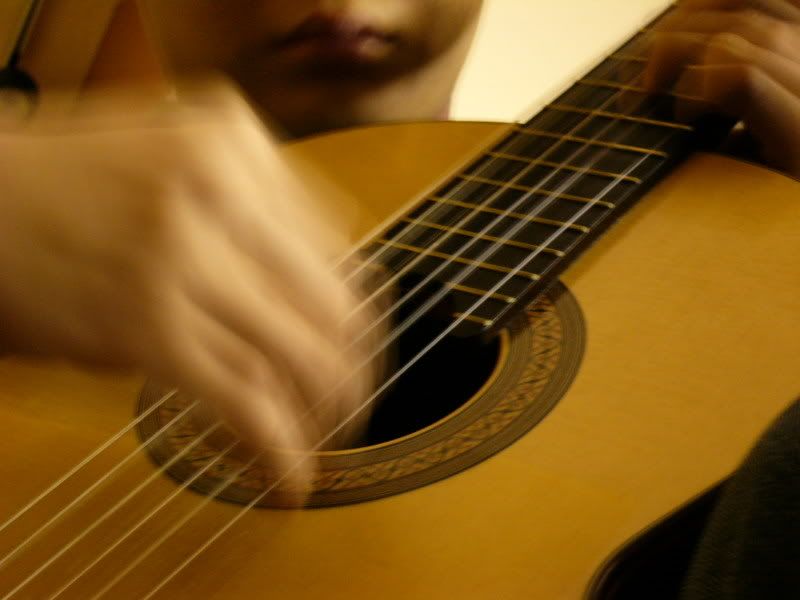
I was goofing off in my room yesterday afternoon, having just gotten up at 3pm after a good night's observing. Suddenly, the room began to rumble and shake. I looked out the window to see if there was some large truck driving by, and then I realised that I was at the top of a mountain with just narrow roads. There are no trucks up here.
This was an earthquake.
However, from the fact that I was still on my feet and things weren't falling off my table yet, it couldn't have been any more than 3 or 4 on the Richter scale, so I didn't bother leaving the room.
Still, it was my first direct experience with seismic activity. (My indirect experience came from the fact that a beach-side house I once lived in was hit by the 2005 tsunami).
Saturday, March 17, 2007

Thursday, March 15, 2007
Magnificent desolation.
Standing on the edge of a cliff high in the Atacama desert, with the sun beating down on me from the cloudless blue sky, I can almost feel my skin burning under the merciless rays. A cool wind howls past, offering some respite from the relentless heat. I had never realised there were so many different hues of brown and red, the palette colouring the mountains stretching out across the horizon. Mighty as they are, these mountains are no more than the southern foothills of the mighty peaks of the Andes far to the north.
Apart from a few telescope domes and small dormitories, the landscape of Las Campanas is an alien one, implacably hostie to human life with its heat and scarcity of water. Humanity's presence here is no more than a small community of people dedicated to servicing the observatory to support visiting astronomers, but even they work only in one-week shifts.
At night, I am reminded even more of the fragility of life, as the immensity of the cosmos is spread out at night. In the clear night sky, unspoiled by water vapour and the lights of civilisation, one can see the Milky Way stretching from horizon to horizon, and thousands of stars across the entire firmament. It tingles my spine to comprehend the vastness of the universe, and also a sense of gratitude that I have the opportunity to do astronomy.
Standing on the edge of a cliff high in the Atacama desert, with the sun beating down on me from the cloudless blue sky, I can almost feel my skin burning under the merciless rays. A cool wind howls past, offering some respite from the relentless heat. I had never realised there were so many different hues of brown and red, the palette colouring the mountains stretching out across the horizon. Mighty as they are, these mountains are no more than the southern foothills of the mighty peaks of the Andes far to the north.
Apart from a few telescope domes and small dormitories, the landscape of Las Campanas is an alien one, implacably hostie to human life with its heat and scarcity of water. Humanity's presence here is no more than a small community of people dedicated to servicing the observatory to support visiting astronomers, but even they work only in one-week shifts.
At night, I am reminded even more of the fragility of life, as the immensity of the cosmos is spread out at night. In the clear night sky, unspoiled by water vapour and the lights of civilisation, one can see the Milky Way stretching from horizon to horizon, and thousands of stars across the entire firmament. It tingles my spine to comprehend the vastness of the universe, and also a sense of gratitude that I have the opportunity to do astronomy.
Thursday, February 22, 2007
Sunday, February 18, 2007
Today, Princeton Men's Volleyball Club had our first home game, against Seton Hall University. Our team plays against other institutions around the area, mostly small colleges and university in the New Jersey area.
The last time I played competitive volleyball was over a year ago, and hardly touched a volleyball since then. I play as libero, rotating the position with Dave between sets. I managed to get some good passes in since none of the opposing players served me any floaters, the style of serve which I am utterly crap at receiving. Ironically, we scored quite a few points from dumping floaters on to their libero, who seemed as inept at dealing with them as I would have.
The game fluctuated back-and-forth, and a lot of our lost points were from silly mistakes, e.g. service errors. We had to go to 5 sets before we got the victory, and I felt that I had a lot more of my game to work on, especially keeping calm when dealing with floaters, and also my reading of the game.
Our next game is on Tuesday, which is pretty rushed.
The last time I played competitive volleyball was over a year ago, and hardly touched a volleyball since then. I play as libero, rotating the position with Dave between sets. I managed to get some good passes in since none of the opposing players served me any floaters, the style of serve which I am utterly crap at receiving. Ironically, we scored quite a few points from dumping floaters on to their libero, who seemed as inept at dealing with them as I would have.
The game fluctuated back-and-forth, and a lot of our lost points were from silly mistakes, e.g. service errors. We had to go to 5 sets before we got the victory, and I felt that I had a lot more of my game to work on, especially keeping calm when dealing with floaters, and also my reading of the game.
Our next game is on Tuesday, which is pretty rushed.
Thursday, February 15, 2007
I am doing a new semester project this semester on primordial black holes with Jerry Ostriker, one of the most senior figures in astrophysics. I was discussing some physics of the early universe with Jerry, and we tried to look up some stuff in a cosmology textbook written by Jim Peebles, another senior statesman in astrophysics who works across the road in the Physics Department here in Princeton.
We couldn't seem to find what we were looking for, and then suddenly Jerry picks up his phone and calls up Peebles. I was speechless as Jerry started quizzing Peebles on some subtleties of hydrodynamics in the early universe.
After several minutes of conversation on the phone, Jerry turns to me and dead-pans: 'Well, we didn't get very far'.
We couldn't seem to find what we were looking for, and then suddenly Jerry picks up his phone and calls up Peebles. I was speechless as Jerry started quizzing Peebles on some subtleties of hydrodynamics in the early universe.
After several minutes of conversation on the phone, Jerry turns to me and dead-pans: 'Well, we didn't get very far'.
Friday, February 09, 2007
I will be going to Chile in March! By a happy coincidence in timing, I will be going there for both an observing run (on a sample of magnetically active brown dwarfs) and a summer school (recall that it'll be summer in the southern hemisphere) on the theoretical aspects of the Atacama Cosmology Telescope project, which aims to measure the small-scale fluctuations on the cosmic microwave background.
The observing run will be at the Carnegie Institute's observatory in Las Campañas, about 200km north of the capital Santiago, in the Atacama desert (the driest desert in the world...I'd better bring a small bottle of Evian!). Incidentally, Chile must be one of the most one-dimensional countries in the world, in that one can describe most locations in the country in terms of north or south.
We have four nights at Las Campañas from the 13th to the 17th of March, and I am pretty excited at the chance to learn some observational skills. Now here's the interesting part: since our last night is the 17th, we will finish on the morning of the 18th. I then have to travel back to Santiago, where the summer school starts on the morning of the 19th. So I have less than a day to change from a night shift to a normal day shift, which should be interesting.
I won't have much time to do actual sightseeing apart from a couple of days after the summer school, but it should be a fun and very educational experience. I can't wait...
The observing run will be at the Carnegie Institute's observatory in Las Campañas, about 200km north of the capital Santiago, in the Atacama desert (the driest desert in the world...I'd better bring a small bottle of Evian!). Incidentally, Chile must be one of the most one-dimensional countries in the world, in that one can describe most locations in the country in terms of north or south.
We have four nights at Las Campañas from the 13th to the 17th of March, and I am pretty excited at the chance to learn some observational skills. Now here's the interesting part: since our last night is the 17th, we will finish on the morning of the 18th. I then have to travel back to Santiago, where the summer school starts on the morning of the 19th. So I have less than a day to change from a night shift to a normal day shift, which should be interesting.
I won't have much time to do actual sightseeing apart from a couple of days after the summer school, but it should be a fun and very educational experience. I can't wait...
Saturday, February 03, 2007
The new term starts in the coming Monday. It's been amazing how much I can get done when I can work at my own leisure without classes and seminars to attend. Nevertheless the reason I came over to this side of the Atlantic was to take extra classes and learn material I otherwise would not learn, so I'd better not complain.
Since getting back from my winter break, the past month has mostly been about doing the take-home final for my stellar structure class, and after that working to try to get something done in my semester project from the last term.
The take-home final had an interesting problem on the larger-than-expected radii on extra-solar planets close to their host stars. It was obviously highly simplified for us to work on, but the probable answer is that the atmosphere of the planet has a high metal content which increases the opacity. Hence, like a bubble with a thicker skin, it puffs up more than it would otherwise.
The flip side was that this problem intrigued me so much that I didn't pay as much attention to some of the other problems on the exam, which pulled my final grade down to a B. It's the first B I've received since I started university education, but at least better than I initially feared when I was trying to settle into grad school.
Since getting back from my winter break, the past month has mostly been about doing the take-home final for my stellar structure class, and after that working to try to get something done in my semester project from the last term.
The take-home final had an interesting problem on the larger-than-expected radii on extra-solar planets close to their host stars. It was obviously highly simplified for us to work on, but the probable answer is that the atmosphere of the planet has a high metal content which increases the opacity. Hence, like a bubble with a thicker skin, it puffs up more than it would otherwise.
The flip side was that this problem intrigued me so much that I didn't pay as much attention to some of the other problems on the exam, which pulled my final grade down to a B. It's the first B I've received since I started university education, but at least better than I initially feared when I was trying to settle into grad school.
Friday, January 26, 2007
Saturday, January 06, 2007
A news article I saw on the BBC today:
I salute you, sir, for bringing sustenance to impoverished university students worldwide.
Inventor of instant noodles dies
The inventor of instant noodles, Momofuku Ando, has died in Japan, aged 96, of a heart attack.
Mr Ando was born in Taiwan in 1910 and moved to Japan in 1933, founding Nissin Food Products Co after WWII to provide cheap, quick food for the masses. His most famous product, Cup Noodle, was released in 1971.
Its taste and ease of preparation - adding hot water to dried noodles in a waterproof polystyrene container - have made it popular around the world. Mr Ando said the inspiration for his product came when he saw people lining up to buy bowls of hot ramen noodle soup at a black market stall during the food shortages after World War II.
Noodles in space
He developed his first instant noodles, Chicken Ramen, in 1958. The product came out as Japan recovered from the ravages of WWII and began a long period of economic expansion. It was the masterstroke of providing a waterproof polystyrene container for the noodles that made his Cup Noodle an instant success in 1971.
Nissin has led the global instant noodle industry since then, selling 85.7 billion servings every year, according to Agence France Presse. His firm also developed a version of Cup Noodle for Japanese astronauts to eat on the space shuttle Discovery in 2005.
In 1999, Mr Ando opened a museum in Osaka devoted to instant noodles. He retired as Nissin's chairman in 2005. Japanese newspapers and businesspeople have been paying tribute to Mr Ando. "He was a self-made man who developed an epoch-making instant noodle product and spread it to all corners of the world," Akio Nomura, chairman of the Osaka Chamber of Commerce and Industry, told Kyodo news agency.
Mr Ando remained active until just days before his death, giving a New Year's speech to Nissin employees and having a lunch of Chicken Ramen with company executives.
I salute you, sir, for bringing sustenance to impoverished university students worldwide.
Sunday, December 24, 2006
Even though I've only left London for a few months after spending the past 4 years there, stopping by for 2 days on my way home for the Christmas break was a big shock from the sedate environs of Princeton.
Apart from the crowds in the West End, it was a change to hear the cacophony of different languages being spoken around me by the potpourri of nationalities. The graduate students in Princeton are a fairly diverse bunch, but the university as a whole is generally populated by rich young WASP undergrads, so it was invigorating to sit on the Tube with a Japanese couple to my left while to my right several Russians held an animated discussion.
I haven't noticed this before, but it seems that the white Englishman is increasingly becoming an endangered species in London. Staying with my friend Jia Hong in the East End, the area was crammed with dingy kebab joints and Pakistani grocery shops, and I'm certain that I did not see a single English person in the area while I was there. The only white people I saw were conversing in some East European language I didn't recognise.
Going back to UCL was a surreal experience. It seemed only like yesterday that I was trudging through the corridors, rushing from one lecture to the next, yet this time I was an outsider.
At a stairwell, I had the pleasant surprise of bumping into Prof. David Miller. My first encounter with him was through the UCL Chamber Music Club, as he was organising a chamber concert that I wanted to perform in back in my first year in UCL. That was my first public performance in London, and I also had the opportunity of hearing his fine baritone voice later in the concert. He later taught my 2nd year E&M class, and while teaching it he was the first lecturer to spot my potential, and the next couple of years he was the professor I went to for advice and encouragement.
In the middle of last year (2005), I agreed to accompany him on my guitar on some Dowland songs that he wanted to sing, but in September he got a stroke which damaged half of his brain functionality. I was very upset by this, more so when I saw how his ebullient and cheerful self had been changed by the stroke. However, I was in the chaos of my final year, and regrettably I didn't get in touch with him apart from a couple of emails and phone calls.
When I saw him this time round, he seemed to be in much better shape. He could smile and recall that I'm in Princeton, which was more than he could do before I left London. He isn't quite his old self yet, but definitely he's made a lot of progress. My only regret is that I never did manage to accompany him in the songs.
Apart from the crowds in the West End, it was a change to hear the cacophony of different languages being spoken around me by the potpourri of nationalities. The graduate students in Princeton are a fairly diverse bunch, but the university as a whole is generally populated by rich young WASP undergrads, so it was invigorating to sit on the Tube with a Japanese couple to my left while to my right several Russians held an animated discussion.
I haven't noticed this before, but it seems that the white Englishman is increasingly becoming an endangered species in London. Staying with my friend Jia Hong in the East End, the area was crammed with dingy kebab joints and Pakistani grocery shops, and I'm certain that I did not see a single English person in the area while I was there. The only white people I saw were conversing in some East European language I didn't recognise.
Going back to UCL was a surreal experience. It seemed only like yesterday that I was trudging through the corridors, rushing from one lecture to the next, yet this time I was an outsider.
At a stairwell, I had the pleasant surprise of bumping into Prof. David Miller. My first encounter with him was through the UCL Chamber Music Club, as he was organising a chamber concert that I wanted to perform in back in my first year in UCL. That was my first public performance in London, and I also had the opportunity of hearing his fine baritone voice later in the concert. He later taught my 2nd year E&M class, and while teaching it he was the first lecturer to spot my potential, and the next couple of years he was the professor I went to for advice and encouragement.
In the middle of last year (2005), I agreed to accompany him on my guitar on some Dowland songs that he wanted to sing, but in September he got a stroke which damaged half of his brain functionality. I was very upset by this, more so when I saw how his ebullient and cheerful self had been changed by the stroke. However, I was in the chaos of my final year, and regrettably I didn't get in touch with him apart from a couple of emails and phone calls.
When I saw him this time round, he seemed to be in much better shape. He could smile and recall that I'm in Princeton, which was more than he could do before I left London. He isn't quite his old self yet, but definitely he's made a lot of progress. My only regret is that I never did manage to accompany him in the songs.
Tuesday, December 12, 2006
I'm listening to a fantastic recording by Xuefei Yang, a great guitarist whom I first met and listened to some 4 years ago in Singapore. She's based in London, so while I was there I had a couple more opportunities to see her play, and she also by chance happened to be an old housemate of my pianist friend Bobby Chen.
She's got a reputation as one of the best classical guitarists in the world today, and listening to her now I am reminded of what it means to be a true musician.
She's got a reputation as one of the best classical guitarists in the world today, and listening to her now I am reminded of what it means to be a true musician.
Sunday, December 10, 2006
Many scientists and mathematicians are also musicians. Einstein himself was a violinist of no small talent. An anecdote has it that a music critic, unaware that Einstein's fame comes from being a physicist, wrote after hearing Einstein play: "While his playing is excellent, but he does not deserve world fame; there are many others who play just as well". When I was an undergraduate in UCL, I took part in the informal chamber music club run by faculty and students; I was constantly surprised how many of the performers were from the physics department, or were otherwise scientists. So much for the cold and prosaic nature of scientists.
Before I entered university, I had an argument with my parents because I wanted to go into music. In retrospect, it wasn't a good idea because my playing level then was nowhere as good as I imagined it (a little exposure can sometimes go a long way towards deflating one's ego), but my love for music didn't fade even though my parents squashed the idea of paying for me to study music. In the first two years of university, I was practising my guitar so much that I did little else apart from physics. My nights were spent in a caress with my guitar, as I pushed my uncooperative fingers to make music. My memory holds many different emotions from those days: frustration from being unable to create beauty, pain from making my fingers do things they weren't born to do, ecstasy from those few moments when everything came together and I was the alpha and omega of my personal world of music.
I was aware of the sacrifices I was making, and there were times when I questioned if it was worthwhile. Yet, despite the social exclusion and frustrations of making music, I kept going back to my guitar. Paradoxically, the more I played the more I discovered my limitations; at the same time, I was discovering my potential in physics and astronomy. I knew that my career ahead probably lies in science. My love of music did not diminish, but instead of playing myself I started to listen to more music, which was something I could do at the same time as my academic work. I never really stopped playing, but there were weeks at a time when I didn't touch my guitar, and my old repertoire started falling away faster than I could learn new music. This forced me to change my focus towards perfecting a few pieces, rather than try to memorise large amounts of music. This allowed me to continue growing as a musician, as I started to listen more to my own playing, and to control the music with my will instead of letting my limited technique dictate the direction of the music.
*To be continued*
Before I entered university, I had an argument with my parents because I wanted to go into music. In retrospect, it wasn't a good idea because my playing level then was nowhere as good as I imagined it (a little exposure can sometimes go a long way towards deflating one's ego), but my love for music didn't fade even though my parents squashed the idea of paying for me to study music. In the first two years of university, I was practising my guitar so much that I did little else apart from physics. My nights were spent in a caress with my guitar, as I pushed my uncooperative fingers to make music. My memory holds many different emotions from those days: frustration from being unable to create beauty, pain from making my fingers do things they weren't born to do, ecstasy from those few moments when everything came together and I was the alpha and omega of my personal world of music.
I was aware of the sacrifices I was making, and there were times when I questioned if it was worthwhile. Yet, despite the social exclusion and frustrations of making music, I kept going back to my guitar. Paradoxically, the more I played the more I discovered my limitations; at the same time, I was discovering my potential in physics and astronomy. I knew that my career ahead probably lies in science. My love of music did not diminish, but instead of playing myself I started to listen to more music, which was something I could do at the same time as my academic work. I never really stopped playing, but there were weeks at a time when I didn't touch my guitar, and my old repertoire started falling away faster than I could learn new music. This forced me to change my focus towards perfecting a few pieces, rather than try to memorise large amounts of music. This allowed me to continue growing as a musician, as I started to listen more to my own playing, and to control the music with my will instead of letting my limited technique dictate the direction of the music.
*To be continued*
Friday, December 08, 2006
Tuesday, December 05, 2006
Astronomy images are generally stunning, but at a talk recently I saw a picture that completely took my breath away. At first glance I thought it was an impression by a particularly good artist, but it turns out that nature is more than poetic enough to provide this image.
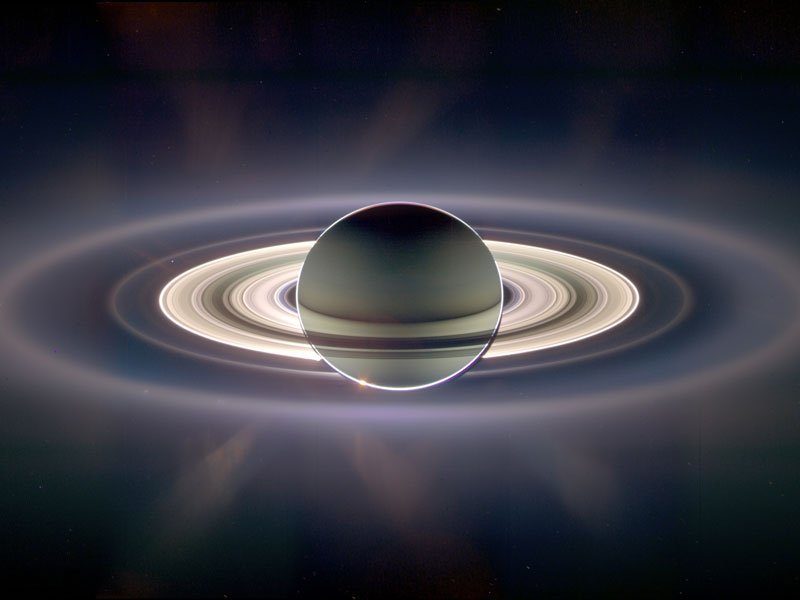 This is a mosaic of some images taken by the Cassini spacecraft which is currently in orbit around Saturn. Cassini happened to pass right behind Saturn, which completely eclipsed the Sun at a distance of 2.2 million km from the spacecraft.
The sunlight spilling past the Saturn's disk has illuminated its rings beautifully in a glow of pastel colours, revealing faint inner and outer rings which are normally invisible. Most poetically, within the left side of the rings, one can glimpse the pale blue dot that we call our home, almost insignificant in the splendour of the cosmos.
This is a mosaic of some images taken by the Cassini spacecraft which is currently in orbit around Saturn. Cassini happened to pass right behind Saturn, which completely eclipsed the Sun at a distance of 2.2 million km from the spacecraft.The sunlight spilling past the Saturn's disk has illuminated its rings beautifully in a glow of pastel colours, revealing faint inner and outer rings which are normally invisible. Most poetically, within the left side of the rings, one can glimpse the pale blue dot that we call our home, almost insignificant in the splendour of the cosmos.
Monday, December 04, 2006
I had a very interesting (not necessarily in a good way) experience with one of my homeworks, which was to construct a simple theoretical model for a red giant. First of all, it was due about 2 weeks ago, but Jeremy (the prof) is so smart that he won't have any trouble marking it at any time (most people try to mark homeworks all in one go to get into the mindset). In any case, the deadlines are only 'suggestions' because no one really cares very much about the grade so long as the students are learning.
The reason I'm 2 weeks overdue is that the problem set is difficult, and I'm not the only one to discover this. I've spent several whole days trying to figure out the problem and I had to disregard some of the conditions set out by the question in order to solve the problem.
Then today I found out the probable reason why I was having so much trouble. Jeremy himself apparently hasn't bothered working out the answer for the question himself yet.
The reason I'm 2 weeks overdue is that the problem set is difficult, and I'm not the only one to discover this. I've spent several whole days trying to figure out the problem and I had to disregard some of the conditions set out by the question in order to solve the problem.
Then today I found out the probable reason why I was having so much trouble. Jeremy himself apparently hasn't bothered working out the answer for the question himself yet.
Wednesday, November 29, 2006
I've realised that I dislike term breaks, like the 4 day-weekend we had over Thanksgiving last week. Before coming to Princeton I was expecting to become a workaholic and work non-stop to keep up, and in the first couple of months here that's precisely what I tried to do (albeit not very well).
However, I've just discovered an interesting fact: so long as I pass my courses in the first two years, and squeeze out at least one paper out of the 3 or 4 research projects in that time, I can't actually get kicked out, and hopefully I will be able to pass my General Exams in the end of the 2nd year.
Having realised this a couple of weeks ago, my first response was to...slack off. I spent the entire Thanksgiving sitting in my room watching the entire Black Adder series, and I now feel tremendously guilty about the wasted time.
I'm now taking part in the Princeton Men's Volleyball Club, and the level is just right for me so it's fun to play, and also I'm joining a meditation group. I'm also trying to remind myself that I used to play the guitar, and so I'm trying to squeeze some practice time into my week as well.
I'm probably not working as hard as I could be, but if that's the price for keeping sane, I'd gladly take it.
However, I've just discovered an interesting fact: so long as I pass my courses in the first two years, and squeeze out at least one paper out of the 3 or 4 research projects in that time, I can't actually get kicked out, and hopefully I will be able to pass my General Exams in the end of the 2nd year.
Having realised this a couple of weeks ago, my first response was to...slack off. I spent the entire Thanksgiving sitting in my room watching the entire Black Adder series, and I now feel tremendously guilty about the wasted time.
I'm now taking part in the Princeton Men's Volleyball Club, and the level is just right for me so it's fun to play, and also I'm joining a meditation group. I'm also trying to remind myself that I used to play the guitar, and so I'm trying to squeeze some practice time into my week as well.
I'm probably not working as hard as I could be, but if that's the price for keeping sane, I'd gladly take it.
Tuesday, November 14, 2006
I was told before coming to Princeton that life wouldn't be easy for me. Apart from the work load, there would also be the psychological pressure from being in an elite institution, I was told. Even having this in mind, it was hard to go from being the cream of crop at UCL to being mediocre at best in Princeton.
It seemed as if everyone knew more about everything, and in greater depth than I could. It doesn't help when I sometimes realise that I should actually know what people are talking about because I've studied it before, but just can't remember for the life of me. I'm friendly with the physics grad students here, but I often feel reluctant to socialise too much with them, partly because they often 'shop talk' about things happening specifically within their department, and partly because they spend a lot of time talking about physics. The former would exclude anyone who's not within the physics department, and the latter makes me feel excluded because my knowledge of theoretical physics is very shallow compared to them. In particular, a couple of the physicists irritate me because of their self-assurance (and dare I say arrogance?) when casually talking about stuff I know nothing about. I'm OK when people talk about far-out stuff in a cautious and speculative tone, but when they talk about it as if it's the law and that they know everything, it's very off-putting.
In due course, I had learned to take the attitude that I'm privileged to be in the company of such brilliant people, and that I have much to learn from them. The likes of Richard Feynmann were once in their shoes, and it's likely that more geniuses would emerged from the ranks of the Princeton physics grad students. If I had gone to somewhere less demanding, I would have still been among the better students, but I wouldn't know how far I am from the very best. There's the saying the greatest fool is he who does not know he's a fool, so I guess I am less of a fool here in Princeton.
It seemed as if everyone knew more about everything, and in greater depth than I could. It doesn't help when I sometimes realise that I should actually know what people are talking about because I've studied it before, but just can't remember for the life of me. I'm friendly with the physics grad students here, but I often feel reluctant to socialise too much with them, partly because they often 'shop talk' about things happening specifically within their department, and partly because they spend a lot of time talking about physics. The former would exclude anyone who's not within the physics department, and the latter makes me feel excluded because my knowledge of theoretical physics is very shallow compared to them. In particular, a couple of the physicists irritate me because of their self-assurance (and dare I say arrogance?) when casually talking about stuff I know nothing about. I'm OK when people talk about far-out stuff in a cautious and speculative tone, but when they talk about it as if it's the law and that they know everything, it's very off-putting.
In due course, I had learned to take the attitude that I'm privileged to be in the company of such brilliant people, and that I have much to learn from them. The likes of Richard Feynmann were once in their shoes, and it's likely that more geniuses would emerged from the ranks of the Princeton physics grad students. If I had gone to somewhere less demanding, I would have still been among the better students, but I wouldn't know how far I am from the very best. There's the saying the greatest fool is he who does not know he's a fool, so I guess I am less of a fool here in Princeton.
Thursday, November 09, 2006
Monday, November 06, 2006
Last week was probably the darkest time of my life. It was the fall break, which meant that most students had gone home. Although not that many of the grad students actually went home (mostly because 40% of the grad students are foreign), meals were not served in the week, so the focal point for social interaction was removed. So there weren't that many people visibly around the grad college.
I was already feeling extremely stressed due to the pressures at work, so I planned to commit myself to studying virtually full-time during the break, which wasn't something I felt like doing but I nevertheless felt I had to push myself to do. With the loneliness and my unhappiness thrown into the mix, something just snapped.
By Tuesday, I was feeling utterly weary of life, and would have welcomed eternal sleep. I just couldn't get up in the mornings, and when I did, I couldn't make myself leave me room, not even to buy food. I was spending hours upon hours sitting listlessly in front of my laptop, and now I can't even remember what I was doing in front of the computer. I was already undergoing counselling, but with my next session schedule for 2 weeks later, I felt there was nowhere to turn.
Eventually I did go to the health centre to request an urgent appointment, and spoke to a counselor. It felt much better to be able to let things out, and I immediately regretted some of the things I had done when I hit bottom. The next few days, I began to force myself to shut out my negative emotions and get something done, although it was still difficult to motivate myself to do anything.
Classes restarted today, and things felt so much better with everyone back. I wouldn't say that I'm happy at the moment, but I hope I never reach the depths of last week ever again.
I was already feeling extremely stressed due to the pressures at work, so I planned to commit myself to studying virtually full-time during the break, which wasn't something I felt like doing but I nevertheless felt I had to push myself to do. With the loneliness and my unhappiness thrown into the mix, something just snapped.
By Tuesday, I was feeling utterly weary of life, and would have welcomed eternal sleep. I just couldn't get up in the mornings, and when I did, I couldn't make myself leave me room, not even to buy food. I was spending hours upon hours sitting listlessly in front of my laptop, and now I can't even remember what I was doing in front of the computer. I was already undergoing counselling, but with my next session schedule for 2 weeks later, I felt there was nowhere to turn.
Eventually I did go to the health centre to request an urgent appointment, and spoke to a counselor. It felt much better to be able to let things out, and I immediately regretted some of the things I had done when I hit bottom. The next few days, I began to force myself to shut out my negative emotions and get something done, although it was still difficult to motivate myself to do anything.
Classes restarted today, and things felt so much better with everyone back. I wouldn't say that I'm happy at the moment, but I hope I never reach the depths of last week ever again.
Sunday, October 29, 2006
I've realised that I have really bad long-term memory, even when dealing with physics concepts. If I'm not constantly working with a given field, e.g. electromagnetism, I'd rapidly lose my intuition for it. I'm struggling these days because my brain isn't in 'physics mode', and lately I've realised that even back in UCL my mind wasn't always working. In fact, it would only work after the month or two of solid cramming that precedes my finals, which is why I always do well in finals.
It looks like I'll need to carry the cramming ethic (i.e. about 8 hours of studying per day) over to my daily routine here....
It looks like I'll need to carry the cramming ethic (i.e. about 8 hours of studying per day) over to my daily routine here....
Subscribe to:
Posts (Atom)