Sam and I were supposed to go watch an Australian Rules Football match in downtown Sydney today afternoon. He was the one who suggested it, so I let him do the planning. We were supposed to meet at the lounge at noon before setting off, and when I got there he was already waiting.
He seemed slightly discomfitted when he saw me. He said, "Uhh...I have slightly bad news...I just found out that the match today is an away game." Apparently, he had not picked up on the fact that the location of the match at Melbourne Cricket Ground probably meant it was not in Sydney.
We went into town anyway and spent the entire day walking a huge circle around the city centre, walking to Macquarie Point where we had spectacular views of the Harbour Bridge and Opera House, moving on to Hyde Park passing through the dodgy Kings Cross area (best shop sign ever: "THE LOVE MACHINE"), before walking back through Oxford St. before ending up at the Town Hall where we started. My legs were just worn out by the evening.
A couple of days ago, as I was wiping my spectacles in my morning, the damn thing broke off right at the bridge connecting the two lens, leaving me holding the one half on each hand. I did not bring any spare glasses nor contact lenses, so the prospect of spending a couple of days being effectively blind was not very palatable.
However, I fell on my figurative feet, as the AAO has an engineering department, so I brought my spectacles to them, and one particular technician, Stan, kindly spent an hour welding my specs together with a blowtorch(!). My glasses now look as if it's been through a flame thrower (which it effectively has), but at least it's essentially back in business.
While he was fixing my frame, he mentioned that he once worked as a jeweller (!!). His surname is Miziarski and he speaks with a strong East-European accent, implying he's very likely Jewish. It's such a stereotype, the Jewish jeweller...
Saturday, August 27, 2005

Wednesday, August 24, 2005
When I was up in Siding Spring, holed up in the telescope control room, I spent a lot of time around Kinwah, my supervisor. He was my secondary supervisor for my research project last year, so I had to meet him regularly (I had commented some time ago on his propensity to just sit there lecturing me for hours while I sat there nodding), but having to hang around with him for 15 hours a day was a totally different proposition.
He is a remarkably perceptive person (he has an unfinished PhD in educational psychology), and extremely blunt if he has something to say to me. On the coach journey to Coona, he suddenly commented, 'You seem as if you have something to prove most of the time...'.
Which is true.
I've spent most of the past few years being haunted by the spectre of failure, and pushing myself into an insane workrate. It's a complex motivation with many facets, driven in part by the memories of being a perennial underachiever in school, a thirst for glory and fame, and other psychological baggage. I've pushed myself this far, so it's just a means to a good end, isn't it? However...
'If you carry on like this for too long you'll get a nervous breakdown sooner or later', Kinwah said, 'and if you care so much about what people think about you, as you progress in your career you'll meet much smarter people...'. He says that if I put all my motivation into making people think I'm smart etc., I will crash the moment I meet true geniuses in my career.
The only way out is for me to put all my motivation into a love for science. So far, I've tried taking his advice, but it's not easy to make the transition. I'm the laziest git I know by far, and the laziness has been winning in the past few days. It's not that I don't love science, but sometimes when dealing with boring and tedious work, it difficult to call up the wonder and joy of discovery.
Thought of the day: I've been dealing a lot with the solar spectrum (more on that some other day), which involved working with some old data catalogues dating back to the 1940s and '50s. These are thick and heavy tomes encasing reams of arcane data, which are literally pages and pages of numbers. Back before the days before computers, it must have been an incredibly tedious and slow process to create the catalogues by hand. Yet there were people who devoted their entire careers to such unglamorous work.
What could have driven them?
He is a remarkably perceptive person (he has an unfinished PhD in educational psychology), and extremely blunt if he has something to say to me. On the coach journey to Coona, he suddenly commented, 'You seem as if you have something to prove most of the time...'.
Which is true.
I've spent most of the past few years being haunted by the spectre of failure, and pushing myself into an insane workrate. It's a complex motivation with many facets, driven in part by the memories of being a perennial underachiever in school, a thirst for glory and fame, and other psychological baggage. I've pushed myself this far, so it's just a means to a good end, isn't it? However...
'If you carry on like this for too long you'll get a nervous breakdown sooner or later', Kinwah said, 'and if you care so much about what people think about you, as you progress in your career you'll meet much smarter people...'. He says that if I put all my motivation into making people think I'm smart etc., I will crash the moment I meet true geniuses in my career.
The only way out is for me to put all my motivation into a love for science. So far, I've tried taking his advice, but it's not easy to make the transition. I'm the laziest git I know by far, and the laziness has been winning in the past few days. It's not that I don't love science, but sometimes when dealing with boring and tedious work, it difficult to call up the wonder and joy of discovery.
Thought of the day: I've been dealing a lot with the solar spectrum (more on that some other day), which involved working with some old data catalogues dating back to the 1940s and '50s. These are thick and heavy tomes encasing reams of arcane data, which are literally pages and pages of numbers. Back before the days before computers, it must have been an incredibly tedious and slow process to create the catalogues by hand. Yet there were people who devoted their entire careers to such unglamorous work.
What could have driven them?
I've just updated my other blog with the article which won me the first prize in the Royal Astronomical Society (RAS)'s Science Writing competition.
Tuesday, August 23, 2005
I have realised that my blog must have seemed rather schizophrenic lately, with my opinions and anecdotes on various issues mixed in with some personal rants. So, I'm creating a separate blog, where I put my thoughts on science and other 'professional' stuff. It's here.
Some of you also know I like to write science articles for the general public, and I hope to regularly post such pieces on the blog. Everytime I update that site, I will mention it in this blog, so regular readers have no need to bookmark both blogs.
Some of you also know I like to write science articles for the general public, and I hope to regularly post such pieces on the blog. Everytime I update that site, I will mention it in this blog, so regular readers have no need to bookmark both blogs.
Saturday, August 20, 2005
It might have come to your notice that I had dropped out of notice for around a week last month. This was because I was out in the outback doing some observations on a telescope.
The AAO has 2 telescopes in Siding Spring out in the country, but as I'm doing a theoretical project, I wasn't really expecting to get to do any actual observations.
However, it turns out that my supervisor from UCL in London is coming down to Australia for an observing run on the Australian National University 2.3m telescope which is also based in Siding Spring, so I took off for 5 days from work to support this observation.
Siding Spring is right on the edge of the Warrumbungle National Park (I love Aussie names!) in NSW, and the nearest town is Coonabarabran, about 600km from Sydney. It was a 8 hour train/bus ride, first through the Blue Mountains, and then through cattle country. The only towns we passed by weren't so much sleepy as comatose.
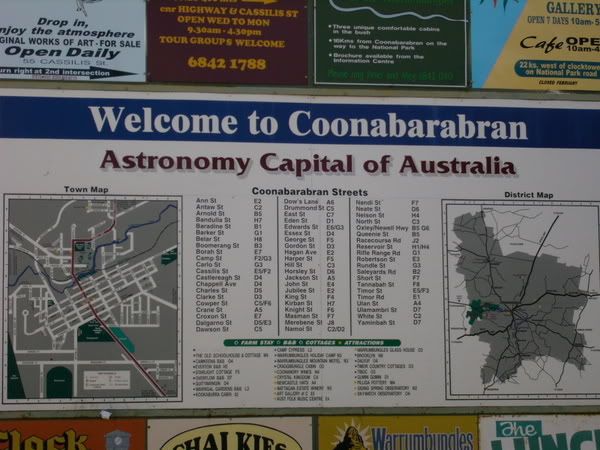
Finally, we got to Coona:
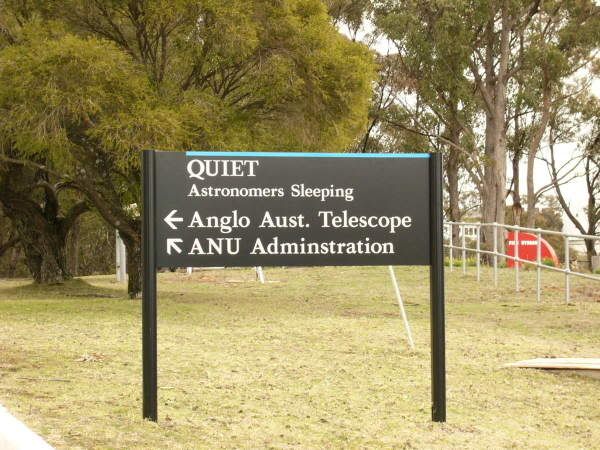
From Coona, we get a taxi up to Siding Spring, which is a mountain about 1000m high. We see a sign warning us not to disturb the local wildlife...
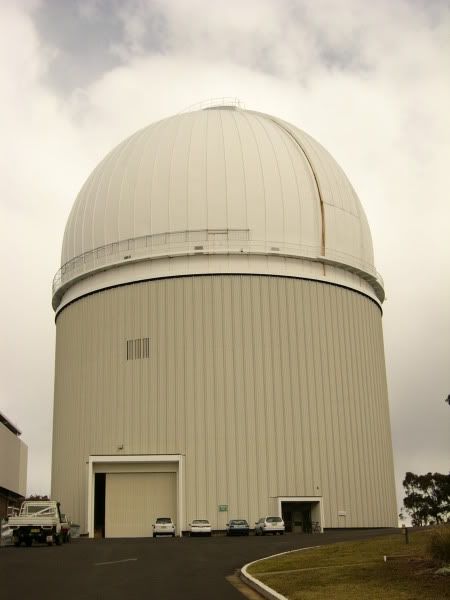
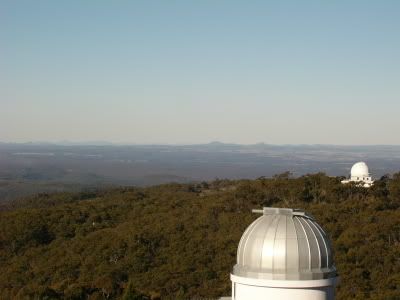
The first thing we see when we approach Siding Spring is the dome of the 3.9m diameter Anglo-Australian Telescope (AAT) looping over us...
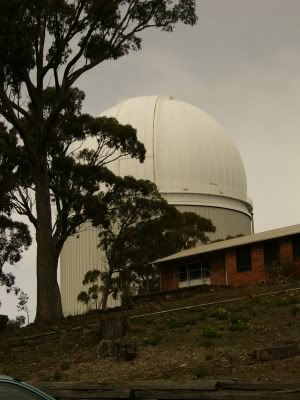
A closer view of the AAT dome...
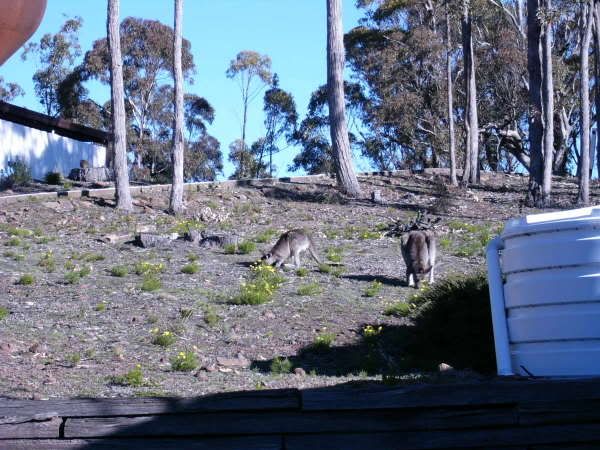
Close-by, a couple of scientifically-minded wallabies have also come on observing runs:
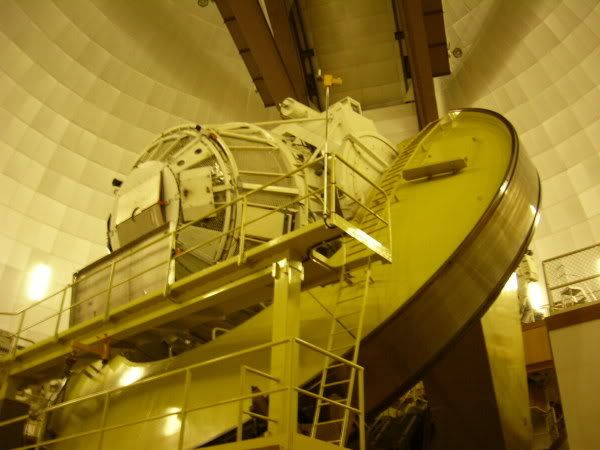
I'm officially an employee of the AAO, so I get a desk inside the dome. However, the actual telescope is off-limits to everyone apart from technical staff and observers, so I couldn't go close-up to the telescope. I got this shot from the tourist gallery. The telescope is on an equatorial mount, which means that the mounting is actually inclined at the same angle as the latitude of its position, which facilitates star-tracking, as you only need to track along one axis of the telescope:
Just for reference, here is a picture of the AAT nicked off the net...

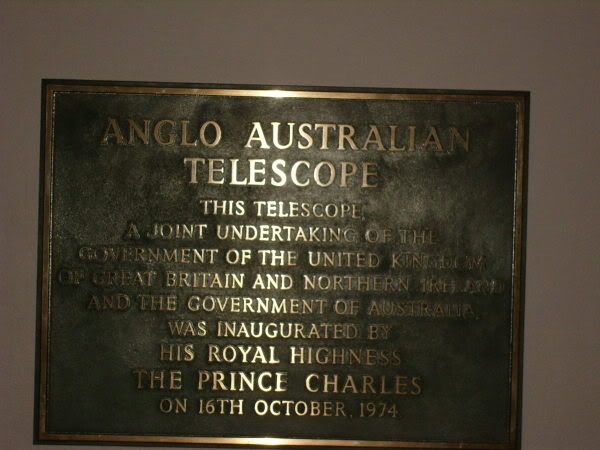
And a royal touch...
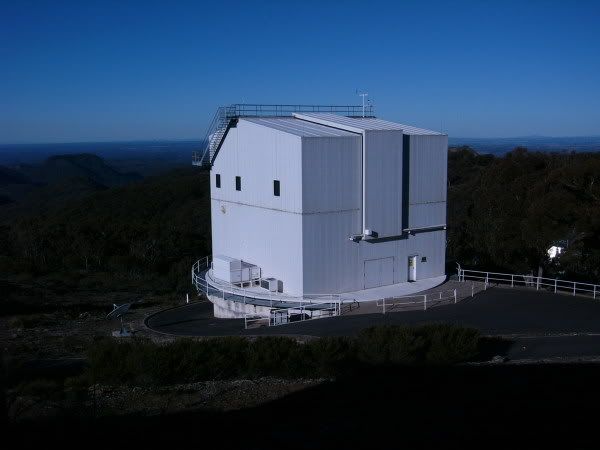
The telescope we'll be using is the ANU 2.3m reflector, which is in an 'alt-az' mounting, which is similar to a naval gun mounting. It's more difficult to track stars because u have to simultaneously adjust both axes at once. The entire building rotates with the telescope, and it's really cool as everything rattles and shakes as the telescope slews to acquire a new target...the big disadvantage is that they can't attack any plumbing to the dome, so the toilet is right at the base on the far side of this picture. The control room is about at the 2nd storey of the dome. To get from the control room to the main entrances means passing through the telescope...during observations, the light-spillage and thermal air drafts caused by this is unacceptable, so to take a piss, I have to walk out though the external door and walk down the metal stairs, all in pitch dark and freezing night wind...
There are about 8 telescopes at Siding Spring...from L-R: ANU 15-inch, ANU 2.3m, ANU 40-inch, AAO 1.2 Schmidt, 2m Faulkes, and the 3.9m AAT. A couple of other smaller telescopes are not visible here.
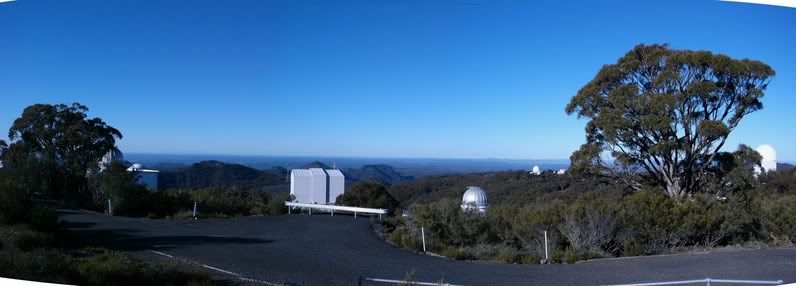
Siding Spring was chosen because there's hardly anyone within the horizon, and because it's high (by Aussie standards anyway). The mountains in the background of this view are about 100 miles away. At night, it's basically pitch-black all the way out to the horizon.
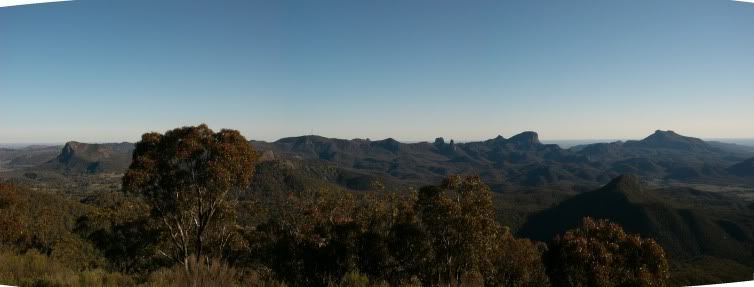
The surrounding areas are mostly national parks, and Siding Spring is the highest point nearby, so there were some spectacular views...
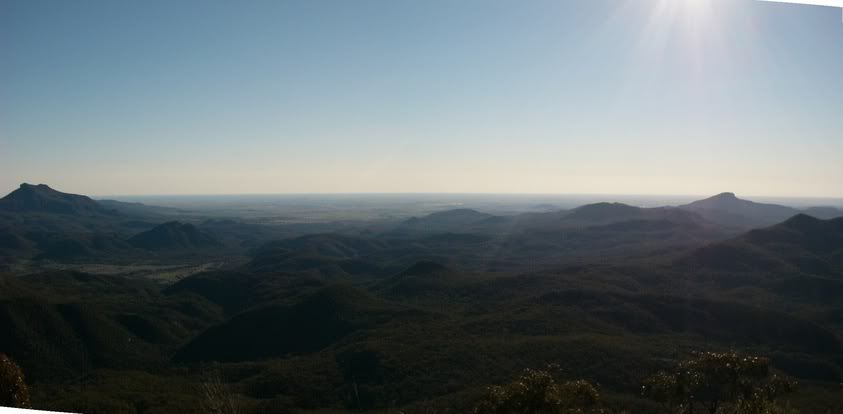
That's all for now...will be back on another day with more pics of the actual observations...
The AAO has 2 telescopes in Siding Spring out in the country, but as I'm doing a theoretical project, I wasn't really expecting to get to do any actual observations.
However, it turns out that my supervisor from UCL in London is coming down to Australia for an observing run on the Australian National University 2.3m telescope which is also based in Siding Spring, so I took off for 5 days from work to support this observation.
Siding Spring is right on the edge of the Warrumbungle National Park (I love Aussie names!) in NSW, and the nearest town is Coonabarabran, about 600km from Sydney. It was a 8 hour train/bus ride, first through the Blue Mountains, and then through cattle country. The only towns we passed by weren't so much sleepy as comatose.
Finally, we got to Coona:
From Coona, we get a taxi up to Siding Spring, which is a mountain about 1000m high. We see a sign warning us not to disturb the local wildlife...
The first thing we see when we approach Siding Spring is the dome of the 3.9m diameter Anglo-Australian Telescope (AAT) looping over us...
A closer view of the AAT dome...
Close-by, a couple of scientifically-minded wallabies have also come on observing runs:
I'm officially an employee of the AAO, so I get a desk inside the dome. However, the actual telescope is off-limits to everyone apart from technical staff and observers, so I couldn't go close-up to the telescope. I got this shot from the tourist gallery. The telescope is on an equatorial mount, which means that the mounting is actually inclined at the same angle as the latitude of its position, which facilitates star-tracking, as you only need to track along one axis of the telescope:
Just for reference, here is a picture of the AAT nicked off the net...
And a royal touch...
The telescope we'll be using is the ANU 2.3m reflector, which is in an 'alt-az' mounting, which is similar to a naval gun mounting. It's more difficult to track stars because u have to simultaneously adjust both axes at once. The entire building rotates with the telescope, and it's really cool as everything rattles and shakes as the telescope slews to acquire a new target...the big disadvantage is that they can't attack any plumbing to the dome, so the toilet is right at the base on the far side of this picture. The control room is about at the 2nd storey of the dome. To get from the control room to the main entrances means passing through the telescope...during observations, the light-spillage and thermal air drafts caused by this is unacceptable, so to take a piss, I have to walk out though the external door and walk down the metal stairs, all in pitch dark and freezing night wind...
There are about 8 telescopes at Siding Spring...from L-R: ANU 15-inch, ANU 2.3m, ANU 40-inch, AAO 1.2 Schmidt, 2m Faulkes, and the 3.9m AAT. A couple of other smaller telescopes are not visible here.
Siding Spring was chosen because there's hardly anyone within the horizon, and because it's high (by Aussie standards anyway). The mountains in the background of this view are about 100 miles away. At night, it's basically pitch-black all the way out to the horizon.
The surrounding areas are mostly national parks, and Siding Spring is the highest point nearby, so there were some spectacular views...
That's all for now...will be back on another day with more pics of the actual observations...
Wednesday, August 17, 2005
We had a coffee meeting this morning... I came in a bit late and the Director of the AAO was talking about some projects in progress in the Gemini Observatory. It went something like this, 'Well, the proposals for Gemini is that there is a competition between HERNIA and PERVS, so they'll need to split their efforts...'
What? HERNIA? PERVS? One thing which I noticed about astronomers is this: they like to contrive really silly acronyms for things. I found this website called DOOFAS (Dumb Or Overly Forced Astronomical Acronyms).
Here are some of my favourites:
2D-FRUTTI: 2-D Photon Counting System (I swear, I didn't make this up)
ANIS: All Neutrino Interaction Simulation (LOL!)
BAD: Balmer-Absorption-Dominated (Nuclei)
BICEP: Background Imaging of Cosmic Extragalactic Polarization (feel the burn)
CANGAROO: Collaboration between Australian and Nippon for a Gamma Ray Observatory in the Outback (krazy!)
COLA: Compact Objects in Low power Agns
GOD: Gravity One Dimension (The paper was entitled `The likelihood of GODs' existence'...)
HIS/HERS: High Intensity Spectrograph / High Energy Range Spectrometer
HO-BAGS: Hubble Observatory BAckground Galaxy Survey
HOEs: Holographic Optical Elements
MACHO: MAssive Compact Halo Objects
MIRACLE: Mid-InfraRed Array Camera of Least Effort
OWL: Overwhelmingly Large Telescope (so big, it's ridiculous)
PIG: Partially Ionized Globule
PINOCCHIO: PINpointing Orbit-Crossing Collapsed HIerarchial Objects (Egad!)
POOPSY: Phase One Observing Proposal SYstem
SAURON: Spectroscopic Areal Unit for Research on Optical Nebulae (mmmm, nerdy)
SMIRFS: Sub Millimeter InfraRed Fiber-feed System (or something)
SPIFFI: SPectrometer for Infrared Faint Field Imaging
T-RECS: Thermal REgion Camera System
YORIC: Yet another Optimal Resolution Image Constructor (Alas...)
These are NOT made up....I recognise several acronyms I know of which are real. So, it would appear that astronomers have way too much time on their hands...must be while waiting for bad weather to clear during observations...
What? HERNIA? PERVS? One thing which I noticed about astronomers is this: they like to contrive really silly acronyms for things. I found this website called DOOFAS (Dumb Or Overly Forced Astronomical Acronyms).
Here are some of my favourites:
2D-FRUTTI: 2-D Photon Counting System (I swear, I didn't make this up)
ANIS: All Neutrino Interaction Simulation (LOL!)
BAD: Balmer-Absorption-Dominated (Nuclei)
BICEP: Background Imaging of Cosmic Extragalactic Polarization (feel the burn)
CANGAROO: Collaboration between Australian and Nippon for a Gamma Ray Observatory in the Outback (krazy!)
COLA: Compact Objects in Low power Agns
GOD: Gravity One Dimension (The paper was entitled `The likelihood of GODs' existence'...)
HIS/HERS: High Intensity Spectrograph / High Energy Range Spectrometer
HO-BAGS: Hubble Observatory BAckground Galaxy Survey
HOEs: Holographic Optical Elements
MACHO: MAssive Compact Halo Objects
MIRACLE: Mid-InfraRed Array Camera of Least Effort
OWL: Overwhelmingly Large Telescope (so big, it's ridiculous)
PIG: Partially Ionized Globule
PINOCCHIO: PINpointing Orbit-Crossing Collapsed HIerarchial Objects (Egad!)
POOPSY: Phase One Observing Proposal SYstem
SAURON: Spectroscopic Areal Unit for Research on Optical Nebulae (mmmm, nerdy)
SMIRFS: Sub Millimeter InfraRed Fiber-feed System (or something)
SPIFFI: SPectrometer for Infrared Faint Field Imaging
T-RECS: Thermal REgion Camera System
YORIC: Yet another Optimal Resolution Image Constructor (Alas...)
These are NOT made up....I recognise several acronyms I know of which are real. So, it would appear that astronomers have way too much time on their hands...must be while waiting for bad weather to clear during observations...
Friday, August 05, 2005
Today, the 6th of August, marks 60 years since the first combat use of an atomic bomb over Hiroshima. 3 days later, on the 9th, another nuclear weapon was dropped on Nagasaki (little known fact: the original target was the city of Kokura, but it was covered with clouds, preventing from the aircraft from aiming the bomb. So the bomber proceeded to Nagasaki instead). These strikes precipitated the Japanese surrender less than a week later.
As a physicist, I regard the beginning of the nuclear age as a loss of innocence for physics... the entire Manhattan project which created the atom bomb involved countless physicists, many of them already well-established (like Fermi, Oppenheimer, Bethe etc) and others who would eventually go on to become Nobel-prize winners in their respective fields, like Feynmann and Segre. So in a sense, my intellectual predecessors were responsible for opening this Pandora's box, and I am personally fascinated by the history of this effort, which had its beginnings with the discovery of radioactivity in the late 19th century, at the end of the steam age.
It was also this moment when physicists went from being detached boffins to becoming a strategic resource...the nation with the most physicists would hold the key to power (this is of course not as simplistic, but certainly it must have seemed so in the immediate aftermath of Hiroshima and Nagasaki. Billions of dollars were poured into physics research, a lot of it directly into nuclear weapons development, but much of it had very tenuous links, like particle physics and space research. For scientists in the US and Soviet Union, making vague, indirect links to weapons programmes used to be a useful way to get research funding (a project with the word 'nuclear' or 'atomic' in it doesn't necessarily have much to do with nuclear weapons or energy at all).
I have been to Hiroshima some years back, and it was quite a harrowing experience; the Peace Park is such a serene and beautiful place, until you realise that before the bombing it was a densely populated slum. I dearly wish Nagasaki is the last time anyone ever uses the bomb, but... I think the decision to drop the bombs was the right thing to do.
Japan was being blockaded by mid-1945, most of its navy on the bottom and its army beaten back from across the Pacific, but there was still an absolute refusal to surrender unconditionally (the military elite were only hoping for a conditional 'surrender' which would mean, among other things, that no occupation troops were to touch mainland Japan and most of the existing power structures would remain intact).
It was intended that in the event of an Allied invasion of mainland Japan, every man, woman and child would fight to the death. This was no idle threat: in the battle of Iwo Jima, the Japanese residents (including elderly and children) there had flung themselves off a cliff rather than be captured by American troops. So if the invasion had occured, in addition to massive combat casualties on both the Allied and Japanese sides, huge numbers of Japanese civillians were likely to have perished as well. A million Japanese combat troops were still stationed in China/Manchuria, and they would have provided a huge fight for the Allies, as well as continuing the brutal oppression of the occupied Chinese.
So, I believe that in the cold arithmetic of war, the use of atomic weapons was a tragic, but necessary decision.
As a physicist, I regard the beginning of the nuclear age as a loss of innocence for physics... the entire Manhattan project which created the atom bomb involved countless physicists, many of them already well-established (like Fermi, Oppenheimer, Bethe etc) and others who would eventually go on to become Nobel-prize winners in their respective fields, like Feynmann and Segre. So in a sense, my intellectual predecessors were responsible for opening this Pandora's box, and I am personally fascinated by the history of this effort, which had its beginnings with the discovery of radioactivity in the late 19th century, at the end of the steam age.
It was also this moment when physicists went from being detached boffins to becoming a strategic resource...the nation with the most physicists would hold the key to power (this is of course not as simplistic, but certainly it must have seemed so in the immediate aftermath of Hiroshima and Nagasaki. Billions of dollars were poured into physics research, a lot of it directly into nuclear weapons development, but much of it had very tenuous links, like particle physics and space research. For scientists in the US and Soviet Union, making vague, indirect links to weapons programmes used to be a useful way to get research funding (a project with the word 'nuclear' or 'atomic' in it doesn't necessarily have much to do with nuclear weapons or energy at all).
I have been to Hiroshima some years back, and it was quite a harrowing experience; the Peace Park is such a serene and beautiful place, until you realise that before the bombing it was a densely populated slum. I dearly wish Nagasaki is the last time anyone ever uses the bomb, but... I think the decision to drop the bombs was the right thing to do.
Japan was being blockaded by mid-1945, most of its navy on the bottom and its army beaten back from across the Pacific, but there was still an absolute refusal to surrender unconditionally (the military elite were only hoping for a conditional 'surrender' which would mean, among other things, that no occupation troops were to touch mainland Japan and most of the existing power structures would remain intact).
It was intended that in the event of an Allied invasion of mainland Japan, every man, woman and child would fight to the death. This was no idle threat: in the battle of Iwo Jima, the Japanese residents (including elderly and children) there had flung themselves off a cliff rather than be captured by American troops. So if the invasion had occured, in addition to massive combat casualties on both the Allied and Japanese sides, huge numbers of Japanese civillians were likely to have perished as well. A million Japanese combat troops were still stationed in China/Manchuria, and they would have provided a huge fight for the Allies, as well as continuing the brutal oppression of the occupied Chinese.
So, I believe that in the cold arithmetic of war, the use of atomic weapons was a tragic, but necessary decision.
Wednesday, August 03, 2005
On Tuesday evening, I was working overtime at the office when suddenly I received a phone call from home. My mum had just called me on the weekend, so it was unusual for her to call again so soon. She asked me what I was doing, if I had dinner etc., which was what she always starts off with whenever she calls me. A few minutes into the conversation, she suddenly said, 'Your eldest aunt's husband just passed away yesterday.' (We were talking in Mandarin, and it's a bit less awkward sounding it seems in English). This came as a total shock to me; I knew he had been ill for the past few years and he had to have major liver surgery last year, but there was no indication that he was critically ill. He wasn't the first family member to have passed away in my recent memory, but yet I felt a sadness that I haven't felt previously, and tears started welling up.
When I was a baby, my parents left me under the care of my father's eldest sister as my mother wanted to keep working; I only went back home with my parents in the weekends. Thus, I spent the first two years of my life in that house with my aunt's family, until my sister was born and my mother decided to quit work. There is hardly anything I remember from that period of infancy, but my parents tell me that my aunt's husband was very fond of me when I was staying in his house, and I used to cry whenever my parents came at the weekend to bring me home.
Years later, when I was about 4-6 years old, when my family went to visit this aunt, or when we were all at my grandmother's house, I would insist on staying overnight at my aunt's house... I still have memories from this part of my life, squeezing into bed with my cousins (they were 6-7 years older than me, and as I was my parents' eldest child, I regarded them as older brothers), and digging for toys in the musty dust-filled storeroom. I remember clambering up the shelves in the living room,looking for things I could play with.
After I was past 8 years old or so, my bond to my aunt's family waned... memories from my infancy and early childhood faded as I grew up, and I've hardly spoken to my cousins or their father since then. Still, I continued feeling a strong, unspoken, affinity to my aunt and her family. Whenever my family went to visit their house, I would somehow feel very much at home as every corner carried echoes of my early years. The cabinets which I had climbed up as a child now seemed so very small, yet so comfortingly familiar.
In the past decade, I must have not spoken directly to my aunt's husband except for greeting him (in part because I'm not very fluent in my supposedly native Hokkien language, and because the generation gap is so huge), yet went my mother told me he had passed away, I started crying (I have tears in my eyes as I write this). Maybe it's because he was present in some of the happiest memories of my life, and with his passing I seemed to have lost another link to my childhood.
I have not said anything about what sort of person he was, but on a level it doesn't matter. All my personal reminiscences of him have now regressed beneath the level of my conscious memory, and the emotion I felt at his passing is coming from a little boy who still lurks somewhere within my subconscious. Yet, I have one very vivid memory of him: I must have been 6 or 7, and my family was visiting his house. At that age, he seemed so towering, and he picked him up and swung me around as I squealed and laughed. In that brief moment, I was flying.
I have no other memories of anyone ever doing that to me.
When I was a baby, my parents left me under the care of my father's eldest sister as my mother wanted to keep working; I only went back home with my parents in the weekends. Thus, I spent the first two years of my life in that house with my aunt's family, until my sister was born and my mother decided to quit work. There is hardly anything I remember from that period of infancy, but my parents tell me that my aunt's husband was very fond of me when I was staying in his house, and I used to cry whenever my parents came at the weekend to bring me home.
Years later, when I was about 4-6 years old, when my family went to visit this aunt, or when we were all at my grandmother's house, I would insist on staying overnight at my aunt's house... I still have memories from this part of my life, squeezing into bed with my cousins (they were 6-7 years older than me, and as I was my parents' eldest child, I regarded them as older brothers), and digging for toys in the musty dust-filled storeroom. I remember clambering up the shelves in the living room,looking for things I could play with.
After I was past 8 years old or so, my bond to my aunt's family waned... memories from my infancy and early childhood faded as I grew up, and I've hardly spoken to my cousins or their father since then. Still, I continued feeling a strong, unspoken, affinity to my aunt and her family. Whenever my family went to visit their house, I would somehow feel very much at home as every corner carried echoes of my early years. The cabinets which I had climbed up as a child now seemed so very small, yet so comfortingly familiar.
In the past decade, I must have not spoken directly to my aunt's husband except for greeting him (in part because I'm not very fluent in my supposedly native Hokkien language, and because the generation gap is so huge), yet went my mother told me he had passed away, I started crying (I have tears in my eyes as I write this). Maybe it's because he was present in some of the happiest memories of my life, and with his passing I seemed to have lost another link to my childhood.
I have not said anything about what sort of person he was, but on a level it doesn't matter. All my personal reminiscences of him have now regressed beneath the level of my conscious memory, and the emotion I felt at his passing is coming from a little boy who still lurks somewhere within my subconscious. Yet, I have one very vivid memory of him: I must have been 6 or 7, and my family was visiting his house. At that age, he seemed so towering, and he picked him up and swung me around as I squealed and laughed. In that brief moment, I was flying.
I have no other memories of anyone ever doing that to me.
Sunday, July 31, 2005
So far, work has been good. I met Joss, my supervisor on Tuesday. He had just returned from a couple of months in Europe on Sunday, and he was too jet lagged to come into work on Monday. Joss is actually an Englishman, and he had presumably brought his family back to UK/Europe for vacation.
Joss is a very nice person, and in fact one of the most charismatic people I've met. He is effervescencely enthusiastic about the project we'll be doing (more on this later...). He might have noticed that I seemed rather glum most of the time.... but whenever I'm with someone who is very animated, I tend to be quite 'down', as if their friendliness is pushing me down. Or is it a natural suspicion towards people who are friendly towards me for no reason? He was also praising me a lot even on my first day at work, which made me feel a bit more unconfortable.... I tend to get uncomfortable when I get praised which I do not feel is warranted. I once had a friend who said that she liked praising people because it made her feel good...maybe he's like that as well. Personally, I feel that praise is devalued if it's given out too liberally.
Still, work is nice. The AAO shares is in the same compound as the Australian Telescope National Facility (which deals with radio telescopes...while the AAO operates optical/IR telescopes, and most of the buildings here actually belong to the ATNF. The ATNF also runs a lodge where visitors can stay, and this is where I'm staying. The other two summer students in this programme, Sam from Yorkshire and Pablo from Valencia (Spain), are also staying in my place. The rooms are en-suite, and the lodge is very well equipped, with a nice kitchen, free laundry facilities and TV lounge, and I'm basically paying hostel prices for this, so I have plenty of money to spend on other things.
I just went to downtown Sydney last weekend, and my pics of the harsh Sydney winter are here...
Joss is a very nice person, and in fact one of the most charismatic people I've met. He is effervescencely enthusiastic about the project we'll be doing (more on this later...). He might have noticed that I seemed rather glum most of the time.... but whenever I'm with someone who is very animated, I tend to be quite 'down', as if their friendliness is pushing me down. Or is it a natural suspicion towards people who are friendly towards me for no reason? He was also praising me a lot even on my first day at work, which made me feel a bit more unconfortable.... I tend to get uncomfortable when I get praised which I do not feel is warranted. I once had a friend who said that she liked praising people because it made her feel good...maybe he's like that as well. Personally, I feel that praise is devalued if it's given out too liberally.
Still, work is nice. The AAO shares is in the same compound as the Australian Telescope National Facility (which deals with radio telescopes...while the AAO operates optical/IR telescopes, and most of the buildings here actually belong to the ATNF. The ATNF also runs a lodge where visitors can stay, and this is where I'm staying. The other two summer students in this programme, Sam from Yorkshire and Pablo from Valencia (Spain), are also staying in my place. The rooms are en-suite, and the lodge is very well equipped, with a nice kitchen, free laundry facilities and TV lounge, and I'm basically paying hostel prices for this, so I have plenty of money to spend on other things.
I just went to downtown Sydney last weekend, and my pics of the harsh Sydney winter are here...
Monday, July 25, 2005
Apologies for not posting anything for over a month. This was due to a combination of heavy workload and a lack of Internet access outside my workplace.
In any case, a quick update on what I've been up to... I was at MSSL for 5 weeks in most of June and early July, creating a new model describing relativistically shifted AGN reflection spectra. The model creation was reasonably straightforward, but the testing and verification has been an absolute bitch due to my inexperience in experimental x-ray astronomy, which wasn't helped by the fact that both my supervisors were away during my last week in MSSL.
Of course, on 7/7 the London bombings occured. I was at MSSL in Surrey (1 hour outside London) when it happened, so I wasn't directly affected by the chaos which ensued, but nevertheless it was emotionally catastrophic. It's not nice to have carnage happening in places which I'm familiar with (the Edgware Rd, Kings Cross and Tavistock Sq blasts were within walking distance of UCL, and I often take the No. 30 bus that got blown up with 13 fatalities). I'm familiar enough with the locations of the incidents to note the irony that the Tavistock Sq blast occured virtually in front of a statue of Mohandas Gandhi situated right in the middle of the square.
In the weekend after the attacks, I went to visit 'La Loco' Mel in Cambridge. The train to Camb from London departs from Kings Cross station (the National Rail trains were mostly unaffected, just the Tube), and there were missing-person notices plastering the walls in and around the station. A street corner outside the station was set aside for floral tributes from the public to the victims, with an army of journalists and TV camera crews nearby. I was standing outside watching the scene when I saw an old man giving his respects to the dead. It happened that the weekend was the commemoration day for the end of the Second World War, and this old gentleman had a chestful of medals, obviously a veteran of the carnage 60 years ago. It was deeply moving to see him quietly bowing his head to the victims, when he had already gone through the worst carnage in human history nearly an entire lifetime ago.
Anyway Cambridge was blast... Mel brought me for lunch at a tapas restaurant so she could laugh at my feeble attempts at speaking Espanol, we listened to a symphonic concert by the Camb Graduate Orchestra in the magnificent Trinity College Chapel, and took punt along the River Cam. Mel is doing her PhD in the Institute of Astronomy in Camb, so she brought me there to take a look... I was such a workaholic that I actually managed to get a fair amount of work done by remote connection to MSSL via one of the IoA workstations. It's a nice spacious place with plenty of large windows and greenery just outside. Mel also pointed me out to Andy Fabian a.k.a. King Carlos IV of Spain. Andy Fabian is famous because he's one of the most prolific authors in astronomy, and we nicknamed him King Carlos IV because he bears an uncanny resemblance to several portraits of the monarch we saw in the Museo del Prado in Madrid.

Separated at birth? King Carlos IV of Spain (left image, at left) and Andy Fabian (R)
A few days after returning from Cambridge I flew back to KL. I stayed in KL for only 4 days (although I managed to have a big argument with my parents within that time) before flying down to Melbourne in Oz, along with my sister. She's starting a degree in Creative Arts in the University of Melbourne, so as I was going down to Australia anyway, my parents decided to let me accompany her. Officially Melbourne was supposed to be a holiday for me, but I spent half the time helping my sister settle and sort out her things, while another part was spent trying to finish my MSSL project (unsuccessfully) via my hotel room's wireless connection. I didn't get to do much sight-seeing in Melbourne (my camera ran out of batteries, so no pics from Melbourne unfortunately), although I did manage to meet up with a couple of old friends (except *cough cough* Gin).
I flew over to Sydney last Sunday ... the Anglo-Australian Observatory (AAO) where I'm working is in Epping, a suburb about 30 mins train ride from downtown Sydney, and surprisingly I managed to get to AAO without any hassle. AAO is in the premises of the Australian National Telescope Facility (ATNF), and I'm staying in a lodge within the ANTF grounds just a few minutes walk from work. My supervisor, Joss Bland-Hawthorn, just flew back from overseas in the weekend, and he didn't come in yesterday (Monday), so I spent the day goofing around reading science magazines and trying to finish my MSSL project (again, didn't get very far). Joss has just come in today, but he's entertaining a guest so I'm still goofing off at the moment.
I'll write more about AAO and Sydney later, but for now I'd better wrap up this post.
In any case, a quick update on what I've been up to... I was at MSSL for 5 weeks in most of June and early July, creating a new model describing relativistically shifted AGN reflection spectra. The model creation was reasonably straightforward, but the testing and verification has been an absolute bitch due to my inexperience in experimental x-ray astronomy, which wasn't helped by the fact that both my supervisors were away during my last week in MSSL.
Of course, on 7/7 the London bombings occured. I was at MSSL in Surrey (1 hour outside London) when it happened, so I wasn't directly affected by the chaos which ensued, but nevertheless it was emotionally catastrophic. It's not nice to have carnage happening in places which I'm familiar with (the Edgware Rd, Kings Cross and Tavistock Sq blasts were within walking distance of UCL, and I often take the No. 30 bus that got blown up with 13 fatalities). I'm familiar enough with the locations of the incidents to note the irony that the Tavistock Sq blast occured virtually in front of a statue of Mohandas Gandhi situated right in the middle of the square.
In the weekend after the attacks, I went to visit 'La Loco' Mel in Cambridge. The train to Camb from London departs from Kings Cross station (the National Rail trains were mostly unaffected, just the Tube), and there were missing-person notices plastering the walls in and around the station. A street corner outside the station was set aside for floral tributes from the public to the victims, with an army of journalists and TV camera crews nearby. I was standing outside watching the scene when I saw an old man giving his respects to the dead. It happened that the weekend was the commemoration day for the end of the Second World War, and this old gentleman had a chestful of medals, obviously a veteran of the carnage 60 years ago. It was deeply moving to see him quietly bowing his head to the victims, when he had already gone through the worst carnage in human history nearly an entire lifetime ago.
Anyway Cambridge was blast... Mel brought me for lunch at a tapas restaurant so she could laugh at my feeble attempts at speaking Espanol, we listened to a symphonic concert by the Camb Graduate Orchestra in the magnificent Trinity College Chapel, and took punt along the River Cam. Mel is doing her PhD in the Institute of Astronomy in Camb, so she brought me there to take a look... I was such a workaholic that I actually managed to get a fair amount of work done by remote connection to MSSL via one of the IoA workstations. It's a nice spacious place with plenty of large windows and greenery just outside. Mel also pointed me out to Andy Fabian a.k.a. King Carlos IV of Spain. Andy Fabian is famous because he's one of the most prolific authors in astronomy, and we nicknamed him King Carlos IV because he bears an uncanny resemblance to several portraits of the monarch we saw in the Museo del Prado in Madrid.
Separated at birth? King Carlos IV of Spain (left image, at left) and Andy Fabian (R)
A few days after returning from Cambridge I flew back to KL. I stayed in KL for only 4 days (although I managed to have a big argument with my parents within that time) before flying down to Melbourne in Oz, along with my sister. She's starting a degree in Creative Arts in the University of Melbourne, so as I was going down to Australia anyway, my parents decided to let me accompany her. Officially Melbourne was supposed to be a holiday for me, but I spent half the time helping my sister settle and sort out her things, while another part was spent trying to finish my MSSL project (unsuccessfully) via my hotel room's wireless connection. I didn't get to do much sight-seeing in Melbourne (my camera ran out of batteries, so no pics from Melbourne unfortunately), although I did manage to meet up with a couple of old friends (except *cough cough* Gin).
I flew over to Sydney last Sunday ... the Anglo-Australian Observatory (AAO) where I'm working is in Epping, a suburb about 30 mins train ride from downtown Sydney, and surprisingly I managed to get to AAO without any hassle. AAO is in the premises of the Australian National Telescope Facility (ATNF), and I'm staying in a lodge within the ANTF grounds just a few minutes walk from work. My supervisor, Joss Bland-Hawthorn, just flew back from overseas in the weekend, and he didn't come in yesterday (Monday), so I spent the day goofing around reading science magazines and trying to finish my MSSL project (again, didn't get very far). Joss has just come in today, but he's entertaining a guest so I'm still goofing off at the moment.
I'll write more about AAO and Sydney later, but for now I'd better wrap up this post.
Thursday, June 09, 2005
I'm currently working in MSSL, nestled on the side of a hill in the Surrey countryside. I'm supposed to be here for 5 weeks (although I'm being funded to work for 8 weeks, heh), and I just got here on Monday. MSSL is in an old Victorian mansion which some rich old person donated to UCL, which did the most obvious thing: turn it into a space science lab. Anyway it's a very nice location, if slightly out of the way. The view is a stunning vista across the fields of Surrey and almost all the way to the coast. And the old Victorian architecture here gives an ambience of poshness which scientists aren't very used to in general.
I'm staying with one of my supervisor's post-docs, Curtis. Before I came here, he warned that his flat is crammed with things his family sent him which he didn't need, and that he has the habit of working strange hours. When I first arrived at his flat, I saw that he wasn't exaggerating about his flat being cramped. Before saying anything else, I should mention that Curtis is the epitome of a Star Wars fan. I consider myself a fan, but I do not own 98% of all Star Wars publications nor a third of the toys (Curtis' own estimate). His storeroom, where I was to put up, was filled to the ceiling with boxes of Star Wars toys. We moved about half of the stuff to his living room, just enough for me to put my inflatable mattress. As a result, his living room, which already had stuff scattered all over the place is now packed to the brim with all manner of boxes and miscellaneous objects.
When I opened the window in my room (i.e. the storeroom) to ventilate it, he said, 'Oh good, that'll let in some insects for my carnivorous plants'. Cue awkward pause from me. He does in fact have carnivorous plants hanging near the windows around his flat, although they don't look as menacing as I'd imagine. He also has a couple of tropical plants in his bathroom, with several sun-lamps permanently shining on them. This has the unintended effect of turning his bathroom into a sauna.
He then mentioned to me, 'I hope you brought some plates of your own, because I have only one plate'. I did in fact bring along with me my tupperware and cutlery, but that was more with the intention of using it to cook instant noodles than for holding its own as my only utensils. He also didn't have any dish-washing liquid ('Ive never bothered, because I never entertain visitors'), so I had to buy some to clean up after I eat.
In spite of this situation, things are actually quite fine. Curtis is a bit eccentric to say the least, but he's pretty nice, and the fact that he seems to like working late means that we don't get into each others' way so much. His flat is a bit too cramped for my tastes, but there's an endless supply of Star Wars comics and books to keep me entertained, and my inflatable mattress is actually surprisingly comfortable.
The only slight quibble left is the fact that I have to walk about 40 minutes as part of my daily commute to work, This is a bit of a drag, but at least I get plenty of exercise.
Life is good here.
I'm staying with one of my supervisor's post-docs, Curtis. Before I came here, he warned that his flat is crammed with things his family sent him which he didn't need, and that he has the habit of working strange hours. When I first arrived at his flat, I saw that he wasn't exaggerating about his flat being cramped. Before saying anything else, I should mention that Curtis is the epitome of a Star Wars fan. I consider myself a fan, but I do not own 98% of all Star Wars publications nor a third of the toys (Curtis' own estimate). His storeroom, where I was to put up, was filled to the ceiling with boxes of Star Wars toys. We moved about half of the stuff to his living room, just enough for me to put my inflatable mattress. As a result, his living room, which already had stuff scattered all over the place is now packed to the brim with all manner of boxes and miscellaneous objects.
When I opened the window in my room (i.e. the storeroom) to ventilate it, he said, 'Oh good, that'll let in some insects for my carnivorous plants'. Cue awkward pause from me. He does in fact have carnivorous plants hanging near the windows around his flat, although they don't look as menacing as I'd imagine. He also has a couple of tropical plants in his bathroom, with several sun-lamps permanently shining on them. This has the unintended effect of turning his bathroom into a sauna.
He then mentioned to me, 'I hope you brought some plates of your own, because I have only one plate'. I did in fact bring along with me my tupperware and cutlery, but that was more with the intention of using it to cook instant noodles than for holding its own as my only utensils. He also didn't have any dish-washing liquid ('Ive never bothered, because I never entertain visitors'), so I had to buy some to clean up after I eat.
In spite of this situation, things are actually quite fine. Curtis is a bit eccentric to say the least, but he's pretty nice, and the fact that he seems to like working late means that we don't get into each others' way so much. His flat is a bit too cramped for my tastes, but there's an endless supply of Star Wars comics and books to keep me entertained, and my inflatable mattress is actually surprisingly comfortable.
The only slight quibble left is the fact that I have to walk about 40 minutes as part of my daily commute to work, This is a bit of a drag, but at least I get plenty of exercise.
Life is good here.
Thursday, May 12, 2005
I have finished 4 of my exams now....there is one more paper left which is 2 weeks away,but I guess I'll only need to study part-time for it, so to speak. The exams haven't been bad overall....apart from solid s*** physics, I think I did all that was humanly possible for the other papers. But I'd better not speak too soon...I have one more paper to go.
Anyway, on Tuesday I went to a CD launch by my pianist friend Mei Yi, who is a fellow Malaysian. It was held at a piano centre in a posh part of London near Picadilly. I was supposed to meet Jane and Bobby there so that we can discuss our concert in November along with Mei Yi, but I was the first of us to arrive, apart from Mei Yi who was already there, but she was busy greeting people for a while before she withdrew to prepare for her recital. Thus, I spent quite a while milling about aimlessly amongst the literally chattering classes, partaking in the free beverages and Pringles on offer. As this was a private event, a lot of the people there were clearly Mei Yi's friends, and from their conversation they seemed to be mostly musicians as well. Apart from musicians themselves, most of the people there were rich old people who see themselve as patrons of the arts. The musician in me appreciates this, but then the socialist in me is shouting 'Bourgeouisie!'.
Mei Yi gave a short recital, followed with a lot of congratulations from the audience and a CD signing session afterwards. I won't say much more about the recital itself, except to say that she has a solo recital at Wigmore Hall next Thursday which I am looking forward to listening.
I was however impressed with the fierce adoration that Mei Yi has among her fans. I spoke to this lady who turns up to virtually every single one of her performances in London... she told me that at an earlier concert in Wigmore Hall, Mei Yi played before two other musicians. After Mei Yi finished, the lady just left the hall because she went just to watch Mei Yi. One of the people who spoke after the short recital concluded with, '...and we look forward to seeing Mei Yi becoming one of the premier concert pianists!'.
I would be a bit more cynical than that... she's a fine pianist, but she's already 25 and there are so many other pianists out there that the competition is insanely ferocious. In the naivette of my youth, I had wanted to be a musician. My parents had given a firm 'no' to that, and I was extremely angry at the time, but now I know actual professional musicians and how they have to struggle, I have to admit that I see their wisdom.
As for Mei Yi, even if she doesn't hit the absolute prime-time, I think she has already secured for herself a great career as a concert pianist.
Anyway, on Tuesday I went to a CD launch by my pianist friend Mei Yi, who is a fellow Malaysian. It was held at a piano centre in a posh part of London near Picadilly. I was supposed to meet Jane and Bobby there so that we can discuss our concert in November along with Mei Yi, but I was the first of us to arrive, apart from Mei Yi who was already there, but she was busy greeting people for a while before she withdrew to prepare for her recital. Thus, I spent quite a while milling about aimlessly amongst the literally chattering classes, partaking in the free beverages and Pringles on offer. As this was a private event, a lot of the people there were clearly Mei Yi's friends, and from their conversation they seemed to be mostly musicians as well. Apart from musicians themselves, most of the people there were rich old people who see themselve as patrons of the arts. The musician in me appreciates this, but then the socialist in me is shouting 'Bourgeouisie!'.
Mei Yi gave a short recital, followed with a lot of congratulations from the audience and a CD signing session afterwards. I won't say much more about the recital itself, except to say that she has a solo recital at Wigmore Hall next Thursday which I am looking forward to listening.
I was however impressed with the fierce adoration that Mei Yi has among her fans. I spoke to this lady who turns up to virtually every single one of her performances in London... she told me that at an earlier concert in Wigmore Hall, Mei Yi played before two other musicians. After Mei Yi finished, the lady just left the hall because she went just to watch Mei Yi. One of the people who spoke after the short recital concluded with, '...and we look forward to seeing Mei Yi becoming one of the premier concert pianists!'.
I would be a bit more cynical than that... she's a fine pianist, but she's already 25 and there are so many other pianists out there that the competition is insanely ferocious. In the naivette of my youth, I had wanted to be a musician. My parents had given a firm 'no' to that, and I was extremely angry at the time, but now I know actual professional musicians and how they have to struggle, I have to admit that I see their wisdom.
As for Mei Yi, even if she doesn't hit the absolute prime-time, I think she has already secured for herself a great career as a concert pianist.
Saturday, May 07, 2005
I had 2 exams this week: quantum mechanics on Thursday and cosmology the day after that. I shan't say more about the exams apart from the fact that I could do most of the stuff, although cosmology had a bit too many 'wordy' questions for my liking.
Immediately after the cosmology exam, as I was packing up my stuff, a guy from my class whom I didn't really know came up to me and said, 'Khee Gan, could I ask you something?'. I'm used to people coming up to me asking me questions about the courses, occasionally even from people I do not know, so I just said yes. 'Is it true that you left early in quantum yesterday?'. Usually, people leave early in exams if a)They can't do any of the questions and can't be bothered to sit there in boredom, or b) They are so good at the paper that they've finished everything well before the allocated time.
Now, I'm fairly well known in class as the guy who always asks questions in class, and my reputation for being the top student in class is quite widespread (even though technically I'm not the top student...my average lagged Xinhui's by < 1% last year). So he must have been implying that I was so smart that I can walk out of the toughest paper before time. I gave him a puzzled look and said no. He turned to his friends and said, 'See...he didn't leave early!'.
I've had earlier indications about crazy rumours circulating about my prowess. Last term, Courtney in my space systems tech class leaned over to me and asked, 'Khee Gan, out of sheer curiosity, is it true that you got an average of 97% last year?'. Now, I was pretty pleased about my 91%, but I personally think that 97% is just plain insane and out of reach. I never boast as I feel that arrogant people are just asking to be put down, but apparently in this case the fact that I don't talk about my results has just let all sorts of rumours about me spring up. Maybe there are rumours that I'm being nominated for the Nobel prize floating around as well.
Most people get gossip about relationships and stuff. I get gossip about my imaginary intellectual prowess.
Immediately after the cosmology exam, as I was packing up my stuff, a guy from my class whom I didn't really know came up to me and said, 'Khee Gan, could I ask you something?'. I'm used to people coming up to me asking me questions about the courses, occasionally even from people I do not know, so I just said yes. 'Is it true that you left early in quantum yesterday?'. Usually, people leave early in exams if a)They can't do any of the questions and can't be bothered to sit there in boredom, or b) They are so good at the paper that they've finished everything well before the allocated time.
Now, I'm fairly well known in class as the guy who always asks questions in class, and my reputation for being the top student in class is quite widespread (even though technically I'm not the top student...my average lagged Xinhui's by < 1% last year). So he must have been implying that I was so smart that I can walk out of the toughest paper before time. I gave him a puzzled look and said no. He turned to his friends and said, 'See...he didn't leave early!'.
I've had earlier indications about crazy rumours circulating about my prowess. Last term, Courtney in my space systems tech class leaned over to me and asked, 'Khee Gan, out of sheer curiosity, is it true that you got an average of 97% last year?'. Now, I was pretty pleased about my 91%, but I personally think that 97% is just plain insane and out of reach. I never boast as I feel that arrogant people are just asking to be put down, but apparently in this case the fact that I don't talk about my results has just let all sorts of rumours about me spring up. Maybe there are rumours that I'm being nominated for the Nobel prize floating around as well.
Most people get gossip about relationships and stuff. I get gossip about my imaginary intellectual prowess.
Tuesday, April 26, 2005
I am pretty much a confirmed atheist, but sometimes it does feel as if my life is being pushed in a certain direction by circumstances beyond my control. People sometimes think I must be an absolute genius of some kind, but my answer would be: get stuck in a Catholic men-only hall, have no girlfriend despite years of trying, hardly any interest in pop culture, what's left to do?
Monday, April 18, 2005
So I went to the finals of the London International Piano Competition last Tuesday at the Royal Festival Hall. There were 3 finalists who were to play a concerto each with the London Philharmonic. By chance, all of them offered almost the same programmes (one Liszt and one Beethoven concerto each, from which the jury selected one for them to play). So Jayson-Lloyd Gilham of Australia and Frederick Neuburger of France were to play the Liszt 1st and 2nd piano concertos respectively, while Herbert Schuch of Germany was to play the Beethoven 5th.
There was certainly an element of luck involved, because it's much easier to show of one's musicality playing Beethoven, than with Liszt. Incidentally, Herbert Schuch was the German I watched at the beginning rounds with the love affair with his sustain pedal, as I mentioned a couple of posts ago, so I guess his combination of exquisite tone and lavish romanticism has more than overcome any stylistic doubts (I still think his Bach was totally wrong!).
Of the two Liszt concertos, I personally prefered the 1st over the 2nd, which probably coloured my perceptions regarding the French pianist (who played the latter), because he received a very enthusiastic response from the audience, while I didn't find myself as touched by it. The Beethoven by Schuch was very well played, but again I personally felt his approach was a bit archaic in this time and day, and would be less out of place 50 years ago. Don't get me wrong, I love a lyrical and romantic approach towards interpretation, but from an objective point of view (i.e. that of the typical music critic) I wouldn't have thought he could progress through the first rounds.
In the event, Schuch in fact did win the first prize, with Neuburger getting the 2nd prize and the Gilham, the Aussie, getting the 3rd prize (I should also point out that both Neuburger and Gilham are only 18 years old, while Shuch is a comparatively more mature 26). However, I thought all three pianists were absolutely incredible, and I would have paid money to watch any one of them alone. Somehow, having to seat there and figure out who was better detracted from the enjoyment from just listening to the music.
More random stuff about the competition... after the competition, I was present at the reception. A random old chap mistook me for one of the semi-finalists who was a Chinese, despite the fact that the pianist was about 6 inches taller and didn't wear specs. I also got to speak briefly with the conductor who led the London Phil, a nice lady called Sian Edwards. When I mentioned that I was doing physics in UCL, she asked me if I knew Marshall Stoneham, one of the professors there (yes, I did know him). Apparently, Prof. Stoneham is an amateur horn player, and when Sian Edwards was a young girl, she used to go to his house to play in a string quartet... talk about a small world.
The Earl of Wessex (Prince Edward, brother of Charles) was present as the VIP, and he is WAY better looking than the Prince of Wales. While he was on stage to give out the prizes, I was horrified to see that he was sitting on a humble straight-backed chair. In Malaysia, the organisers would have been shot, hung, and then quartered if even the most minor royalty had to sit on anything less than a full-blown leather sofa armchair with a long yellow carpet leading all the way up to it.
A picture of the finalists awaiting the moment of truth: (L-R) Neuburger, Shuch and Gilham. The Chinese guy in the back is my alleged spitting image according to some 80-year old eyes.

There was certainly an element of luck involved, because it's much easier to show of one's musicality playing Beethoven, than with Liszt. Incidentally, Herbert Schuch was the German I watched at the beginning rounds with the love affair with his sustain pedal, as I mentioned a couple of posts ago, so I guess his combination of exquisite tone and lavish romanticism has more than overcome any stylistic doubts (I still think his Bach was totally wrong!).
Of the two Liszt concertos, I personally prefered the 1st over the 2nd, which probably coloured my perceptions regarding the French pianist (who played the latter), because he received a very enthusiastic response from the audience, while I didn't find myself as touched by it. The Beethoven by Schuch was very well played, but again I personally felt his approach was a bit archaic in this time and day, and would be less out of place 50 years ago. Don't get me wrong, I love a lyrical and romantic approach towards interpretation, but from an objective point of view (i.e. that of the typical music critic) I wouldn't have thought he could progress through the first rounds.
In the event, Schuch in fact did win the first prize, with Neuburger getting the 2nd prize and the Gilham, the Aussie, getting the 3rd prize (I should also point out that both Neuburger and Gilham are only 18 years old, while Shuch is a comparatively more mature 26). However, I thought all three pianists were absolutely incredible, and I would have paid money to watch any one of them alone. Somehow, having to seat there and figure out who was better detracted from the enjoyment from just listening to the music.
More random stuff about the competition... after the competition, I was present at the reception. A random old chap mistook me for one of the semi-finalists who was a Chinese, despite the fact that the pianist was about 6 inches taller and didn't wear specs. I also got to speak briefly with the conductor who led the London Phil, a nice lady called Sian Edwards. When I mentioned that I was doing physics in UCL, she asked me if I knew Marshall Stoneham, one of the professors there (yes, I did know him). Apparently, Prof. Stoneham is an amateur horn player, and when Sian Edwards was a young girl, she used to go to his house to play in a string quartet... talk about a small world.
The Earl of Wessex (Prince Edward, brother of Charles) was present as the VIP, and he is WAY better looking than the Prince of Wales. While he was on stage to give out the prizes, I was horrified to see that he was sitting on a humble straight-backed chair. In Malaysia, the organisers would have been shot, hung, and then quartered if even the most minor royalty had to sit on anything less than a full-blown leather sofa armchair with a long yellow carpet leading all the way up to it.
A picture of the finalists awaiting the moment of truth: (L-R) Neuburger, Shuch and Gilham. The Chinese guy in the back is my alleged spitting image according to some 80-year old eyes.
Sunday, April 10, 2005
My final exams are 2 weeks away, panic is starting to set in, so I've been spending large amounts of time in the library. The funny thing is, I have every single hour of revision planned out before the Easter break even started, and this year I am taking only 5 papers compared with 7 last year, so in principle I should have at least 25% more free time.
This is true to a certain extent... I have been practising my guitar and exercising a lot more than I did in the same period last year. I think the problem is that I treat these as part of my schedule, rather than as something extra. My parents probably wouldn't think of me as being too organised from having me lazing around the house for 19 years, but truth is that when I have a large period of time free in front of me, I mentally plan things even when it is probably unnecesary. For example, I already have my exercise schedule planned out for the next week....gym Tuesday, short run Thursday, long run Friday, gym Sunday. Or at least, that's how I plan it... I'll probably not follow it to the letter, but it's the thought that counts (i.e. I'm stressing myself over it).
The part of my revision that is the most time-consuming is the process of understanding the material. One of my courses is solid state physics (affectionately nicknamed solid-s*** physics) is taught by a lecturer whom we have (equally affectionately) nicknamed 'Horseface'. As I have mentioned before, Horseface is a lecturer only in name, and his 'teaching' involves some rambling in class and scribbling random undecipherable things on the board. Thus, literally all the material in solid-s*** is totally new to me, and I have learn it from scratch. The course isn't trivial either, as the material is conceptually new.
One thing I've realised from my revision is the process of intuition that goes with being a physicist. When going through the notes, there is always the temptation to think that just because I can follow the mathematical steps in the derivations, I 'know' the material. But just following derivations in a linear way isn't assimilating it... doing physics requires one to 'feel' the subject matter. It's hard to describe, but 'feel' is the only word I can think of. I refuse to move on from a section until I can feel it intuitively, and understand what it means physically and how it relates to other things. The intuition is one of my main strengths, and if I don't make sure I intuitively understand the material, there isn't much to differentiate me from Mr. "I-Hate-Physics-But-I'm-Doing-This-Course-Because-Investment-Banks-Like-Physicists".
It's back to the grind tomorrow morning....
This is true to a certain extent... I have been practising my guitar and exercising a lot more than I did in the same period last year. I think the problem is that I treat these as part of my schedule, rather than as something extra. My parents probably wouldn't think of me as being too organised from having me lazing around the house for 19 years, but truth is that when I have a large period of time free in front of me, I mentally plan things even when it is probably unnecesary. For example, I already have my exercise schedule planned out for the next week....gym Tuesday, short run Thursday, long run Friday, gym Sunday. Or at least, that's how I plan it... I'll probably not follow it to the letter, but it's the thought that counts (i.e. I'm stressing myself over it).
The part of my revision that is the most time-consuming is the process of understanding the material. One of my courses is solid state physics (affectionately nicknamed solid-s*** physics) is taught by a lecturer whom we have (equally affectionately) nicknamed 'Horseface'. As I have mentioned before, Horseface is a lecturer only in name, and his 'teaching' involves some rambling in class and scribbling random undecipherable things on the board. Thus, literally all the material in solid-s*** is totally new to me, and I have learn it from scratch. The course isn't trivial either, as the material is conceptually new.
One thing I've realised from my revision is the process of intuition that goes with being a physicist. When going through the notes, there is always the temptation to think that just because I can follow the mathematical steps in the derivations, I 'know' the material. But just following derivations in a linear way isn't assimilating it... doing physics requires one to 'feel' the subject matter. It's hard to describe, but 'feel' is the only word I can think of. I refuse to move on from a section until I can feel it intuitively, and understand what it means physically and how it relates to other things. The intuition is one of my main strengths, and if I don't make sure I intuitively understand the material, there isn't much to differentiate me from Mr. "I-Hate-Physics-But-I'm-Doing-This-Course-Because-Investment-Banks-Like-Physicists".
It's back to the grind tomorrow morning....
Sunday, April 03, 2005
I had an interesting day today. A fellow guitarist I 'met' over the 'net, Ivor, invited me to his house. He lives in Middlesex, right at the boundary of London, in a nice but small-looking suburban house (at least from the outside). After we entered and I met his wife, he showed me his garden, which had to be at least double the size of the interior of his house (he told me that he calls his house the 'Tardis', after Dr. Who's hideout which has an interior 100 times larger than the exterior).
Ivor is 71, although he looks in his 50's. After a light lunch with his wife, we got down to the business of checking out his guitars and playing for each other. The thing we have in common is that we both take lessons with Carlos, although apparently he has been playing for almost 50 years, before taking up classical guitar seriously in the past year or so. He has at least 3 concert guitars (at least, he showed me 3 of them), and it was interesting to try them, as I have essentially not touched any other guitar apart from my own in the past couple of years. Still, it must be said that I still prefered my own guitar, which I guess is probably because I have been accustomed to it for so many years.
Ivor is very well-travelled, and he has been to the Far East many times, and this is reflected in the furnishing of his house, which isn't large, but very nice. We swapped stories with each other, and I was there for a few hours, just playing for each other and talking about music.
In the evening, I met up with Jane outside the Royal Academy of Music. She had managed to get a couple of tickets to the first round of the London International Piano Competition, which was being held in the Duke's Hall in RAM. It's been some time since I went out for a concert or recital, and here was the prospect of listening to a half-dozen of the most promising pianists from all over the world. The Duke's Hall isn't a very large hall, but it certainly has an atmosphere, with paintings of musicians lining the wall, large chandeliers overhead and a full-scale pipe organ just hidden away behind some partitions. A Steinway concert grand piano was the solitary object on the stage, and we took front-row seats just to the left of the piano, which allows a good view of the pianists' fingers.
There were 5 pianists in the session we went to; the first was Lithuanian girl, and there was a German guy, two Russian pianists (one guy and one girl), and one girl with her nationality listed as Israeli but with a Russian name. Each pianist has about 30 minutes of music to present, selected from a given list, although there were no repetitions of repertoire among the competitors of the present session.
It's extremely interesting to be able to listen to several different pianists one after another... in normal concerts, the listener has to contrast the musician with others from memory. Overall, all the competitors were superb pianists... but the difference in their styles were definitely there. The Lithuanian girl and Russian girl were in my opinion the best of the evening... both were technically superb, yet played with feeling and panache. The Russian guy was a bit of a robot unfortunately... he was clearly nervous, and the nervous energy transfered well into Lizst and Bach, but when he play a Schubert sonata, it was totally obvious that he didn't have the delicacy and lightness of touch to play it properly. The German was not bad, and I enjoyed his Romantic approach, but he seemed to be in love with his sustain pedal, which totally ruined his Bach.
Overall, it was an enjoyable evening, and I will probably be going to the grand finals in about 10 days....
Ivor is 71, although he looks in his 50's. After a light lunch with his wife, we got down to the business of checking out his guitars and playing for each other. The thing we have in common is that we both take lessons with Carlos, although apparently he has been playing for almost 50 years, before taking up classical guitar seriously in the past year or so. He has at least 3 concert guitars (at least, he showed me 3 of them), and it was interesting to try them, as I have essentially not touched any other guitar apart from my own in the past couple of years. Still, it must be said that I still prefered my own guitar, which I guess is probably because I have been accustomed to it for so many years.
Ivor is very well-travelled, and he has been to the Far East many times, and this is reflected in the furnishing of his house, which isn't large, but very nice. We swapped stories with each other, and I was there for a few hours, just playing for each other and talking about music.
In the evening, I met up with Jane outside the Royal Academy of Music. She had managed to get a couple of tickets to the first round of the London International Piano Competition, which was being held in the Duke's Hall in RAM. It's been some time since I went out for a concert or recital, and here was the prospect of listening to a half-dozen of the most promising pianists from all over the world. The Duke's Hall isn't a very large hall, but it certainly has an atmosphere, with paintings of musicians lining the wall, large chandeliers overhead and a full-scale pipe organ just hidden away behind some partitions. A Steinway concert grand piano was the solitary object on the stage, and we took front-row seats just to the left of the piano, which allows a good view of the pianists' fingers.
There were 5 pianists in the session we went to; the first was Lithuanian girl, and there was a German guy, two Russian pianists (one guy and one girl), and one girl with her nationality listed as Israeli but with a Russian name. Each pianist has about 30 minutes of music to present, selected from a given list, although there were no repetitions of repertoire among the competitors of the present session.
It's extremely interesting to be able to listen to several different pianists one after another... in normal concerts, the listener has to contrast the musician with others from memory. Overall, all the competitors were superb pianists... but the difference in their styles were definitely there. The Lithuanian girl and Russian girl were in my opinion the best of the evening... both were technically superb, yet played with feeling and panache. The Russian guy was a bit of a robot unfortunately... he was clearly nervous, and the nervous energy transfered well into Lizst and Bach, but when he play a Schubert sonata, it was totally obvious that he didn't have the delicacy and lightness of touch to play it properly. The German was not bad, and I enjoyed his Romantic approach, but he seemed to be in love with his sustain pedal, which totally ruined his Bach.
Overall, it was an enjoyable evening, and I will probably be going to the grand finals in about 10 days....
Sunday, March 27, 2005
I haven been posting much lately because the end of the second term has been, quite frankly, insane. I had to write a 50-page report on my research project, and as if that was not enough, I had to prepare and give a presentation, in addition to my usual work. I also had to suffer through two Java exams, but at least once that's over and done with I don't have to worry about it anymore .
Easter break has started, spring has arrived early this year, although I'm not too thrilled at the prospect of staying over during summer in a country where air-conditioning and fans are a bit of a rarity. In the meantime, I'll be studying for most of Easter, although fortunately for me I'm only doing 5 papers in my finals this year (as opposed to 7 last year), so this Easter break should be a bit more relaxed than last year's.
I don't think I have mentioned my plan for the coming summer... immediately after my finals, I'll be going over to MSSL in Surrey to do work for my supervisor, mostly involving writing a paper based on work done in just-completed research project. In mid-July, probably, I'll flying down to Australia, as I have been accepted to an internship in the Anglo-Australian Observatory near Sydney. It should be fun, and I can't wait to visit all my friends in Melbourne and Brisbane (can't think of any friends who are in Sydney, though...). My sister is going to start her degree in Melbourne in July as well, so I might go there first to help her settle.
Anyway Happy Easter to all...I'm going to take a nap now....
Easter break has started, spring has arrived early this year, although I'm not too thrilled at the prospect of staying over during summer in a country where air-conditioning and fans are a bit of a rarity. In the meantime, I'll be studying for most of Easter, although fortunately for me I'm only doing 5 papers in my finals this year (as opposed to 7 last year), so this Easter break should be a bit more relaxed than last year's.
I don't think I have mentioned my plan for the coming summer... immediately after my finals, I'll be going over to MSSL in Surrey to do work for my supervisor, mostly involving writing a paper based on work done in just-completed research project. In mid-July, probably, I'll flying down to Australia, as I have been accepted to an internship in the Anglo-Australian Observatory near Sydney. It should be fun, and I can't wait to visit all my friends in Melbourne and Brisbane (can't think of any friends who are in Sydney, though...). My sister is going to start her degree in Melbourne in July as well, so I might go there first to help her settle.
Anyway Happy Easter to all...I'm going to take a nap now....
Saturday, March 19, 2005
The following is an email I wrote in response to an interesting article by Sim Kwang Yang on Malaysiakini, on MCA's campaign for life-long learning.
Dear Kwang Yang,
I have corresponded with you not too long ago regarding philosophy teaching in Malaysia, and your excellent article on life-long learning has made me want to share my experiences with you.
When I was still in early primary school (I think in Standard 1 or 2), my parents bought me a set of childrens' encyclopedia. Now, I'm sure a lot of Malaysian parents buy their children encyclopedia sets, but I actually set about the task about actually reading them. To this date I'm still unsure as to why I did this, but nevertheless I did. This was clearly before the full weight of the exam paradigm hit me (there isn't that much to study in Primary 1 and 2, after all...), and just before the full weight of the information age hit with 24-hour cartoons on satellite TV and video games (this latter was due at least thanks to my parents, who have never succumbed to years of my petitioning to buy a Sega Megadrive). I soon graduated to raiding my parents' collections of 10 year old back-issues in Reader's Digest and Far East Economic Review (!).
For better or worse, I have never stopped being addicted to books, and throughout my primary and secondary education I would rather curl up in my bed with a good book than do my homework. In this respect, I was somewhat fortunate that my parents were too busy to supervise me too closely, and I managed to go through 11 years of state-education without doing much homework at all (my primary education was in a Chinese-medium school, and I consistently got into trouble because of this... secondary school was a government school, which meant very few teachers ever cared...).
I managed to scrape through that 11 years with reasonably good, if not exceptional results... I was intelligent enough to do well in primary education without studying much, and in secondary school I became an expert in last-minute cramming despite my aversion to regular work.
I am now studying in London, doing physics, a subject which I was always fascinated with, and which my parents to their credit allowed me to do, despite its dubious utility (to Malaysian eyes, that is). At the risk of seeming immodest, I have blossomed in university, and I am the top student in my year (there is a Singaporean Education Ministry scholar here who barely edges me in exam performance, but more of my lecturers would agree that I am the better student overall). One of my research supervisors, who has worked with the top physicists in the world, believes that I am one of the top few brains to come from Malaysia, although you would certainly not see that from my SPM or PMR results.
There are almost certainly a lot more intelligent Malaysians out there... my IQ isn't exceptionally high (only about 120-130, and I know friends who are 180). But it is not intelligence which makes me a good physicist, but a critical and questioning mind as well as an ability to think creatively (qualities which, alas, I rarely see in Malaysians).
Clearly, I did not learn these qualities from the Malaysian educational system; indeed, they are IN SPITE of my schooling. You might be surprised that I was totally uninspired by physics in secondary school.... I spent most of my time either asleep or ignoring the teacher during the physics classes. My inspiration to do physics was from reading books outside my curriculum (often at the expense of my schoolwork), and from an inspirational teacher I had in A-levels.
While I do not deny the fact that I had learnt a lot of things from my formal schooling (in particular, I was fortunate that most of my mathematics teachers were good), nevertheless if I not for my intellectual rebellion against the educational system, I would not be where I am today.
I think it's sad that my desire to learn had to be sustained AGAINST the educational system, instead of being fed by it. Perhaps not everyone can be as passionate about a single subject like me, but I have many other interests in history, literature and philosophy in addition to science, so I'm far from a single-minded nerd.
In UK, students who decide to study subjects like history, literature or art do so because they are passionate and interested in it; in Malaysia, they do so because they cannot be accepted into university to do 'proper' subjects. I think this is a sad symptom for the overall condition of a country which aspires to be developed.
Regards,
Khee Gan
Dear Kwang Yang,
I have corresponded with you not too long ago regarding philosophy teaching in Malaysia, and your excellent article on life-long learning has made me want to share my experiences with you.
When I was still in early primary school (I think in Standard 1 or 2), my parents bought me a set of childrens' encyclopedia. Now, I'm sure a lot of Malaysian parents buy their children encyclopedia sets, but I actually set about the task about actually reading them. To this date I'm still unsure as to why I did this, but nevertheless I did. This was clearly before the full weight of the exam paradigm hit me (there isn't that much to study in Primary 1 and 2, after all...), and just before the full weight of the information age hit with 24-hour cartoons on satellite TV and video games (this latter was due at least thanks to my parents, who have never succumbed to years of my petitioning to buy a Sega Megadrive). I soon graduated to raiding my parents' collections of 10 year old back-issues in Reader's Digest and Far East Economic Review (!).
For better or worse, I have never stopped being addicted to books, and throughout my primary and secondary education I would rather curl up in my bed with a good book than do my homework. In this respect, I was somewhat fortunate that my parents were too busy to supervise me too closely, and I managed to go through 11 years of state-education without doing much homework at all (my primary education was in a Chinese-medium school, and I consistently got into trouble because of this... secondary school was a government school, which meant very few teachers ever cared...).
I managed to scrape through that 11 years with reasonably good, if not exceptional results... I was intelligent enough to do well in primary education without studying much, and in secondary school I became an expert in last-minute cramming despite my aversion to regular work.
I am now studying in London, doing physics, a subject which I was always fascinated with, and which my parents to their credit allowed me to do, despite its dubious utility (to Malaysian eyes, that is). At the risk of seeming immodest, I have blossomed in university, and I am the top student in my year (there is a Singaporean Education Ministry scholar here who barely edges me in exam performance, but more of my lecturers would agree that I am the better student overall). One of my research supervisors, who has worked with the top physicists in the world, believes that I am one of the top few brains to come from Malaysia, although you would certainly not see that from my SPM or PMR results.
There are almost certainly a lot more intelligent Malaysians out there... my IQ isn't exceptionally high (only about 120-130, and I know friends who are 180). But it is not intelligence which makes me a good physicist, but a critical and questioning mind as well as an ability to think creatively (qualities which, alas, I rarely see in Malaysians).
Clearly, I did not learn these qualities from the Malaysian educational system; indeed, they are IN SPITE of my schooling. You might be surprised that I was totally uninspired by physics in secondary school.... I spent most of my time either asleep or ignoring the teacher during the physics classes. My inspiration to do physics was from reading books outside my curriculum (often at the expense of my schoolwork), and from an inspirational teacher I had in A-levels.
While I do not deny the fact that I had learnt a lot of things from my formal schooling (in particular, I was fortunate that most of my mathematics teachers were good), nevertheless if I not for my intellectual rebellion against the educational system, I would not be where I am today.
I think it's sad that my desire to learn had to be sustained AGAINST the educational system, instead of being fed by it. Perhaps not everyone can be as passionate about a single subject like me, but I have many other interests in history, literature and philosophy in addition to science, so I'm far from a single-minded nerd.
In UK, students who decide to study subjects like history, literature or art do so because they are passionate and interested in it; in Malaysia, they do so because they cannot be accepted into university to do 'proper' subjects. I think this is a sad symptom for the overall condition of a country which aspires to be developed.
Regards,
Khee Gan
Friday, March 11, 2005
It's been a crazy few weeks. Actually, the rush started after I finished the main programming for my project... having the code actually run is great, but that's when the science really started. After the program started spitting out the results, the hard questions started flooding in from my supervisors: Are you ABSOLUTELY sure there's no bugs in your code? Do the results make sense? What's this feature over at 10 keV?
The crux of the matter was that I had to take full responsibility to my work, as it would eventually (hopefully) make its way into the body of scientific knowledge. Last summer, I was carrying out science as well, but there was a lot more hand-holding in the sense that I already had the program sitting there waiting for me, and I just had to feed it numbers and hope that the outputs matched the observed results. Even when I had to help Yong Chen make modifications to the code (adding in the flared disk geometry), there wasn't such a sense of responsibility as it didn't seem as if the work was going be published.
However, it has been made clear to me that if things work out well, I will be carrying forward with my work over summer, and possibly be the principal author for a paper on the work. Also, the fact that I wrote the program myself means that I'm personally responsible for any cock-ups in it. At every step of the way, I had to double- and triple- check everything to make sure that there are no mistakes, and that everything can be explained in a convincing manner.
In that sense, it's an honour that my supervisors have entrusted me with this project, as third year students are normally thrown some problem that has already been solved, instead of giving original work. But there IS a completely different attitude, may I say a scientific attitude that I have to adopt....
Actually, one of the main reasons I've been so busy is because I have been working on my final project report....which is FIFTY bloody pages long. And the worst thing is that I have the entire thing sitting in my head, but whenever I sit down to put it down into the report it doesn't seem to work immediately, and I have to spend ages modifying and perfecting every single bit before I can let it go. Repeat ad infinitum for 50 pages....
The crux of the matter was that I had to take full responsibility to my work, as it would eventually (hopefully) make its way into the body of scientific knowledge. Last summer, I was carrying out science as well, but there was a lot more hand-holding in the sense that I already had the program sitting there waiting for me, and I just had to feed it numbers and hope that the outputs matched the observed results. Even when I had to help Yong Chen make modifications to the code (adding in the flared disk geometry), there wasn't such a sense of responsibility as it didn't seem as if the work was going be published.
However, it has been made clear to me that if things work out well, I will be carrying forward with my work over summer, and possibly be the principal author for a paper on the work. Also, the fact that I wrote the program myself means that I'm personally responsible for any cock-ups in it. At every step of the way, I had to double- and triple- check everything to make sure that there are no mistakes, and that everything can be explained in a convincing manner.
In that sense, it's an honour that my supervisors have entrusted me with this project, as third year students are normally thrown some problem that has already been solved, instead of giving original work. But there IS a completely different attitude, may I say a scientific attitude that I have to adopt....
Actually, one of the main reasons I've been so busy is because I have been working on my final project report....which is FIFTY bloody pages long. And the worst thing is that I have the entire thing sitting in my head, but whenever I sit down to put it down into the report it doesn't seem to work immediately, and I have to spend ages modifying and perfecting every single bit before I can let it go. Repeat ad infinitum for 50 pages....
Saturday, February 19, 2005
After 3 weeks of wrestling with my programming, I have finally finished my research project. In fairness, most of my difficulty was with learning Fortran, and getting debugging it everytime I make idiotic mistakes in my code. Considering that it took me just over a month to get my program up-and-running (although I still need to clean up bits of it), and that I had to learn Fortran from scratch for this, I probably wasn't wrong when I felt that there wasn't very much scientific knowledge required to do my project. After all, when all was said and done it was essentially about multiplying some numbers together, although the algorithms I had to use probably needed more than just programming ability.
When I mentioned this to Kinwah, he seemed to be rather annoyed. He told me that what I was doing was part of front-line-research, even though my role in it was a minor one, so I should be happy with it as most other students get projects which are 'recycled' stuff which the supervisor has already done before. In fairness, even though the bulk of my work was something any competent programmer could do, the background preparation required me to know the problem in its scientific context.
Having said that, creating a program to model the spectrum from supermassive-black holes in galaxies at the edge of the universe is really cool when I'm not sitting in front of my computer swearing at a bug that I can't find. In any case, I have a month left to prepare my presentation and report, which is plenty of time, apparently.
In any case, this does mean that I'll have more free time on my hands, and I can now renew my acquaintance with my guitar. I've been suddenly hit by the performing bug, and if anyone knows anywhere that I could have a recital near London, let me know.
When I mentioned this to Kinwah, he seemed to be rather annoyed. He told me that what I was doing was part of front-line-research, even though my role in it was a minor one, so I should be happy with it as most other students get projects which are 'recycled' stuff which the supervisor has already done before. In fairness, even though the bulk of my work was something any competent programmer could do, the background preparation required me to know the problem in its scientific context.
Having said that, creating a program to model the spectrum from supermassive-black holes in galaxies at the edge of the universe is really cool when I'm not sitting in front of my computer swearing at a bug that I can't find. In any case, I have a month left to prepare my presentation and report, which is plenty of time, apparently.
In any case, this does mean that I'll have more free time on my hands, and I can now renew my acquaintance with my guitar. I've been suddenly hit by the performing bug, and if anyone knows anywhere that I could have a recital near London, let me know.
Saturday, February 12, 2005
"I want you to be a Fermi.....". I have already mentioned Kinwah's ( my supervisor) propensity towards mentoring me, almost to the exclusion to actually supervising me on my project. This Monday, in our meeting, again we spent the first hour or so sorting out my applications for my summer job.
As a slight aside, if all goes well, I'll be insanely busy this coming summer. I'm applying for a bursary to do research with my supervisors in MSSL in Surrey (about 40 minutes outside London), officially for 8 weeks. In addition to that, I'm applying to do an internship in the Anglo-Australian Observatory outside Sydney, and if I get that I'll probably be spending nights playing with big big BIG telescopes. If I get offers for both, I'll take both on. This lasts 10 weeks. 10 + 8 = 18..... I have maybe 3 1/2 months of summer vacation at most, so how would I make it work. Fortunately, the bursary for the research at MSSL is provided for by a organisation called Nuffield Foundation, but my supervisors will (obviously) be supervising me for the research, and they'll be pretty flexible about timing so long as I get things done.
Anyway back to Kinwah's latest comments/advice to me. His current PhD student, Steven, has gotten himself a post-doc position in Stanford U., and so he told me that Steven could probably help put in a good word for me if I wanted to apply to Stanford for a PhD. Steven is going to be continuing as an X-ray astronomer, so if he's going to be any help to get me into Stanford, I would obviously have to go into X-ray astronomy as well. I do get the vague feeling that Kinwah is trying to push me into his field....
He also said that I remind him of Roberto, his second PhD student who is now on a fellowship at Harvard, in that I am more of an intuitive physicist rather than a purely theoretical type. However, if I were to get a strong theoretical grounding and work mainly as a phenomenologist or experimentalist (e.g. like Enrico Fermi), then he thinks I will be very good at that.
I've always regarded experimentalists as playing second fiddle to theorists, possibly because most of the famous physicists that laypeople hear of are theorists (Einstein, Bohr, Hawking). Also, experimentalists tend not to be able to have so much intellectual ownership of their work, as they tend to work in large groups, compared with theorists. Nevertheless, it's impossible to overestimate the importance of experimentalists....modern science is profoundly based on the experimental method, after all....
My youthful dreams of making an impact on the world a la Einstein and Feynmann, however, have been dispelled by reality. 99.999% of physicists make contributions which the layperson would have heard of, even if they win a Nobel prize (how many Nobel Physics laureates can the average person name off the top of their head?). Science is first and foremost about learning about nature, and the act of doing science should be the greatest reward any scientist can have. Anyone who expects greater rewards from science should look for another career.
As a slight aside, if all goes well, I'll be insanely busy this coming summer. I'm applying for a bursary to do research with my supervisors in MSSL in Surrey (about 40 minutes outside London), officially for 8 weeks. In addition to that, I'm applying to do an internship in the Anglo-Australian Observatory outside Sydney, and if I get that I'll probably be spending nights playing with big big BIG telescopes. If I get offers for both, I'll take both on. This lasts 10 weeks. 10 + 8 = 18..... I have maybe 3 1/2 months of summer vacation at most, so how would I make it work. Fortunately, the bursary for the research at MSSL is provided for by a organisation called Nuffield Foundation, but my supervisors will (obviously) be supervising me for the research, and they'll be pretty flexible about timing so long as I get things done.
Anyway back to Kinwah's latest comments/advice to me. His current PhD student, Steven, has gotten himself a post-doc position in Stanford U., and so he told me that Steven could probably help put in a good word for me if I wanted to apply to Stanford for a PhD. Steven is going to be continuing as an X-ray astronomer, so if he's going to be any help to get me into Stanford, I would obviously have to go into X-ray astronomy as well. I do get the vague feeling that Kinwah is trying to push me into his field....
He also said that I remind him of Roberto, his second PhD student who is now on a fellowship at Harvard, in that I am more of an intuitive physicist rather than a purely theoretical type. However, if I were to get a strong theoretical grounding and work mainly as a phenomenologist or experimentalist (e.g. like Enrico Fermi), then he thinks I will be very good at that.
I've always regarded experimentalists as playing second fiddle to theorists, possibly because most of the famous physicists that laypeople hear of are theorists (Einstein, Bohr, Hawking). Also, experimentalists tend not to be able to have so much intellectual ownership of their work, as they tend to work in large groups, compared with theorists. Nevertheless, it's impossible to overestimate the importance of experimentalists....modern science is profoundly based on the experimental method, after all....
My youthful dreams of making an impact on the world a la Einstein and Feynmann, however, have been dispelled by reality. 99.999% of physicists make contributions which the layperson would have heard of, even if they win a Nobel prize (how many Nobel Physics laureates can the average person name off the top of their head?). Science is first and foremost about learning about nature, and the act of doing science should be the greatest reward any scientist can have. Anyone who expects greater rewards from science should look for another career.
Saturday, February 05, 2005
In the past week, I have not had lectures because the astronomers are on a field trip to France, so lectures have been canceled. However, my Java programming class is still ongoing, and I still have to make progress in my research project. As my research project predominantly involves programming as well (but in Fortran), this means that I've been averaging about 7-8 hours a day programming in one way or another.
I haven't had much programming experience, apart from an abortive attempt to learn VisualBasic before university. I must say it can be a frustrating but absorbing activity. There's nothing like sitting in front of the computer, cursing and swearing while trying to identify the one flaw in the code that's keeping the program from running properly. I literally refused to leave my computer until I hunted down my adversary like a hunter tracking an insidious but elusive prey. Now I understand why 'techie' people often end up neglecting personal hygiene, sunlight and social contact.
Another thing about the past week or so was that I've put aside some time to practise my guitar and listen to music. It's the opposite of drugs I think....when I don't have music, I might not really notice it, but when I get back into it, I can't imagine not having it in my life.
Last Tuesday, I went to a chamber music recital in my uni, and Prof. Miller from my department was one of those performing. I first met Prof. Miller not when I took his Electromagnetic Theory course last year, but before that when he was organising a recital where I played in. Even though he is already in his 60s, he still has a deep baritone voice, which he puts to good use yelling at the students chatting away in the back of the lecture theatre. In fact, he once told me that when he was young, he had toyed with the idea of going professional... he felt that he was "better than the worst" of the opera singers he had worked with.
He was singing a few Schubert lieder ('songs' in German, which have evolved into a genre of their own) called Winterreisse. The lyrics are based on poetry by Wilhelm Muller...here's a typical one:
9. Irrlicht (Will o’ the Wisp)
In die tiefsten Felsengründe
Lockte mich ein Irrlicht hin;
Wie ich einen Ausgang finde,
Liegt nicht schwer mir in dem Sinn.
Into the deepest mountain chasms
A will o’ the wisp lured me;
How to find a way out
Doesn’t worry me much.
Bin gewohnt das Irregehen,
s führt ja jeder Weg zum Ziel;
Uns’re Freuden, uns’re Wehen,
Alles eines Irrlichts Spiel!
I’m used to going astray,
And every way leads to the goal.
Our joys, our sorrows,
Are all a will o’ the wisp’s game!
Durch des Bergstroms trockne Rinnen
Wind’ich ruhig mich hinab,
Jeder Strom wird’s Meer gewinnen,
Jedes Leiden auch sein Grab.
Through the mountain stream’s dry channel
I wend my way calmly downward.
Every river finds its way to the ocean,
And every sorrow to its grave.
...and that's one of the more cheerful ones!
I haven't had much programming experience, apart from an abortive attempt to learn VisualBasic before university. I must say it can be a frustrating but absorbing activity. There's nothing like sitting in front of the computer, cursing and swearing while trying to identify the one flaw in the code that's keeping the program from running properly. I literally refused to leave my computer until I hunted down my adversary like a hunter tracking an insidious but elusive prey. Now I understand why 'techie' people often end up neglecting personal hygiene, sunlight and social contact.
Another thing about the past week or so was that I've put aside some time to practise my guitar and listen to music. It's the opposite of drugs I think....when I don't have music, I might not really notice it, but when I get back into it, I can't imagine not having it in my life.
Last Tuesday, I went to a chamber music recital in my uni, and Prof. Miller from my department was one of those performing. I first met Prof. Miller not when I took his Electromagnetic Theory course last year, but before that when he was organising a recital where I played in. Even though he is already in his 60s, he still has a deep baritone voice, which he puts to good use yelling at the students chatting away in the back of the lecture theatre. In fact, he once told me that when he was young, he had toyed with the idea of going professional... he felt that he was "better than the worst" of the opera singers he had worked with.
He was singing a few Schubert lieder ('songs' in German, which have evolved into a genre of their own) called Winterreisse. The lyrics are based on poetry by Wilhelm Muller...here's a typical one:
9. Irrlicht (Will o’ the Wisp)
In die tiefsten Felsengründe
Lockte mich ein Irrlicht hin;
Wie ich einen Ausgang finde,
Liegt nicht schwer mir in dem Sinn.
Into the deepest mountain chasms
A will o’ the wisp lured me;
How to find a way out
Doesn’t worry me much.
Bin gewohnt das Irregehen,
s führt ja jeder Weg zum Ziel;
Uns’re Freuden, uns’re Wehen,
Alles eines Irrlichts Spiel!
I’m used to going astray,
And every way leads to the goal.
Our joys, our sorrows,
Are all a will o’ the wisp’s game!
Durch des Bergstroms trockne Rinnen
Wind’ich ruhig mich hinab,
Jeder Strom wird’s Meer gewinnen,
Jedes Leiden auch sein Grab.
Through the mountain stream’s dry channel
I wend my way calmly downward.
Every river finds its way to the ocean,
And every sorrow to its grave.
...and that's one of the more cheerful ones!
Thursday, January 27, 2005
Today, the world marks the liberation of the Auschwitz-Birkenau concentration camp in 1945. Spare a thought for all those who were slaughtered, and the inhumanity of those who committed this. For those of you who don't know much about this travesty in the history of mankind, I recommend taking a look at Maus, a graphic novel by Art Spiegelmann. There is nothing more I can say to express my feelings today.
Tuesday, January 25, 2005
My current research project is officially under the supervision of Graziella, but it seems that I'm interacting more with Kinwah nowadays, even though he's officially only the associate supervisor, and is just supposed to help me out with the programming aspects of the project.
I see him more often than I see Graziella, and during our meetings, most of the conversation seems to involve more about my future career than about the work at hand. Don't blame me... I wouldn't mind some advice and help on my future, but he seems to enjoy playing the mentor and gives me lengthy and detailed advice.
Today, I was supposed to pick up an internship form from Kinwah after he filled in. Instead, I ended up sitting there while he sat there telling me about how to improve myself. I needed to get more confidence and tell people my achievements, he said, but at the same time I needed to concentrate more on having 'insight' into physics rather than worry about my crap maths. Apart from that, he gave me some rather lenghty advice on how to be a successful academic and researcher. I basically just sat there and nodded while he told me all this. He has a fondness for using analogies, especially from football...'Right now we're in the FA Cup final, and we're putting you on as a young player....your job is to disrupt the defences to let our main striker into the penalty box. The job may be boring but it's still important', when referring to the fact that my current project could be seen as dull and beneath me.
One thing that did bother me a bit was that he mentioned that I 'moan too much'. Yes, I do have my worries, and I've voiced them out to him, but I'd rather worry now and remain blissfully ignorant. This is definitely not a positive light for him to see me in, but at least he's actually telling me this, so I'm probably not on his shit list just yet. When he was giving me his spiel, I was rather restless because I wanted to get back home and do some work, but instead I just sat there and listened.
Don't get me wrong, I think what he told me was really good advice, and I appreciate it.... but having it rattled off to me in one sitting is probably just a bit too swallow at one go.
I see him more often than I see Graziella, and during our meetings, most of the conversation seems to involve more about my future career than about the work at hand. Don't blame me... I wouldn't mind some advice and help on my future, but he seems to enjoy playing the mentor and gives me lengthy and detailed advice.
Today, I was supposed to pick up an internship form from Kinwah after he filled in. Instead, I ended up sitting there while he sat there telling me about how to improve myself. I needed to get more confidence and tell people my achievements, he said, but at the same time I needed to concentrate more on having 'insight' into physics rather than worry about my crap maths. Apart from that, he gave me some rather lenghty advice on how to be a successful academic and researcher. I basically just sat there and nodded while he told me all this. He has a fondness for using analogies, especially from football...'Right now we're in the FA Cup final, and we're putting you on as a young player....your job is to disrupt the defences to let our main striker into the penalty box. The job may be boring but it's still important', when referring to the fact that my current project could be seen as dull and beneath me.
One thing that did bother me a bit was that he mentioned that I 'moan too much'. Yes, I do have my worries, and I've voiced them out to him, but I'd rather worry now and remain blissfully ignorant. This is definitely not a positive light for him to see me in, but at least he's actually telling me this, so I'm probably not on his shit list just yet. When he was giving me his spiel, I was rather restless because I wanted to get back home and do some work, but instead I just sat there and listened.
Don't get me wrong, I think what he told me was really good advice, and I appreciate it.... but having it rattled off to me in one sitting is probably just a bit too swallow at one go.
Sunday, January 23, 2005
It was in Paris that I saw my first Nobel prize winners....8 of them in total I believe. Of the millions of scientists in the world, and thousands for each field, a maximum of three gets awarded with the ultimate accolade every year, so it is really an incredible achievement to win one.
The first thing to notice about the prize winners is their age... the youngest of them seemed to be Gerard 't Hooft (yes, I got the apostrophe right...) (Physics '97) and Harold Kroto (Chemistry '99), and both were at least in the late 40s or early 50s. Most of the others seemed well into their 50s, and Masatoshi Koshiba (Physics '02) seemed positively geriatric.
Most of them were there to give talks, and so it was from their presentations that my impressions of them were made. The first Nobelist talk was given by Zhores Alpherov (Physics '00). His talk was supposed to be 'Physics and Information Technology', but within 2 slides he'd gone of talking about heterojunction semiconductors and bipolar transistors, stuff that I'd covered in the much-maligned solid-state physics course in first term, but by the halfway point I was completely lost. I'm a third year university student, so I wonder what the high school students in the audience thought about it. I amused myself by laughing at his accent. He has this very RRRRRRuuuusssian accent when he talks, like something a Soviet character out of some bad pantomime. I bet he still calls his friends 'comrades' and has glass of vodka when he wakes up in the morning. One interesting thing is that the work which led to his Nobel prize seemed to date from the early '60s.
The others fortunately did pitch their talks at a somewhat lower level, to an extent that Claude Cohen Tannoudji's (Physics '97) talk on quantum physics touched on stuff that I already knew, but I'm sure lots of people in the audience appreciated this level. Harold Kroto's talk on nanotechnology was notable for his superb presentation style. I can bet that every single person in the audience was at full attention during his talk. He didn't just present the science of nanotech (although admittedly at a pretty low level), but he conveyed the sense of adventure in the journey towards the discoveries, and did so with wit and humour. Although I disagreed with some of his points, there was no doubt that his presentation style is totally fantastic.
Incidentally, the only talk in which I fell asleep was at 't Hooft's talk on particle physics. It wasn't that his talk was dull, but I was completely exhausted from lack of sleep (my roommate at the hotel couldn't sleep, and kept the lights open, tossing and turning etc...that kept me from sleeping as well).
Kobashi was another interesting talk. His talk had been titled 'Cosmology and Astrophysics in the 21st century'. So he tottered on to the stage with his cane, sat down (other speakers had did their presentations at the lectern), made his apologies for his frailty, and announced that he was going to talk on neutrinos instead of the scheduled topic. I guess being a Nobel Laureate had its perks, but anyway neutrinos was his field of expertise anyway. I later described his style to a friend in two words: wizened sageness. He spoke in a very slow pace, with the classic Japanese accent, and periodically jabbed at the screen with his walking stick. It was like the old man from Karate Kid, only this guy was even more sagely, and spoke his words of wisdom with a patience borne out of, well, age.
After the conference, I spent my time during the lectures mimicking the speakers, especially Alpherov. During Nuclear and Particle physics, the lecturer is (I think) from one of the former Soviet republics, so I asked my questions in a perfect Russian accent. I don't think he was particularly amused.
Here are some Googled pics of the people I'm talking about...couldn't be arsed to take/upload my own....
Koshiba:
The first thing to notice about the prize winners is their age... the youngest of them seemed to be Gerard 't Hooft (yes, I got the apostrophe right...) (Physics '97) and Harold Kroto (Chemistry '99), and both were at least in the late 40s or early 50s. Most of the others seemed well into their 50s, and Masatoshi Koshiba (Physics '02) seemed positively geriatric.
Most of them were there to give talks, and so it was from their presentations that my impressions of them were made. The first Nobelist talk was given by Zhores Alpherov (Physics '00). His talk was supposed to be 'Physics and Information Technology', but within 2 slides he'd gone of talking about heterojunction semiconductors and bipolar transistors, stuff that I'd covered in the much-maligned solid-state physics course in first term, but by the halfway point I was completely lost. I'm a third year university student, so I wonder what the high school students in the audience thought about it. I amused myself by laughing at his accent. He has this very RRRRRRuuuusssian accent when he talks, like something a Soviet character out of some bad pantomime. I bet he still calls his friends 'comrades' and has glass of vodka when he wakes up in the morning. One interesting thing is that the work which led to his Nobel prize seemed to date from the early '60s.
The others fortunately did pitch their talks at a somewhat lower level, to an extent that Claude Cohen Tannoudji's (Physics '97) talk on quantum physics touched on stuff that I already knew, but I'm sure lots of people in the audience appreciated this level. Harold Kroto's talk on nanotechnology was notable for his superb presentation style. I can bet that every single person in the audience was at full attention during his talk. He didn't just present the science of nanotech (although admittedly at a pretty low level), but he conveyed the sense of adventure in the journey towards the discoveries, and did so with wit and humour. Although I disagreed with some of his points, there was no doubt that his presentation style is totally fantastic.
Incidentally, the only talk in which I fell asleep was at 't Hooft's talk on particle physics. It wasn't that his talk was dull, but I was completely exhausted from lack of sleep (my roommate at the hotel couldn't sleep, and kept the lights open, tossing and turning etc...that kept me from sleeping as well).
Kobashi was another interesting talk. His talk had been titled 'Cosmology and Astrophysics in the 21st century'. So he tottered on to the stage with his cane, sat down (other speakers had did their presentations at the lectern), made his apologies for his frailty, and announced that he was going to talk on neutrinos instead of the scheduled topic. I guess being a Nobel Laureate had its perks, but anyway neutrinos was his field of expertise anyway. I later described his style to a friend in two words: wizened sageness. He spoke in a very slow pace, with the classic Japanese accent, and periodically jabbed at the screen with his walking stick. It was like the old man from Karate Kid, only this guy was even more sagely, and spoke his words of wisdom with a patience borne out of, well, age.
After the conference, I spent my time during the lectures mimicking the speakers, especially Alpherov. During Nuclear and Particle physics, the lecturer is (I think) from one of the former Soviet republics, so I asked my questions in a perfect Russian accent. I don't think he was particularly amused.
Here are some Googled pics of the people I'm talking about...couldn't be arsed to take/upload my own....
Koshiba:

Alpherov (on the left...hope I don't need to tell you who the guy on the right is):

Kroto:

Saturday, January 22, 2005
One thing I like about physics, is that I can do work anytime I like. When I'm in a bus stop freezing my butt off while waiting for the no. 113, I can keep myself occupied by thinking about problems. I think that when I'm stuck with something, actually staring at the piece of paper strewn with equations can be a hindrance rather than a help. Maybe it's something to do with a mindset...when I'm sitting right there, I'm forcing myself to solve the problem, and if it isn't obvious, I do get frustrated and angry very quickly. When I'm doing something else, the answers somehow start to seep into my brain subconsciously, or if I'm really bored, thinking about problem free-hand is surprisingly effective.
I was a bit pissed of about a derivation that I had to do for particle physics in the afternoon.... it was an integration that looked rather scary (but then, the emotion that pops up in my whenever I see long equations is fear....), and I was getting frustrated as I kept hitting a brick wall. Part of the frustration was a bit more general, as I reflected on my inferior mathematical ability. I decided to go grocery shopping and get an early dinner...while I was walking along in the shopping centre, and steps to get the integration seemed to flow into my head without thinking.
After I came back, I sat down and did the derivation in 5 minutes flat (OK, I got the wrong sign, but I'm not going to be too fussy...). The human brain works in mysterious ways....
I was a bit pissed of about a derivation that I had to do for particle physics in the afternoon.... it was an integration that looked rather scary (but then, the emotion that pops up in my whenever I see long equations is fear....), and I was getting frustrated as I kept hitting a brick wall. Part of the frustration was a bit more general, as I reflected on my inferior mathematical ability. I decided to go grocery shopping and get an early dinner...while I was walking along in the shopping centre, and steps to get the integration seemed to flow into my head without thinking.
After I came back, I sat down and did the derivation in 5 minutes flat (OK, I got the wrong sign, but I'm not going to be too fussy...). The human brain works in mysterious ways....
Wednesday, January 19, 2005
Some of you might know that I was in Paris for a conference last week. It was the UNESCO's launch of the World Year of Physics, 2005, to commemorate Einstein's miracle year in 1905 when he wrote 3 papers that changed the world. Unfortunately, my New Year's resolution is to become a workaholic, so I can't spare the time to write in detail.
However, here's a report that I wrote to the Institute of Physics student newsletter to whet your appetites:
A pic of the Irish, US and UK delegations in front of you-know-what....

However, here's a report that I wrote to the Institute of Physics student newsletter to whet your appetites:
It was appropriate that the launch conference for the United Nations World Year of Physics was held virtually in the shadow of the
A hundred years later, the global physics community and the UN have decided to recognise 2005 as the World Year of Physics (WYP) in homage to Albert Einstein’s annus mirabilis. Jointly organised by UNESCO and the European Physical Society, the launch conference for WYP 2005 was held at the UNESCO headquarters located several blocks from the
The conference consisted of a non-stop schedule of talks and discussion sessions held over the three days. In following with the broad theme of ‘Physics for Tomorrow’ chosen for WYP 2005, the talks addressed of the challenges facing physicists in the 21st century. These were presented by a distinguished panel of speakers composed largely of research physicists, including several Nobel laureates. They presented a fascinating mosaic of the unanswered questions and possibilities open to the physicist of the near future, when research will become increasingly cross-disciplinary and the boundary between fields will blur. However, the future challenges for physics extend well beyond the merely scientific.
Several of the talks and discussion sessions talked about physics in its context of its socio-economic challenges. And these are massive challenges: the increasing disparity between developed and developing countries, declining levels in the public understanding and support of science, difficulties in recruiting young people into physics, and others. The diversity of the delegates ensured that there were representative points of view from across different genders, nationalities, faiths and age groups.
As an aside from the formal sessions, there was a book exposition from various scientific publishers and a very popular showcase of interesting table-top experiments organised by a group of Danish physicists. Of course, there was the opportunity to meet other physicists and students from all over the globe, from countries as far flung as the
The general mood at the conference was one of optimism. Maybe it was due to the energy of the younger delegates, but there was a sense of eagerness to take on the challenges that lie ahead, and overcome them. A century ago, a 26 year-old young man profoundly changed the face of his world. His modern-day counterparts are now preparing themselves to do the same.
A pic of the Irish, US and UK delegations in front of you-know-what....
Wednesday, December 29, 2004
Been home for just about a week. Home is beginning to refer less to any specific place, but rather wherever I happen to be at a particular time. Relations with my parents are still pretty much the same Cold War situation that it was, although we have largely avoided any major flare-ups for now.
Still, I seem to have become more distant to everything in this country. I somehow feel as if I belong less to this country. It's an alarming thing to realise that I relate less to people of my own country than those in Britain. I have never felt the total lack of sophistication in Malaysians so keenly as now (yes, this does completely smack of pretension, but no apologies from me...). On the other hand, when I'm in London, the decadence and pansiness of the British people do drive me up the wall at times, so it's probably a matter of the grass being greener on the other side.
I have been working part-time in the NST again this time round, but things seem to be going slow in the few days I've been here, although I've managed to finish a couple of articles as it is (no guarantee on whether they get published though). Also catching up with some friends, although my reserves of cash is drying up with alarming speed.
The other main thing that's happened this week is of course the earthquake off Sumatra and the resulting tsunamis. It's sad that tragedies only seem really tragic when they happen close to home, but it's true... when tens of thousands of Iranian died in the Bam earthquake last year, there wasn't so much media coverage. As it is, the tourists who perished on the beaches of Thailand probably maximised the amount of coverage in the Western media. Not that this is a necessarily bad thing, as more publicity means more humanitarian assistance and donations from private citizens.
One thing that really chilled me to the bone is the realisation that if not for Sumatra being in the way, we would have taken the brunt of the tsunami across the entire western coast of Peninsular Malaysia, instead of just receiving some of the diffracted wave in Penang. Fortunate for us, but I bet that doesn't comfort all the Acehnese who have suffered so much. Part of me wants to go do something about this. I have called the Maha Vihara, a Buddhist temple in Brickfields where they are accepting donations from the public, and the lady I spoke to told me to just turn up if I want to lend a hand with the work. I just might.
Still, I seem to have become more distant to everything in this country. I somehow feel as if I belong less to this country. It's an alarming thing to realise that I relate less to people of my own country than those in Britain. I have never felt the total lack of sophistication in Malaysians so keenly as now (yes, this does completely smack of pretension, but no apologies from me...). On the other hand, when I'm in London, the decadence and pansiness of the British people do drive me up the wall at times, so it's probably a matter of the grass being greener on the other side.
I have been working part-time in the NST again this time round, but things seem to be going slow in the few days I've been here, although I've managed to finish a couple of articles as it is (no guarantee on whether they get published though). Also catching up with some friends, although my reserves of cash is drying up with alarming speed.
The other main thing that's happened this week is of course the earthquake off Sumatra and the resulting tsunamis. It's sad that tragedies only seem really tragic when they happen close to home, but it's true... when tens of thousands of Iranian died in the Bam earthquake last year, there wasn't so much media coverage. As it is, the tourists who perished on the beaches of Thailand probably maximised the amount of coverage in the Western media. Not that this is a necessarily bad thing, as more publicity means more humanitarian assistance and donations from private citizens.
One thing that really chilled me to the bone is the realisation that if not for Sumatra being in the way, we would have taken the brunt of the tsunami across the entire western coast of Peninsular Malaysia, instead of just receiving some of the diffracted wave in Penang. Fortunate for us, but I bet that doesn't comfort all the Acehnese who have suffered so much. Part of me wants to go do something about this. I have called the Maha Vihara, a Buddhist temple in Brickfields where they are accepting donations from the public, and the lady I spoke to told me to just turn up if I want to lend a hand with the work. I just might.
Saturday, December 18, 2004
As some of you have gathered, I have been in a low ebb in the past couple of months or so. I have had difficulty concentrating on work, sleeping at night, and has barely touched my guitar since my big concert in October. Mel suggested that it might be SAD (Seasonal Adjustment Depression), where the lack of sunlight in the winter (the Sun set at like 3.30pm today) made me depressed. But I've been in London for the past two winters, and I don't remember being so down.
Last night, as I laid in bed tossing and turning at 3am, grappling with my demons, I was completely filled with resentment and anger at all the times I've been wronged, even if they happened years ago, and I was lying there plotting revenge on how to get back on those people who have made me unhappy. I gave in to my anger, when I suddenly realised: this cannot last without me destroying myself mentally.
I sat up in bed, and knew I had to do something. My parents have been trying to drill into me to take up meditation for my own good, and I have always rebelled against them. They don't seem to realise that I'm the perfect candidate for reverse psychology: tell me to do something and I won't do it, even if it's something that I would have done on my own. When I was 14 or 15, I was a believing Buddhist, but my parents suddenly turned towards Mahayana Buddhism, and which had elements I completely dislike, and that turned me away from it. Ironically, the final straw that turned me stop considering myself as Buddhist came from a pamphlet my father made me read when I was about 18. It was by some Thai Buddhist monk, and it contained stuff that I considered so repulsive and ridiculous that I considered myself an atheist from that time onwards.
I realised that I need to continue my own search, and not let my disdain for my parents' particular sect of Buddhism poison my perceptions of the entire religion. When I made that realisation, I calmed down almost immediately, and I decided to pick up a little booklet of Buddhist aphorisms that my mother had given when I left for the UK. After reading a few minutes, I was calm enough to turn off the light and sleep.
It's good that I'll be flying back in 2 days' time. A change of environment can only do me a world of good, and I can't wait to meet up with my friends.
Check out this video of my friend Todd Kreuzberg from Annapolis, whom I visited during my STScI internship in Baltimore. He totally rocks (albeit rather unorthodox playing style), and I've gotta get back to working on my guitar....
Last night, as I laid in bed tossing and turning at 3am, grappling with my demons, I was completely filled with resentment and anger at all the times I've been wronged, even if they happened years ago, and I was lying there plotting revenge on how to get back on those people who have made me unhappy. I gave in to my anger, when I suddenly realised: this cannot last without me destroying myself mentally.
I sat up in bed, and knew I had to do something. My parents have been trying to drill into me to take up meditation for my own good, and I have always rebelled against them. They don't seem to realise that I'm the perfect candidate for reverse psychology: tell me to do something and I won't do it, even if it's something that I would have done on my own. When I was 14 or 15, I was a believing Buddhist, but my parents suddenly turned towards Mahayana Buddhism, and which had elements I completely dislike, and that turned me away from it. Ironically, the final straw that turned me stop considering myself as Buddhist came from a pamphlet my father made me read when I was about 18. It was by some Thai Buddhist monk, and it contained stuff that I considered so repulsive and ridiculous that I considered myself an atheist from that time onwards.
I realised that I need to continue my own search, and not let my disdain for my parents' particular sect of Buddhism poison my perceptions of the entire religion. When I made that realisation, I calmed down almost immediately, and I decided to pick up a little booklet of Buddhist aphorisms that my mother had given when I left for the UK. After reading a few minutes, I was calm enough to turn off the light and sleep.
It's good that I'll be flying back in 2 days' time. A change of environment can only do me a world of good, and I can't wait to meet up with my friends.
Check out this video of my friend Todd Kreuzberg from Annapolis, whom I visited during my STScI internship in Baltimore. He totally rocks (albeit rather unorthodox playing style), and I've gotta get back to working on my guitar....
Tuesday, December 14, 2004
I had dinner with a VIP on Sunday evening. A few days before, Jane had called me, saying that Tourism Malaysia was hosting a dinner for the visiting Minister of Tourism, and they wanted a couple of young Malaysians to be present. My first response was, 'Ummm... do I have to play?'. I haven't touched my guitar for ages, and I most certainly wouldn't have been very eager to play in public anytime soon. Fortunately, we were just to be there to provide company for the minister, so as it was basically a free dinner, I agreed.
One thing to note is that I had NO idea who the minister was even after the dinner... I've since googled his name (Datuk Leo Michael Toyad, 'Datuk' is a title for you non-Malaysians), but I was totally clueless during the dinner and had to cop out by referring to him as 'Datuk'. The dinner was at Satay House, a Malaysian restaurant near Edgware Road, so it was something that would have set my mouth watering if I wasn't going to go home during the Christmas break. Jane and I arrived at the restaurant bang on time, at 8.30pm (and this despite the fact that I was a bit late meeting up with Jane near Edgware Rd). Of course, since there was a VIP going for the dinner, AND the fact that they were all Malaysians, meant that they were precisely 30 minutes late.
There were were the top two people from the Tourism Malaysia London branch there (Zalib and Zailin respectively, I think), and the minister of course, along with a few other people whos names I didn't quite catch (the only non-Malaysian at the table was their driver, who had this extremely Cockney accent). The minister was quite friendly to us, and it turned out that he used to play the classical guitar himself...and he even did Grade 8 and Performance Diploma for it. Small world indeed.
Of course, I absolutely stuffed myself silly with the food, as a prelude to stuffing myself silly when I go back home I guess. As for the dinner table conversation, I must say that I was rather occasionally bored by some of the things that were said, and I confined most of my contributions to nodding and smiling politely, except when talking to the minister about classical guitar of course.
In any case, I would never complain about free food, and I did enjoy the evening.
One thing to note is that I had NO idea who the minister was even after the dinner... I've since googled his name (Datuk Leo Michael Toyad, 'Datuk' is a title for you non-Malaysians), but I was totally clueless during the dinner and had to cop out by referring to him as 'Datuk'. The dinner was at Satay House, a Malaysian restaurant near Edgware Road, so it was something that would have set my mouth watering if I wasn't going to go home during the Christmas break. Jane and I arrived at the restaurant bang on time, at 8.30pm (and this despite the fact that I was a bit late meeting up with Jane near Edgware Rd). Of course, since there was a VIP going for the dinner, AND the fact that they were all Malaysians, meant that they were precisely 30 minutes late.
There were were the top two people from the Tourism Malaysia London branch there (Zalib and Zailin respectively, I think), and the minister of course, along with a few other people whos names I didn't quite catch (the only non-Malaysian at the table was their driver, who had this extremely Cockney accent). The minister was quite friendly to us, and it turned out that he used to play the classical guitar himself...and he even did Grade 8 and Performance Diploma for it. Small world indeed.
Of course, I absolutely stuffed myself silly with the food, as a prelude to stuffing myself silly when I go back home I guess. As for the dinner table conversation, I must say that I was rather occasionally bored by some of the things that were said, and I confined most of my contributions to nodding and smiling politely, except when talking to the minister about classical guitar of course.
In any case, I would never complain about free food, and I did enjoy the evening.
Tuesday, December 07, 2004
My New Year's resolution for this year was to do volunteer work, to ignore myself and give something to other people. I've told very few people about this because I was afraid that I wouldn't have the willpower to carry this out (which in retrospect probably isn't a good thing). I have all the ingredients of happiness with me: talent, intelligence, motivation, stable family, success (at this level). But there has been an emptiness inside me... all of you know I have always been single, and that is something that has been bothering me for ages, but in university it's even more glaring, as it's the stage when even my parents have given me the go-ahead to get a girlfriend.
Of course, it's not been through lack of trying....I've lost track of the number of girls I've pursued with zero success and plenty of rejections, and I've taken every single one personally. One of my personality traits is self-confidence bordering on cockiness, but somewhere inside there's a part of me that takes a huge put-down from those rejections, that's something is inherently wrong with me.
My response to this is to prove my self-worth, and the best way to gain best worth is to give instead of receive. I have received all my life, but rarely have I had a chance to give to someone, and in those occasions, I briefly felt complete. So one night near the beginning of this year, when I was wallowing in my self-pity, I made a resolution to give something away instead of waiting to receive.
When the 2nd term started, I got as far as walking to the Volunteer Services Unit in my Students Union, but there was no one there as it was lunchtime. Since then, my work and extra-curricular activities have swamped me, and I never did think about carry my resolution through. In the beginning of this term, I finally got to the extent to talking to the people of the Volunteer Services Unit, and they have given me some contacts... I have emailed a project working with young children which appeals to me, and we'll see how it goes.
Talk about belated fulfilment....
Of course, it's not been through lack of trying....I've lost track of the number of girls I've pursued with zero success and plenty of rejections, and I've taken every single one personally. One of my personality traits is self-confidence bordering on cockiness, but somewhere inside there's a part of me that takes a huge put-down from those rejections, that's something is inherently wrong with me.
My response to this is to prove my self-worth, and the best way to gain best worth is to give instead of receive. I have received all my life, but rarely have I had a chance to give to someone, and in those occasions, I briefly felt complete. So one night near the beginning of this year, when I was wallowing in my self-pity, I made a resolution to give something away instead of waiting to receive.
When the 2nd term started, I got as far as walking to the Volunteer Services Unit in my Students Union, but there was no one there as it was lunchtime. Since then, my work and extra-curricular activities have swamped me, and I never did think about carry my resolution through. In the beginning of this term, I finally got to the extent to talking to the people of the Volunteer Services Unit, and they have given me some contacts... I have emailed a project working with young children which appeals to me, and we'll see how it goes.
Talk about belated fulfilment....
Sunday, November 28, 2004
Why the fuck should I care about other people? Nobody cares about me. Why should I work so hard? If I am successful, who cares? Why the hell should I be so altruistic, when no one has ever been altruistic towards me?
Why the hell should I keep rattling away at this stupid blog, when no one gives a fuck about it?
Why should I play my guitar, when no one listens? Or even when people do happen to be there, the sounds just go in through one ear and out the other?
Why should I live?
Fuck everything.
Why the hell should I keep rattling away at this stupid blog, when no one gives a fuck about it?
Why should I play my guitar, when no one listens? Or even when people do happen to be there, the sounds just go in through one ear and out the other?
Why should I live?
Fuck everything.
Thursday, November 25, 2004
After endless amounts of flip-flopping that would make John Kerry proud, I have decided to change back to the 4-year MSci, instead of doing a separate Master's degree. One of my research supervisors has persuaded me that the MSci would be the best way for me to get into research. Apparently, the MSc degree is an inferior degree for inferior students, and even doing well in it would be like 'scoring 10 goals in Division 3 compared with scoring 2 goals in the Champions League', as he put it (he later told me about one of MSc students, who got his degree from Keele, not knowing how to do matrices).
Even when I told him that my main motivation is financial, he told me that it would be better to 'suffer for one more year' than to do the MSc (note that I'm talking primarily about the MSc in Physics, not the Cambridge CASM). Apparently one of my first year lecturers, Mark Cropper, has told him about me, because even though I've only just started working with him, he already has a very high opinion of me. He said that he can supply me with a very good reference, and mentioned that most of his students have ended up in places like Princeton, Caltech, MIT etc., and frankly it was this bit that made me decide to trust him and take his advice.
At one point, he started rattling off his students and where they are now, and my ears picked out 'Curtis Saxton'. As you might know, I used to be a hardcore Star Wars fan (and am still eagerly awaiting Episode III even though my fanaticism has abated), and Curtis Saxton created a website called 'The Star Wars Technical Commentaries' some years ago analysing the technology and science in the movies, and it was noticed by the people at LucasFilm, so he ended up being technical advisor of George Lucas for Episodes II and III (and wrote the Incredible Cross-Sections books for them. At that time, he was Kinwah Wu's PhD student in the Uni of Sydney! He graduated a couple of years ago, but get this: HE IS NOW IN UCL!!! He wasn't in MSSL (our lab) when I was there, but I should have a chance to meet him very soon. I am now officially only two degrees of separation from George Lucas :p.
On another note, I just got notification that I have been selected to go to Paris on 13-15 January next year. The international launch of the World Year of Physics (to commemorate Einstein's 'miracle year' of discoveries) will be held in the UNESCO headquarters in Paris, and I will be going as part of the Institute of Physics' British delegation. Wheeeeee.......
Even when I told him that my main motivation is financial, he told me that it would be better to 'suffer for one more year' than to do the MSc (note that I'm talking primarily about the MSc in Physics, not the Cambridge CASM). Apparently one of my first year lecturers, Mark Cropper, has told him about me, because even though I've only just started working with him, he already has a very high opinion of me. He said that he can supply me with a very good reference, and mentioned that most of his students have ended up in places like Princeton, Caltech, MIT etc., and frankly it was this bit that made me decide to trust him and take his advice.
At one point, he started rattling off his students and where they are now, and my ears picked out 'Curtis Saxton'. As you might know, I used to be a hardcore Star Wars fan (and am still eagerly awaiting Episode III even though my fanaticism has abated), and Curtis Saxton created a website called 'The Star Wars Technical Commentaries' some years ago analysing the technology and science in the movies, and it was noticed by the people at LucasFilm, so he ended up being technical advisor of George Lucas for Episodes II and III (and wrote the Incredible Cross-Sections books for them. At that time, he was Kinwah Wu's PhD student in the Uni of Sydney! He graduated a couple of years ago, but get this: HE IS NOW IN UCL!!! He wasn't in MSSL (our lab) when I was there, but I should have a chance to meet him very soon. I am now officially only two degrees of separation from George Lucas :p.
On another note, I just got notification that I have been selected to go to Paris on 13-15 January next year. The international launch of the World Year of Physics (to commemorate Einstein's 'miracle year' of discoveries) will be held in the UNESCO headquarters in Paris, and I will be going as part of the Institute of Physics' British delegation. Wheeeeee.......
Tuesday, November 23, 2004
Sunday, November 21, 2004
They say that a nation's flag should reflect the nation. Most countries have flags rich with symbolism, expressing lofty, grand ideals for the nation to aspire to. Spain's flag is just a yellow section sandwiched between two red ones, with its royal seal encased in yellow. However, it seems to me that apart from any abstract meanings, the colours of the Spanish flag express the physical essence of the country itself.
At least, that's what I thought as my plane approached Barajas airport just outside Madrid just after noon. The sun was hanging in the sky, without a cloud in the sky, its golden rays streaming through the window. Under us, the ground was a reddish brown, with tiny buildings splashed against its flat expanse. After we finally landed, I could see that we were on a great plain, with craggy mountains just visible in the horizon. The entire panorama seemed to suffused with a dusty intensity, as if reality itself has been distilled into a purer form.
Mel had been pestering me and Tom to visit Gara in Madrid for ages (all of us knew each other from Baltimore), and while I agreed immediately, we didn't actually get down to planning the trip until fairly recently, thanks to the demands of the new academic year. Tom, who's up at St. Andrews' in Scotland, didn't feel like travelling all the way to London to catch a flight to Madrid, and pulled out quite early. As the term carried on and work started to pile up, I didn't feel like running away from a weekend either, but I gave my word that I'd go with Mel. We managed to get some cheap plane tickets, but it had to be on Friday morning. That meant that I'd miss some lectures, but I didn't really mind so to speak.
We took the Metro underground trains from the airport to our hostel. The Metro trains were absolutely spanking new, and extremely nice, which would be helpful in their bid for the 2012 Olympics (having been there, I don't think London has a chance now...it's going to be between Paris and Madrid). The parts of the Metro apart from the newly-built lines were older, but still it was better than the London Tube and much cheaper. Gara had helped us find a hostel in the Chueca district, an old quarter, and when we emerged from the station, we were in a small square surrounded by old, faded buildings. Not old and faded from neglect as in most cities, but old and faded in the dignified manner of a place that has not changed for centuries. The streets were narrow and chaotic, with tiny shops in the ground floor of crooked buildings with tiny balconies on the wall. After checking into our hostel, Mel and I went to do some sight-seeing on our own until the evening, when Gara would go and meet us (she had to work as it was Friday). We went to see some of the tourist sights of Madrid, and spent a couple of hours in the Museo del Prado, which was an art gallery which happened to be having a showcase of Spanish portraiture (e.g. El Greco, Diego Velazquez, Goya, Picasso etc), and after that Gara came to meet us. It's been the first time since either of us had seen her since Baltimore, and it was really nice that we were visiting her at her hometown. She brought us to see a few more landmarks before we finally decided to look for a place to eat at around 9pm. We walked quite a while looking for a suitable restaurant before we finally settled on a place around 10.
One of the largest differences the Spanish people have with the rest of Europe is in their culture and lifestyle. The Spaniards are a very laid-back people... the term 'siesta' means to take a nap during a day, a concept which until recently has been regarded as laziness. During the siesta hours, shops traditionally close while people go home for a heavy lunch and siesta, before reopening at around 4pm. Dinner is usually no earlier than 9-10pm, and often later (recall that I mentioned the fact that the Hispanic cabal were extremely reluctant to have dinner at the usual times). While we were there, most of our meals were in tapas restaurants, where small dishes are shared among everyone at the table. In our first meal in Spain, before we had Gara to guide us, we wandered into a crowded little tapas bar like the gormless tourists we were. We stood staring at the menu at the bar counter for about 15 minutes, while Madrilenos bustled around us ordering their lunch and talking loudly. We ordered more or less a la carte rather than a la tapas, because we were too embarrassed to consider the matter further. I ordered a serving of chorizos, a type of spicy sausage, and tortillas verduras, or vegetable-and-potato omelette. The servings turned out to be rather large, but I managed to get it down. Mel, on the other hand, ordered a Spanish omelette (tortillas de patatas) and something called patatas bravas. Now, patatas means potato in Spanish of course, so Mel had the interesting problem of having a large slice of Spanish omelette, and then have a huge plate of potatos with a spicy sauce (presumably called patatas bravas because you have to be brave to eat it). The person at the counter must have thought we were such complete weirdos.
Another thing about the Spanish culture is their love for the night life. In most places, the streets are essentially deserted by midnight or 1am at the latest, but that is the time when Madrid comes to life. Masses of young people (and a lot of not-so-young people) throng the streets, music blares out from discos and clubs that were dormant until then, and the noise is relentless. On our first night, we went to bed at about 1am, and the other people in our dorm room were just about to go out (they must have thought we were totally sad, but we have had a long day). On the second night, we went out with Gara and her friends, and when we left the clubs at 4am, there were still people queuing to get in. When we went to bed, there was still a considerable din outside (hurrah, earplugs, hurrah!).
Note that I made no detailed descriptions of Madrid's architecture and landscapes. That's because I'm letting my pictures do the talking.
Apart from that, a few lessons from the trip:
1. Try not to lose the Metro ticket when you are travelling in Madrid. And then lose a 50 Euro note a few minutes later (OUCH!). (Me)
2. After meticulously writing and affixing stamps to a stack of postcards to send to friends, do not put into mailbox without addresses (we did put names and countries though.... so it was like "Thomas Robitaille, _____________________ Scotland"). (Me and Mel)
3. After checking in for return flight, do not lose the boarding pass. (Me)
4. When buying the return ticket for the train ride to Gatwick Airport, do not accidentally throw away the return ticket after the outbound journey. (Me)
5. Do not walk into lampost. (Gara)
6. When a bunch of bitches appear to be swearing at you in the club in an argument, do not repeatedly say 'Gracias'. (Mel)
That is all for now. Pictures will be up in a day or two.
At least, that's what I thought as my plane approached Barajas airport just outside Madrid just after noon. The sun was hanging in the sky, without a cloud in the sky, its golden rays streaming through the window. Under us, the ground was a reddish brown, with tiny buildings splashed against its flat expanse. After we finally landed, I could see that we were on a great plain, with craggy mountains just visible in the horizon. The entire panorama seemed to suffused with a dusty intensity, as if reality itself has been distilled into a purer form.
Mel had been pestering me and Tom to visit Gara in Madrid for ages (all of us knew each other from Baltimore), and while I agreed immediately, we didn't actually get down to planning the trip until fairly recently, thanks to the demands of the new academic year. Tom, who's up at St. Andrews' in Scotland, didn't feel like travelling all the way to London to catch a flight to Madrid, and pulled out quite early. As the term carried on and work started to pile up, I didn't feel like running away from a weekend either, but I gave my word that I'd go with Mel. We managed to get some cheap plane tickets, but it had to be on Friday morning. That meant that I'd miss some lectures, but I didn't really mind so to speak.
We took the Metro underground trains from the airport to our hostel. The Metro trains were absolutely spanking new, and extremely nice, which would be helpful in their bid for the 2012 Olympics (having been there, I don't think London has a chance now...it's going to be between Paris and Madrid). The parts of the Metro apart from the newly-built lines were older, but still it was better than the London Tube and much cheaper. Gara had helped us find a hostel in the Chueca district, an old quarter, and when we emerged from the station, we were in a small square surrounded by old, faded buildings. Not old and faded from neglect as in most cities, but old and faded in the dignified manner of a place that has not changed for centuries. The streets were narrow and chaotic, with tiny shops in the ground floor of crooked buildings with tiny balconies on the wall. After checking into our hostel, Mel and I went to do some sight-seeing on our own until the evening, when Gara would go and meet us (she had to work as it was Friday). We went to see some of the tourist sights of Madrid, and spent a couple of hours in the Museo del Prado, which was an art gallery which happened to be having a showcase of Spanish portraiture (e.g. El Greco, Diego Velazquez, Goya, Picasso etc), and after that Gara came to meet us. It's been the first time since either of us had seen her since Baltimore, and it was really nice that we were visiting her at her hometown. She brought us to see a few more landmarks before we finally decided to look for a place to eat at around 9pm. We walked quite a while looking for a suitable restaurant before we finally settled on a place around 10.
One of the largest differences the Spanish people have with the rest of Europe is in their culture and lifestyle. The Spaniards are a very laid-back people... the term 'siesta' means to take a nap during a day, a concept which until recently has been regarded as laziness. During the siesta hours, shops traditionally close while people go home for a heavy lunch and siesta, before reopening at around 4pm. Dinner is usually no earlier than 9-10pm, and often later (recall that I mentioned the fact that the Hispanic cabal were extremely reluctant to have dinner at the usual times). While we were there, most of our meals were in tapas restaurants, where small dishes are shared among everyone at the table. In our first meal in Spain, before we had Gara to guide us, we wandered into a crowded little tapas bar like the gormless tourists we were. We stood staring at the menu at the bar counter for about 15 minutes, while Madrilenos bustled around us ordering their lunch and talking loudly. We ordered more or less a la carte rather than a la tapas, because we were too embarrassed to consider the matter further. I ordered a serving of chorizos, a type of spicy sausage, and tortillas verduras, or vegetable-and-potato omelette. The servings turned out to be rather large, but I managed to get it down. Mel, on the other hand, ordered a Spanish omelette (tortillas de patatas) and something called patatas bravas. Now, patatas means potato in Spanish of course, so Mel had the interesting problem of having a large slice of Spanish omelette, and then have a huge plate of potatos with a spicy sauce (presumably called patatas bravas because you have to be brave to eat it). The person at the counter must have thought we were such complete weirdos.
Another thing about the Spanish culture is their love for the night life. In most places, the streets are essentially deserted by midnight or 1am at the latest, but that is the time when Madrid comes to life. Masses of young people (and a lot of not-so-young people) throng the streets, music blares out from discos and clubs that were dormant until then, and the noise is relentless. On our first night, we went to bed at about 1am, and the other people in our dorm room were just about to go out (they must have thought we were totally sad, but we have had a long day). On the second night, we went out with Gara and her friends, and when we left the clubs at 4am, there were still people queuing to get in. When we went to bed, there was still a considerable din outside (hurrah, earplugs, hurrah!).
Note that I made no detailed descriptions of Madrid's architecture and landscapes. That's because I'm letting my pictures do the talking.
Apart from that, a few lessons from the trip:
1. Try not to lose the Metro ticket when you are travelling in Madrid. And then lose a 50 Euro note a few minutes later (OUCH!). (Me)
2. After meticulously writing and affixing stamps to a stack of postcards to send to friends, do not put into mailbox without addresses (we did put names and countries though.... so it was like "Thomas Robitaille, _____________________ Scotland"). (Me and Mel)
3. After checking in for return flight, do not lose the boarding pass. (Me)
4. When buying the return ticket for the train ride to Gatwick Airport, do not accidentally throw away the return ticket after the outbound journey. (Me)
5. Do not walk into lampost. (Gara)
6. When a bunch of bitches appear to be swearing at you in the club in an argument, do not repeatedly say 'Gracias'. (Mel)
That is all for now. Pictures will be up in a day or two.
Subscribe to:
Posts (Atom)