Laziness has gotten the better of me lately. I have only 6 hours of lectures per week, and only have to go into uni two days per week. The rest of the time is supposed to be occupied by my project. However, I met my supervisor Kinwah on the first week of term, at which point he told me that he will be in China for a month, and promptly assigned me about half a graduate textbook to learn up and some other tasks.
So I'm without my project supervisor until early November, and 'merely' have to read up on about 60 pages of radiative transfer physics. This means that I have to force myself to sit down and actually study, which isn't something I can get up to this early in term. It's something to study a topic when it's in set out and nicely defined in a syllabus, and another thing when it's basically open-ended.
I haven't spent as much time as I should be doing the things I'm supposed to. I was aiming to work for at least 6 days a week, but in reality I'm managing something like 4 or 5. It doesn't help that my current top priority is applying for my PhD places, which involves filling in applications, writing personal statements and preparing for the American GRE tests. I reckon that when my supervisor gets back, I might get a bollocking from him over how little I've achieved, but once I get my applications sent off I'll be able to focus more on the project.
Last night I watched Downfall, the German movie released earlier this year portraying the last days of Hitler as the Nazi regime verges on collapsed. It was really great film...it pulls no punches in showing the violence and horror of those last days, but I found it completely absorbing in a macabre way. The acting was superb...at no point did I doubt that the actor Bruno Ganz was Hitler himself. After the film ended, I was deeply disturbed and everyone else who was watching it was, too. I wholeheartly recommend Downfall, but it's not for the faint-hearted.
Saturday, October 22, 2005

Monday, October 17, 2005
Saturday, October 08, 2005
I've been back in London for about a week. Hard to believe that not much more than 2 weeks ago, I was still in Sydney...in the intervening time, I've travelled halfway across the world via Kuala Lumpur. It wasn't that hard to settle back in London since I'm staying back in the same place as before, although the gray skies here are quite different from the Sun of Australia.
In the mean time, I'll just have a health nazi rant. I was in M&S the other day to pick up some lunch. I was looking at some of the salads on the shelves, and I realised one thing: there aren't actually very much vegetables in any of those salads. Instead, they mostly seemed to be filled with pasta of one sort or other. How can you have a salad with hardly any vegetables?!? And this is from a retailer that has a reputation as a 'healthy' food supplier.
In Australia, I was eating so much fruit and veg that I was almost overdosing on the stuff. One of the most popular drinks franchises in Sydney is called 'Boost', which sells fruit smoothies, and there are several fast-food chains which specialise in salads, real salads with vegetables, not nonsense with 80% pasta. Vegetables are also outrageously cheap in supermarkets...I often end up having to carry 10 kilos of food home.
In contrast, the nutritional deficiency of most peoples' diets here are just plain alarming. Most people seem to go through the day without a shred of green or fresh fruit passing through their mouth. Even 'vegetarian' options seem to be loaded with carbohydrates without anything really nutritious. When trying to buy my lunch, it seems to be a daily challenge to try to find a balanced meal without paying through my nose, which is why I often end up eating at Subway: it might be more expensive but at least they load the sandwich with lots of vegetables. A lot of people do not seem to realise that it is recommended to eat at least 5 portions of fruit and veg per day to avoid cancer, and when they DO get cancer, it's as if it was totally unexpected. This is a totally unscientific pure speculation, but I suspect that it might one day be able to show causal links between diet and cancer in the same way we know know the causal link between smoking and lung cancer.
It might seem strange that I would turn out to be a health nazi, since I have more of a reputation as a gourmand. However, anyone who is observant will notice that while I eat large amounts, the food is actually quite balanced. That's it for today...it's off to have some grapes and juice....
In the mean time, I'll just have a health nazi rant. I was in M&S the other day to pick up some lunch. I was looking at some of the salads on the shelves, and I realised one thing: there aren't actually very much vegetables in any of those salads. Instead, they mostly seemed to be filled with pasta of one sort or other. How can you have a salad with hardly any vegetables?!? And this is from a retailer that has a reputation as a 'healthy' food supplier.
In Australia, I was eating so much fruit and veg that I was almost overdosing on the stuff. One of the most popular drinks franchises in Sydney is called 'Boost', which sells fruit smoothies, and there are several fast-food chains which specialise in salads, real salads with vegetables, not nonsense with 80% pasta. Vegetables are also outrageously cheap in supermarkets...I often end up having to carry 10 kilos of food home.
In contrast, the nutritional deficiency of most peoples' diets here are just plain alarming. Most people seem to go through the day without a shred of green or fresh fruit passing through their mouth. Even 'vegetarian' options seem to be loaded with carbohydrates without anything really nutritious. When trying to buy my lunch, it seems to be a daily challenge to try to find a balanced meal without paying through my nose, which is why I often end up eating at Subway: it might be more expensive but at least they load the sandwich with lots of vegetables. A lot of people do not seem to realise that it is recommended to eat at least 5 portions of fruit and veg per day to avoid cancer, and when they DO get cancer, it's as if it was totally unexpected. This is a totally unscientific pure speculation, but I suspect that it might one day be able to show causal links between diet and cancer in the same way we know know the causal link between smoking and lung cancer.
It might seem strange that I would turn out to be a health nazi, since I have more of a reputation as a gourmand. However, anyone who is observant will notice that while I eat large amounts, the food is actually quite balanced. That's it for today...it's off to have some grapes and juice....
Thursday, October 06, 2005
I just discovered a really amusing link, which translates English into moron-speak.
To quote Sir Winston Churchill...
I think that was the sound of the English language finally raising a white flag...
To quote Sir Winston Churchill...
We shaL go on 2 d nd, we shaL fite n France, we shaL fite on d seas & oceans, we shaL fite w grON confidNc & grON strength n d air, we shaL defend our islnd, wutevA d cost mA b, we shaL fite on d beaches, we shaL fite on d landing grounds, we shaL fite n d feLdz & n d st.z, we shaL fite n d hiLz; we shaL nevr surrender.
I think that was the sound of the English language finally raising a white flag...
Saturday, October 01, 2005
I'm kinda annoyed because Blogger cut off my posting halfway through to do maintenance work, so I lost the stuff I was typing...shouldn't they save the damn thing first or something?
Anyway, as I was saying.....
Back to London, and a welcoming rain was drizzling down when I arrived. The flight was OK, apart from the fact that none of the inflight movies were appealing to me (Mr & Mrs Smith? No thanks). So I did a lot of reading... I had a couple of scientific papers that I had to read, and that was a bit going. Aside from that, I am reading a 'popular science' book on a mathematical problem called the Riemann hypothesis, which mathematicians have been trying to prove for over a century. I use quotation marks when referring to it as 'popular science' because it's not trivial... the author actually tries to explain matrix and eigenvalue theory, not to mention bits of complex analysis.
I won't try to explain what the Riemann hypothesis is about, but it's basically something to do with how prime numbers are distributed throughout the real integers. What was fascinating were the large sections devoted to portraying the mathematicians past and present who were working on the problem. Physics tends to attract a lot of obsessive types, and I've encountered some of them (some might even consider yours truly to be one such person), but the mathematicians described are truly nutcases. They tend to start being obsessed with maths from a very early age, whereas I didn't really get into physics until about 2nd year in uni (I started the physics degree with the intention of going into planetary exploration). I guess part of my intimidation with such types is the fact that my own maths ability is my Achilles' heel, but still....
I also finally got round to writing my personal statement for my PhD applications. I'll be applying mostly to US universities, as I can only apply to one UK university. This is because I can only specify one institution for the Queen's Overseas Research Scholarship which is essentially my only source of funding in the UK, so I'll probably be choosing Cambridge, which is a reasonably safe choice. As for US universities, in rough order of preference: Stanford, Princeton ("Might be hard for you to get in", Kinwah said), Caltech, Chicago ("Good chance of getting in"), Harvard ("Pity...I know one of the admissions tutors but he's retiring this year"), Cornell ("Quite good chance..."), and as a backup, the University of California, Santa Cruz.
I'm essentially going to pick any of the US universities (apart from UC Santa Cruz) over Cambridge, because US PhDs take 5-6 years on average compared with 3 years for a UK PhD, and I think I need those extra years to work on my abovementioned weakness in maths.
Notice that apart from Chicago, all my US choices are either on the US Northeast or California....
Anyway, as I was saying.....
Back to London, and a welcoming rain was drizzling down when I arrived. The flight was OK, apart from the fact that none of the inflight movies were appealing to me (Mr & Mrs Smith? No thanks). So I did a lot of reading... I had a couple of scientific papers that I had to read, and that was a bit going. Aside from that, I am reading a 'popular science' book on a mathematical problem called the Riemann hypothesis, which mathematicians have been trying to prove for over a century. I use quotation marks when referring to it as 'popular science' because it's not trivial... the author actually tries to explain matrix and eigenvalue theory, not to mention bits of complex analysis.
I won't try to explain what the Riemann hypothesis is about, but it's basically something to do with how prime numbers are distributed throughout the real integers. What was fascinating were the large sections devoted to portraying the mathematicians past and present who were working on the problem. Physics tends to attract a lot of obsessive types, and I've encountered some of them (some might even consider yours truly to be one such person), but the mathematicians described are truly nutcases. They tend to start being obsessed with maths from a very early age, whereas I didn't really get into physics until about 2nd year in uni (I started the physics degree with the intention of going into planetary exploration). I guess part of my intimidation with such types is the fact that my own maths ability is my Achilles' heel, but still....
I also finally got round to writing my personal statement for my PhD applications. I'll be applying mostly to US universities, as I can only apply to one UK university. This is because I can only specify one institution for the Queen's Overseas Research Scholarship which is essentially my only source of funding in the UK, so I'll probably be choosing Cambridge, which is a reasonably safe choice. As for US universities, in rough order of preference: Stanford, Princeton ("Might be hard for you to get in", Kinwah said), Caltech, Chicago ("Good chance of getting in"), Harvard ("Pity...I know one of the admissions tutors but he's retiring this year"), Cornell ("Quite good chance..."), and as a backup, the University of California, Santa Cruz.
I'm essentially going to pick any of the US universities (apart from UC Santa Cruz) over Cambridge, because US PhDs take 5-6 years on average compared with 3 years for a UK PhD, and I think I need those extra years to work on my abovementioned weakness in maths.
Notice that apart from Chicago, all my US choices are either on the US Northeast or California....
Tuesday, September 27, 2005
Back for 3 days so far, and will be jetting off to London tomorrow at noon. Within 30 minutes of being picked up by my family at the airport, I had managed to get into a massive argument with my dad, and at this point we're still hardly talking to each other, although he seems to be pretty happy to order me around nevertheless.
Significantly, my mum didn't blame me for the situation, so I think I'm definitely not in the wrong. She also mentioned that dad used to have huge arguments with my grandfather whenever they disagreed (when the latter was still alive; he passed away months before I was born). Like father, like son....
I've also updated my other blog with a piece about my work in Sydney....
Significantly, my mum didn't blame me for the situation, so I think I'm definitely not in the wrong. She also mentioned that dad used to have huge arguments with my grandfather whenever they disagreed (when the latter was still alive; he passed away months before I was born). Like father, like son....
I've also updated my other blog with a piece about my work in Sydney....
Thursday, September 22, 2005
My second last day at work in the AAO. I'll be flying back to KL this coming Saturday (24th Sept), and then off to London in the following Wednesday (28th) . The new term actually starts on Monday the 26th, so I'll be missing a few days of classes, boo-hoo.
I must say that I generally had fun here. Work was hectic because I was trying to cram 3 months' research into 2, and it was a bit lonely after Sam and Pablo finished their time here. But Sydney is a fantastic city, and I wouldn't hesitate to live here (whether I would work here however, is a different matter). It's in fact my favourite city after Paris, and it has the great virtue that it isn't filled with French people!
It's not going to be easy to go back to the dreary weather and disgusting food that awaits me in London, but c'est la vie. Not to mention the fact that I have a shitload of work and things to do once I get back. A dozen PhD applications need to be filled out, and Kinwah will be cracking his whip to make sure I don't slip up in his project.
My sister is coming into Sydney tomorrow (Friday), and I was going to take the day off to show her around, but then she just messaged me saying that we should only meet up in the evening because she wanted to spent the day shopping.
Girls.
I must say that I generally had fun here. Work was hectic because I was trying to cram 3 months' research into 2, and it was a bit lonely after Sam and Pablo finished their time here. But Sydney is a fantastic city, and I wouldn't hesitate to live here (whether I would work here however, is a different matter). It's in fact my favourite city after Paris, and it has the great virtue that it isn't filled with French people!
It's not going to be easy to go back to the dreary weather and disgusting food that awaits me in London, but c'est la vie. Not to mention the fact that I have a shitload of work and things to do once I get back. A dozen PhD applications need to be filled out, and Kinwah will be cracking his whip to make sure I don't slip up in his project.
My sister is coming into Sydney tomorrow (Friday), and I was going to take the day off to show her around, but then she just messaged me saying that we should only meet up in the evening because she wanted to spent the day shopping.
Girls.
Wednesday, September 14, 2005
I'm about perform the most significant act in my life since I decided to do physics: I am going to change my name. In scientific circles at least, from now on I will officially be known as Khee-Gan Lee, with a hyphen to make it loud and clear which part of my name is my given name.
I can understand it when people get my name confused...even native Chinese speakers or Malaysians can get confused, as 'Gan' is a common surname as well, so that do not know whether Lee or Gan is my surname. However, it's with Westerners that my name truly gets mangled. People calling me 'Khee' I can live with, people thinking 'Lee' is my given name I can also live with, but when my article comes out in a magazine (Astronomy & Geophysics) with 'Gan Lee' in bold at the top corner in the pages, that's the final straw!
So if I let my first published article(s) be K.G. Lee et al. 2005, I would put up with about 40 years of my name being mangled beyond comprehension, so it'll be K.-G. Lee et al. 2005 to avoid this. Hmm...maybe I should have discussed this with my parents, although I don't imagine it's that big an issue. It's just hyphen after all.
Speaking of K.-G. Lee et al 2005, the MSSL paper was originally slated to be my first, but my supervisor is busy with his PhD student's thesis and wouldn't be free till the end of the month, so it'll only be finished when I get back to London. Fortunately, I have a second K.-G. Lee paper coming up (K.-G. Lee & J. Bland-Hawthorn 2005 actually, as it's just me and my supervisor here at AAO), although this is in an Australian journal which is a bit less impact, but with a bit more work we could probably follow it up in an American journal after I leave, albeit with the author names reversed.
I can understand it when people get my name confused...even native Chinese speakers or Malaysians can get confused, as 'Gan' is a common surname as well, so that do not know whether Lee or Gan is my surname. However, it's with Westerners that my name truly gets mangled. People calling me 'Khee' I can live with, people thinking 'Lee' is my given name I can also live with, but when my article comes out in a magazine (Astronomy & Geophysics) with 'Gan Lee' in bold at the top corner in the pages, that's the final straw!
So if I let my first published article(s) be K.G. Lee et al. 2005, I would put up with about 40 years of my name being mangled beyond comprehension, so it'll be K.-G. Lee et al. 2005 to avoid this. Hmm...maybe I should have discussed this with my parents, although I don't imagine it's that big an issue. It's just hyphen after all.
Speaking of K.-G. Lee et al 2005, the MSSL paper was originally slated to be my first, but my supervisor is busy with his PhD student's thesis and wouldn't be free till the end of the month, so it'll only be finished when I get back to London. Fortunately, I have a second K.-G. Lee paper coming up (K.-G. Lee & J. Bland-Hawthorn 2005 actually, as it's just me and my supervisor here at AAO), although this is in an Australian journal which is a bit less impact, but with a bit more work we could probably follow it up in an American journal after I leave, albeit with the author names reversed.
Thursday, September 08, 2005
I have changed the signature on all my e-mail addresses from Descartes' famous "Cogito, ergo sum"("I think, therefore I am") quote to a new, less well-known, one:
I chose this to reflect that much of what I have achieved so far in life has been down to a readiness to do what I feel is necessary despite what people think. Some of it might seem relatively trivial, like asking questions in class even if it makes other people think that I'm an arrogant twat, but in retrospect this is a habit which has made lecturers notice me when they wouldn't otherwise have. When applying for the STScI internship in Baltimore last year, I asked Dr. Mark Cropper, one of my first year lecturers, to write me a reference letter. I never knew what he said about me as he sent it directly to STScI, but someone else later told me that Dr. Cropper regards me as one of the best students he has ever encountered, and this is based solely on the questions I asked in his class. Prof. Miller, another lecturer I'm friendly with, specifically advised me to continue asking questions regardless of what other people think because it helps me develop my own perception of science.
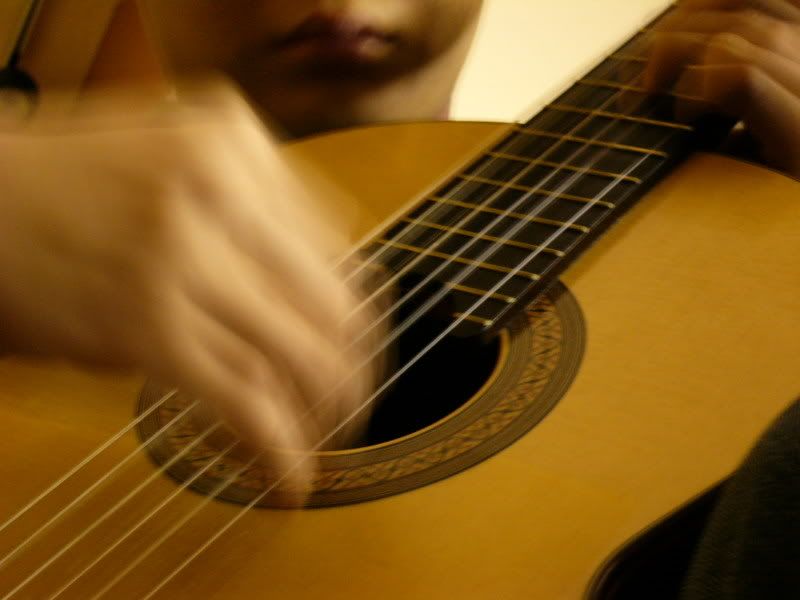
Another little fact which I don't tell many people about: before I entered university, I was briefly working as a professional guitarist both teaching and performing. At that point, I was 19 years old, and it had only been four years since I started learning the guitar, yet I managed to con my way into a job at a music school (I got fired after a few months, not because I was crap, but that's another story...). Even more outrageously, I phoned up every single 4-star hotel in town to ask if they needed a lounge guitarist (I was humble enough to realise that I should get some experience before trying for a job at a 5-star hotel), and surprisingly enough, the Swiss Garden Hotel decided to give me a shot, paying me RM1,500 to play for 12 hours a week (RM1,500 is probably equivalent to US$1000 in spending power, based on the price of McDonalds'). Unfortunately, I had to leave for university after a month on that job, but it was a memorable experience, and I'm not sure too many teenagers have had the experience of playing classical guitar in hotel, dressed in a suit and bow-tie:

(Eek...my technique was SO bad back then...)
Up to now, I've had quite a few jobs up to now ('job' defined as something which has earned me money): musician, reporter, researcher, writer, and I think every single one of them was because of "Audaces fortuna juvat"
"Audaces, fortuna juvat"This is a phrase which means "Fortune favours the bold", by the Roman writer Virgil.
I chose this to reflect that much of what I have achieved so far in life has been down to a readiness to do what I feel is necessary despite what people think. Some of it might seem relatively trivial, like asking questions in class even if it makes other people think that I'm an arrogant twat, but in retrospect this is a habit which has made lecturers notice me when they wouldn't otherwise have. When applying for the STScI internship in Baltimore last year, I asked Dr. Mark Cropper, one of my first year lecturers, to write me a reference letter. I never knew what he said about me as he sent it directly to STScI, but someone else later told me that Dr. Cropper regards me as one of the best students he has ever encountered, and this is based solely on the questions I asked in his class. Prof. Miller, another lecturer I'm friendly with, specifically advised me to continue asking questions regardless of what other people think because it helps me develop my own perception of science.
Another little fact which I don't tell many people about: before I entered university, I was briefly working as a professional guitarist both teaching and performing. At that point, I was 19 years old, and it had only been four years since I started learning the guitar, yet I managed to con my way into a job at a music school (I got fired after a few months, not because I was crap, but that's another story...). Even more outrageously, I phoned up every single 4-star hotel in town to ask if they needed a lounge guitarist (I was humble enough to realise that I should get some experience before trying for a job at a 5-star hotel), and surprisingly enough, the Swiss Garden Hotel decided to give me a shot, paying me RM1,500 to play for 12 hours a week (RM1,500 is probably equivalent to US$1000 in spending power, based on the price of McDonalds'). Unfortunately, I had to leave for university after a month on that job, but it was a memorable experience, and I'm not sure too many teenagers have had the experience of playing classical guitar in hotel, dressed in a suit and bow-tie:
(Eek...my technique was SO bad back then...)
Up to now, I've had quite a few jobs up to now ('job' defined as something which has earned me money): musician, reporter, researcher, writer, and I think every single one of them was because of "Audaces fortuna juvat"
Tuesday, September 06, 2005
It's 11.10pm now and I'm sitting in the office, having just managed to debug my code and set it running...and I was supposed to rest this evening. Admittedly, I spent a couple of hours in the local shopping centre running some errands, and have had dinner (and watched an episode of The Simpsons) so it hasn't been nonstop work all day.
Still, I have less than 3 weeks left in Sydney, and I'm rushing to finish as much of my project (which, incidentally, I haven't gotten around to explaining yet) as possible before I have to go. Joss, my supervisor, is really friendly and cheerful at times, but through email his tone becomes rather brusque and harsh, which is somewhat confusing. He has also been putting subtle pressure on me by referring to my project as 'very important work', which thus far is a brilliant strategy because I'm so sensitive to criticism.
And my MSSL paper still hasn't been completed yet (I guess I should get round to explaining about it some day as well). It's like trying to kill a hydra...everytime I finish part of it, something else crops up that demands doing, or parts of it demands re-doing. I wrote the first draft in early June, and it has always looked like being a week from completion for the past couple of months. I hope dearly that I can finish it off by this weekend, but the jury is still out whether I will.
Am currently listening to Beethoven's 'Hammerklavier' Piano Sonata for about the 5th time today...music has been the thing that's been keeping me sane, but the pressure to prepare for my upcoming recital isn't too welcome.
But it'll be worthwhile in the end.
Still, I have less than 3 weeks left in Sydney, and I'm rushing to finish as much of my project (which, incidentally, I haven't gotten around to explaining yet) as possible before I have to go. Joss, my supervisor, is really friendly and cheerful at times, but through email his tone becomes rather brusque and harsh, which is somewhat confusing. He has also been putting subtle pressure on me by referring to my project as 'very important work', which thus far is a brilliant strategy because I'm so sensitive to criticism.
And my MSSL paper still hasn't been completed yet (I guess I should get round to explaining about it some day as well). It's like trying to kill a hydra...everytime I finish part of it, something else crops up that demands doing, or parts of it demands re-doing. I wrote the first draft in early June, and it has always looked like being a week from completion for the past couple of months. I hope dearly that I can finish it off by this weekend, but the jury is still out whether I will.
Am currently listening to Beethoven's 'Hammerklavier' Piano Sonata for about the 5th time today...music has been the thing that's been keeping me sane, but the pressure to prepare for my upcoming recital isn't too welcome.
But it'll be worthwhile in the end.
Sunday, September 04, 2005
I just received the programme for my upcoming recital in November (the formatting got a bit screwed up in the conversion to PDF, but it should give the general gist of things). It's going to be a blast, so everyone who's anywhere near London is cordially invited, of course.
To make sure that it's actually a blast and not a bomb (heh), I've been practising like crazy. It's not to reassuring that 9 weeks before the recital I still have about 3 pages of the Bach left to memorise, let along bring to performance level. My part of the programme is about 15 non-stop minutes of virtuoso music without any easy stuff in between for my fingers to rest, so I really have to make sure that everything is completely secure, as any insecurity will lead to tension, which in turn will tire me out really quickly.
As for work here, I can't believe that I only have 3 more weeks left in Sydney, but at least it looks like my project is making some progress, although whether I can manage to actually squeeze a publishable paper out of this remains to be seen.
Pablo has already left, and Sam is leaving this Thursday, so after that I'll be the only sucker here till I go. It's gonna be a bit lonely and depressing, but on the bright (kind of) side I can manage my time more effectively as I won't have anyone to hang out with.
To make sure that it's actually a blast and not a bomb (heh), I've been practising like crazy. It's not to reassuring that 9 weeks before the recital I still have about 3 pages of the Bach left to memorise, let along bring to performance level. My part of the programme is about 15 non-stop minutes of virtuoso music without any easy stuff in between for my fingers to rest, so I really have to make sure that everything is completely secure, as any insecurity will lead to tension, which in turn will tire me out really quickly.
As for work here, I can't believe that I only have 3 more weeks left in Sydney, but at least it looks like my project is making some progress, although whether I can manage to actually squeeze a publishable paper out of this remains to be seen.
Pablo has already left, and Sam is leaving this Thursday, so after that I'll be the only sucker here till I go. It's gonna be a bit lonely and depressing, but on the bright (kind of) side I can manage my time more effectively as I won't have anyone to hang out with.
Monday, August 29, 2005
Saturday, August 27, 2005
Sam and I were supposed to go watch an Australian Rules Football match in downtown Sydney today afternoon. He was the one who suggested it, so I let him do the planning. We were supposed to meet at the lounge at noon before setting off, and when I got there he was already waiting.
He seemed slightly discomfitted when he saw me. He said, "Uhh...I have slightly bad news...I just found out that the match today is an away game." Apparently, he had not picked up on the fact that the location of the match at Melbourne Cricket Ground probably meant it was not in Sydney.
We went into town anyway and spent the entire day walking a huge circle around the city centre, walking to Macquarie Point where we had spectacular views of the Harbour Bridge and Opera House, moving on to Hyde Park passing through the dodgy Kings Cross area (best shop sign ever: "THE LOVE MACHINE"), before walking back through Oxford St. before ending up at the Town Hall where we started. My legs were just worn out by the evening.
A couple of days ago, as I was wiping my spectacles in my morning, the damn thing broke off right at the bridge connecting the two lens, leaving me holding the one half on each hand. I did not bring any spare glasses nor contact lenses, so the prospect of spending a couple of days being effectively blind was not very palatable.
However, I fell on my figurative feet, as the AAO has an engineering department, so I brought my spectacles to them, and one particular technician, Stan, kindly spent an hour welding my specs together with a blowtorch(!). My glasses now look as if it's been through a flame thrower (which it effectively has), but at least it's essentially back in business.
While he was fixing my frame, he mentioned that he once worked as a jeweller (!!). His surname is Miziarski and he speaks with a strong East-European accent, implying he's very likely Jewish. It's such a stereotype, the Jewish jeweller...
He seemed slightly discomfitted when he saw me. He said, "Uhh...I have slightly bad news...I just found out that the match today is an away game." Apparently, he had not picked up on the fact that the location of the match at Melbourne Cricket Ground probably meant it was not in Sydney.
We went into town anyway and spent the entire day walking a huge circle around the city centre, walking to Macquarie Point where we had spectacular views of the Harbour Bridge and Opera House, moving on to Hyde Park passing through the dodgy Kings Cross area (best shop sign ever: "THE LOVE MACHINE"), before walking back through Oxford St. before ending up at the Town Hall where we started. My legs were just worn out by the evening.
A couple of days ago, as I was wiping my spectacles in my morning, the damn thing broke off right at the bridge connecting the two lens, leaving me holding the one half on each hand. I did not bring any spare glasses nor contact lenses, so the prospect of spending a couple of days being effectively blind was not very palatable.
However, I fell on my figurative feet, as the AAO has an engineering department, so I brought my spectacles to them, and one particular technician, Stan, kindly spent an hour welding my specs together with a blowtorch(!). My glasses now look as if it's been through a flame thrower (which it effectively has), but at least it's essentially back in business.
While he was fixing my frame, he mentioned that he once worked as a jeweller (!!). His surname is Miziarski and he speaks with a strong East-European accent, implying he's very likely Jewish. It's such a stereotype, the Jewish jeweller...
Wednesday, August 24, 2005
When I was up in Siding Spring, holed up in the telescope control room, I spent a lot of time around Kinwah, my supervisor. He was my secondary supervisor for my research project last year, so I had to meet him regularly (I had commented some time ago on his propensity to just sit there lecturing me for hours while I sat there nodding), but having to hang around with him for 15 hours a day was a totally different proposition.
He is a remarkably perceptive person (he has an unfinished PhD in educational psychology), and extremely blunt if he has something to say to me. On the coach journey to Coona, he suddenly commented, 'You seem as if you have something to prove most of the time...'.
Which is true.
I've spent most of the past few years being haunted by the spectre of failure, and pushing myself into an insane workrate. It's a complex motivation with many facets, driven in part by the memories of being a perennial underachiever in school, a thirst for glory and fame, and other psychological baggage. I've pushed myself this far, so it's just a means to a good end, isn't it? However...
'If you carry on like this for too long you'll get a nervous breakdown sooner or later', Kinwah said, 'and if you care so much about what people think about you, as you progress in your career you'll meet much smarter people...'. He says that if I put all my motivation into making people think I'm smart etc., I will crash the moment I meet true geniuses in my career.
The only way out is for me to put all my motivation into a love for science. So far, I've tried taking his advice, but it's not easy to make the transition. I'm the laziest git I know by far, and the laziness has been winning in the past few days. It's not that I don't love science, but sometimes when dealing with boring and tedious work, it difficult to call up the wonder and joy of discovery.
Thought of the day: I've been dealing a lot with the solar spectrum (more on that some other day), which involved working with some old data catalogues dating back to the 1940s and '50s. These are thick and heavy tomes encasing reams of arcane data, which are literally pages and pages of numbers. Back before the days before computers, it must have been an incredibly tedious and slow process to create the catalogues by hand. Yet there were people who devoted their entire careers to such unglamorous work.
What could have driven them?
He is a remarkably perceptive person (he has an unfinished PhD in educational psychology), and extremely blunt if he has something to say to me. On the coach journey to Coona, he suddenly commented, 'You seem as if you have something to prove most of the time...'.
Which is true.
I've spent most of the past few years being haunted by the spectre of failure, and pushing myself into an insane workrate. It's a complex motivation with many facets, driven in part by the memories of being a perennial underachiever in school, a thirst for glory and fame, and other psychological baggage. I've pushed myself this far, so it's just a means to a good end, isn't it? However...
'If you carry on like this for too long you'll get a nervous breakdown sooner or later', Kinwah said, 'and if you care so much about what people think about you, as you progress in your career you'll meet much smarter people...'. He says that if I put all my motivation into making people think I'm smart etc., I will crash the moment I meet true geniuses in my career.
The only way out is for me to put all my motivation into a love for science. So far, I've tried taking his advice, but it's not easy to make the transition. I'm the laziest git I know by far, and the laziness has been winning in the past few days. It's not that I don't love science, but sometimes when dealing with boring and tedious work, it difficult to call up the wonder and joy of discovery.
Thought of the day: I've been dealing a lot with the solar spectrum (more on that some other day), which involved working with some old data catalogues dating back to the 1940s and '50s. These are thick and heavy tomes encasing reams of arcane data, which are literally pages and pages of numbers. Back before the days before computers, it must have been an incredibly tedious and slow process to create the catalogues by hand. Yet there were people who devoted their entire careers to such unglamorous work.
What could have driven them?
I've just updated my other blog with the article which won me the first prize in the Royal Astronomical Society (RAS)'s Science Writing competition.
Tuesday, August 23, 2005
I have realised that my blog must have seemed rather schizophrenic lately, with my opinions and anecdotes on various issues mixed in with some personal rants. So, I'm creating a separate blog, where I put my thoughts on science and other 'professional' stuff. It's here.
Some of you also know I like to write science articles for the general public, and I hope to regularly post such pieces on the blog. Everytime I update that site, I will mention it in this blog, so regular readers have no need to bookmark both blogs.
Some of you also know I like to write science articles for the general public, and I hope to regularly post such pieces on the blog. Everytime I update that site, I will mention it in this blog, so regular readers have no need to bookmark both blogs.
Saturday, August 20, 2005
It might have come to your notice that I had dropped out of notice for around a week last month. This was because I was out in the outback doing some observations on a telescope.
The AAO has 2 telescopes in Siding Spring out in the country, but as I'm doing a theoretical project, I wasn't really expecting to get to do any actual observations.
However, it turns out that my supervisor from UCL in London is coming down to Australia for an observing run on the Australian National University 2.3m telescope which is also based in Siding Spring, so I took off for 5 days from work to support this observation.
Siding Spring is right on the edge of the Warrumbungle National Park (I love Aussie names!) in NSW, and the nearest town is Coonabarabran, about 600km from Sydney. It was a 8 hour train/bus ride, first through the Blue Mountains, and then through cattle country. The only towns we passed by weren't so much sleepy as comatose.
Finally, we got to Coona:

From Coona, we get a taxi up to Siding Spring, which is a mountain about 1000m high. We see a sign warning us not to disturb the local wildlife...

The first thing we see when we approach Siding Spring is the dome of the 3.9m diameter Anglo-Australian Telescope (AAT) looping over us...

A closer view of the AAT dome...

Close-by, a couple of scientifically-minded wallabies have also come on observing runs:

I'm officially an employee of the AAO, so I get a desk inside the dome. However, the actual telescope is off-limits to everyone apart from technical staff and observers, so I couldn't go close-up to the telescope. I got this shot from the tourist gallery. The telescope is on an equatorial mount, which means that the mounting is actually inclined at the same angle as the latitude of its position, which facilitates star-tracking, as you only need to track along one axis of the telescope:

Just for reference, here is a picture of the AAT nicked off the net...

And a royal touch...

The telescope we'll be using is the ANU 2.3m reflector, which is in an 'alt-az' mounting, which is similar to a naval gun mounting. It's more difficult to track stars because u have to simultaneously adjust both axes at once. The entire building rotates with the telescope, and it's really cool as everything rattles and shakes as the telescope slews to acquire a new target...the big disadvantage is that they can't attack any plumbing to the dome, so the toilet is right at the base on the far side of this picture. The control room is about at the 2nd storey of the dome. To get from the control room to the main entrances means passing through the telescope...during observations, the light-spillage and thermal air drafts caused by this is unacceptable, so to take a piss, I have to walk out though the external door and walk down the metal stairs, all in pitch dark and freezing night wind...

There are about 8 telescopes at Siding Spring...from L-R: ANU 15-inch, ANU 2.3m, ANU 40-inch, AAO 1.2 Schmidt, 2m Faulkes, and the 3.9m AAT. A couple of other smaller telescopes are not visible here.

Siding Spring was chosen because there's hardly anyone within the horizon, and because it's high (by Aussie standards anyway). The mountains in the background of this view are about 100 miles away. At night, it's basically pitch-black all the way out to the horizon.

The surrounding areas are mostly national parks, and Siding Spring is the highest point nearby, so there were some spectacular views...


That's all for now...will be back on another day with more pics of the actual observations...
The AAO has 2 telescopes in Siding Spring out in the country, but as I'm doing a theoretical project, I wasn't really expecting to get to do any actual observations.
However, it turns out that my supervisor from UCL in London is coming down to Australia for an observing run on the Australian National University 2.3m telescope which is also based in Siding Spring, so I took off for 5 days from work to support this observation.
Siding Spring is right on the edge of the Warrumbungle National Park (I love Aussie names!) in NSW, and the nearest town is Coonabarabran, about 600km from Sydney. It was a 8 hour train/bus ride, first through the Blue Mountains, and then through cattle country. The only towns we passed by weren't so much sleepy as comatose.
Finally, we got to Coona:
From Coona, we get a taxi up to Siding Spring, which is a mountain about 1000m high. We see a sign warning us not to disturb the local wildlife...
The first thing we see when we approach Siding Spring is the dome of the 3.9m diameter Anglo-Australian Telescope (AAT) looping over us...
A closer view of the AAT dome...
Close-by, a couple of scientifically-minded wallabies have also come on observing runs:
I'm officially an employee of the AAO, so I get a desk inside the dome. However, the actual telescope is off-limits to everyone apart from technical staff and observers, so I couldn't go close-up to the telescope. I got this shot from the tourist gallery. The telescope is on an equatorial mount, which means that the mounting is actually inclined at the same angle as the latitude of its position, which facilitates star-tracking, as you only need to track along one axis of the telescope:
Just for reference, here is a picture of the AAT nicked off the net...
And a royal touch...
The telescope we'll be using is the ANU 2.3m reflector, which is in an 'alt-az' mounting, which is similar to a naval gun mounting. It's more difficult to track stars because u have to simultaneously adjust both axes at once. The entire building rotates with the telescope, and it's really cool as everything rattles and shakes as the telescope slews to acquire a new target...the big disadvantage is that they can't attack any plumbing to the dome, so the toilet is right at the base on the far side of this picture. The control room is about at the 2nd storey of the dome. To get from the control room to the main entrances means passing through the telescope...during observations, the light-spillage and thermal air drafts caused by this is unacceptable, so to take a piss, I have to walk out though the external door and walk down the metal stairs, all in pitch dark and freezing night wind...
There are about 8 telescopes at Siding Spring...from L-R: ANU 15-inch, ANU 2.3m, ANU 40-inch, AAO 1.2 Schmidt, 2m Faulkes, and the 3.9m AAT. A couple of other smaller telescopes are not visible here.
Siding Spring was chosen because there's hardly anyone within the horizon, and because it's high (by Aussie standards anyway). The mountains in the background of this view are about 100 miles away. At night, it's basically pitch-black all the way out to the horizon.
The surrounding areas are mostly national parks, and Siding Spring is the highest point nearby, so there were some spectacular views...
That's all for now...will be back on another day with more pics of the actual observations...
Wednesday, August 17, 2005
We had a coffee meeting this morning... I came in a bit late and the Director of the AAO was talking about some projects in progress in the Gemini Observatory. It went something like this, 'Well, the proposals for Gemini is that there is a competition between HERNIA and PERVS, so they'll need to split their efforts...'
What? HERNIA? PERVS? One thing which I noticed about astronomers is this: they like to contrive really silly acronyms for things. I found this website called DOOFAS (Dumb Or Overly Forced Astronomical Acronyms).
Here are some of my favourites:
2D-FRUTTI: 2-D Photon Counting System (I swear, I didn't make this up)
ANIS: All Neutrino Interaction Simulation (LOL!)
BAD: Balmer-Absorption-Dominated (Nuclei)
BICEP: Background Imaging of Cosmic Extragalactic Polarization (feel the burn)
CANGAROO: Collaboration between Australian and Nippon for a Gamma Ray Observatory in the Outback (krazy!)
COLA: Compact Objects in Low power Agns
GOD: Gravity One Dimension (The paper was entitled `The likelihood of GODs' existence'...)
HIS/HERS: High Intensity Spectrograph / High Energy Range Spectrometer
HO-BAGS: Hubble Observatory BAckground Galaxy Survey
HOEs: Holographic Optical Elements
MACHO: MAssive Compact Halo Objects
MIRACLE: Mid-InfraRed Array Camera of Least Effort
OWL: Overwhelmingly Large Telescope (so big, it's ridiculous)
PIG: Partially Ionized Globule
PINOCCHIO: PINpointing Orbit-Crossing Collapsed HIerarchial Objects (Egad!)
POOPSY: Phase One Observing Proposal SYstem
SAURON: Spectroscopic Areal Unit for Research on Optical Nebulae (mmmm, nerdy)
SMIRFS: Sub Millimeter InfraRed Fiber-feed System (or something)
SPIFFI: SPectrometer for Infrared Faint Field Imaging
T-RECS: Thermal REgion Camera System
YORIC: Yet another Optimal Resolution Image Constructor (Alas...)
These are NOT made up....I recognise several acronyms I know of which are real. So, it would appear that astronomers have way too much time on their hands...must be while waiting for bad weather to clear during observations...
What? HERNIA? PERVS? One thing which I noticed about astronomers is this: they like to contrive really silly acronyms for things. I found this website called DOOFAS (Dumb Or Overly Forced Astronomical Acronyms).
Here are some of my favourites:
2D-FRUTTI: 2-D Photon Counting System (I swear, I didn't make this up)
ANIS: All Neutrino Interaction Simulation (LOL!)
BAD: Balmer-Absorption-Dominated (Nuclei)
BICEP: Background Imaging of Cosmic Extragalactic Polarization (feel the burn)
CANGAROO: Collaboration between Australian and Nippon for a Gamma Ray Observatory in the Outback (krazy!)
COLA: Compact Objects in Low power Agns
GOD: Gravity One Dimension (The paper was entitled `The likelihood of GODs' existence'...)
HIS/HERS: High Intensity Spectrograph / High Energy Range Spectrometer
HO-BAGS: Hubble Observatory BAckground Galaxy Survey
HOEs: Holographic Optical Elements
MACHO: MAssive Compact Halo Objects
MIRACLE: Mid-InfraRed Array Camera of Least Effort
OWL: Overwhelmingly Large Telescope (so big, it's ridiculous)
PIG: Partially Ionized Globule
PINOCCHIO: PINpointing Orbit-Crossing Collapsed HIerarchial Objects (Egad!)
POOPSY: Phase One Observing Proposal SYstem
SAURON: Spectroscopic Areal Unit for Research on Optical Nebulae (mmmm, nerdy)
SMIRFS: Sub Millimeter InfraRed Fiber-feed System (or something)
SPIFFI: SPectrometer for Infrared Faint Field Imaging
T-RECS: Thermal REgion Camera System
YORIC: Yet another Optimal Resolution Image Constructor (Alas...)
These are NOT made up....I recognise several acronyms I know of which are real. So, it would appear that astronomers have way too much time on their hands...must be while waiting for bad weather to clear during observations...
Friday, August 05, 2005
Today, the 6th of August, marks 60 years since the first combat use of an atomic bomb over Hiroshima. 3 days later, on the 9th, another nuclear weapon was dropped on Nagasaki (little known fact: the original target was the city of Kokura, but it was covered with clouds, preventing from the aircraft from aiming the bomb. So the bomber proceeded to Nagasaki instead). These strikes precipitated the Japanese surrender less than a week later.
As a physicist, I regard the beginning of the nuclear age as a loss of innocence for physics... the entire Manhattan project which created the atom bomb involved countless physicists, many of them already well-established (like Fermi, Oppenheimer, Bethe etc) and others who would eventually go on to become Nobel-prize winners in their respective fields, like Feynmann and Segre. So in a sense, my intellectual predecessors were responsible for opening this Pandora's box, and I am personally fascinated by the history of this effort, which had its beginnings with the discovery of radioactivity in the late 19th century, at the end of the steam age.
It was also this moment when physicists went from being detached boffins to becoming a strategic resource...the nation with the most physicists would hold the key to power (this is of course not as simplistic, but certainly it must have seemed so in the immediate aftermath of Hiroshima and Nagasaki. Billions of dollars were poured into physics research, a lot of it directly into nuclear weapons development, but much of it had very tenuous links, like particle physics and space research. For scientists in the US and Soviet Union, making vague, indirect links to weapons programmes used to be a useful way to get research funding (a project with the word 'nuclear' or 'atomic' in it doesn't necessarily have much to do with nuclear weapons or energy at all).
I have been to Hiroshima some years back, and it was quite a harrowing experience; the Peace Park is such a serene and beautiful place, until you realise that before the bombing it was a densely populated slum. I dearly wish Nagasaki is the last time anyone ever uses the bomb, but... I think the decision to drop the bombs was the right thing to do.
Japan was being blockaded by mid-1945, most of its navy on the bottom and its army beaten back from across the Pacific, but there was still an absolute refusal to surrender unconditionally (the military elite were only hoping for a conditional 'surrender' which would mean, among other things, that no occupation troops were to touch mainland Japan and most of the existing power structures would remain intact).
It was intended that in the event of an Allied invasion of mainland Japan, every man, woman and child would fight to the death. This was no idle threat: in the battle of Iwo Jima, the Japanese residents (including elderly and children) there had flung themselves off a cliff rather than be captured by American troops. So if the invasion had occured, in addition to massive combat casualties on both the Allied and Japanese sides, huge numbers of Japanese civillians were likely to have perished as well. A million Japanese combat troops were still stationed in China/Manchuria, and they would have provided a huge fight for the Allies, as well as continuing the brutal oppression of the occupied Chinese.
So, I believe that in the cold arithmetic of war, the use of atomic weapons was a tragic, but necessary decision.
As a physicist, I regard the beginning of the nuclear age as a loss of innocence for physics... the entire Manhattan project which created the atom bomb involved countless physicists, many of them already well-established (like Fermi, Oppenheimer, Bethe etc) and others who would eventually go on to become Nobel-prize winners in their respective fields, like Feynmann and Segre. So in a sense, my intellectual predecessors were responsible for opening this Pandora's box, and I am personally fascinated by the history of this effort, which had its beginnings with the discovery of radioactivity in the late 19th century, at the end of the steam age.
It was also this moment when physicists went from being detached boffins to becoming a strategic resource...the nation with the most physicists would hold the key to power (this is of course not as simplistic, but certainly it must have seemed so in the immediate aftermath of Hiroshima and Nagasaki. Billions of dollars were poured into physics research, a lot of it directly into nuclear weapons development, but much of it had very tenuous links, like particle physics and space research. For scientists in the US and Soviet Union, making vague, indirect links to weapons programmes used to be a useful way to get research funding (a project with the word 'nuclear' or 'atomic' in it doesn't necessarily have much to do with nuclear weapons or energy at all).
I have been to Hiroshima some years back, and it was quite a harrowing experience; the Peace Park is such a serene and beautiful place, until you realise that before the bombing it was a densely populated slum. I dearly wish Nagasaki is the last time anyone ever uses the bomb, but... I think the decision to drop the bombs was the right thing to do.
Japan was being blockaded by mid-1945, most of its navy on the bottom and its army beaten back from across the Pacific, but there was still an absolute refusal to surrender unconditionally (the military elite were only hoping for a conditional 'surrender' which would mean, among other things, that no occupation troops were to touch mainland Japan and most of the existing power structures would remain intact).
It was intended that in the event of an Allied invasion of mainland Japan, every man, woman and child would fight to the death. This was no idle threat: in the battle of Iwo Jima, the Japanese residents (including elderly and children) there had flung themselves off a cliff rather than be captured by American troops. So if the invasion had occured, in addition to massive combat casualties on both the Allied and Japanese sides, huge numbers of Japanese civillians were likely to have perished as well. A million Japanese combat troops were still stationed in China/Manchuria, and they would have provided a huge fight for the Allies, as well as continuing the brutal oppression of the occupied Chinese.
So, I believe that in the cold arithmetic of war, the use of atomic weapons was a tragic, but necessary decision.
Wednesday, August 03, 2005
On Tuesday evening, I was working overtime at the office when suddenly I received a phone call from home. My mum had just called me on the weekend, so it was unusual for her to call again so soon. She asked me what I was doing, if I had dinner etc., which was what she always starts off with whenever she calls me. A few minutes into the conversation, she suddenly said, 'Your eldest aunt's husband just passed away yesterday.' (We were talking in Mandarin, and it's a bit less awkward sounding it seems in English). This came as a total shock to me; I knew he had been ill for the past few years and he had to have major liver surgery last year, but there was no indication that he was critically ill. He wasn't the first family member to have passed away in my recent memory, but yet I felt a sadness that I haven't felt previously, and tears started welling up.
When I was a baby, my parents left me under the care of my father's eldest sister as my mother wanted to keep working; I only went back home with my parents in the weekends. Thus, I spent the first two years of my life in that house with my aunt's family, until my sister was born and my mother decided to quit work. There is hardly anything I remember from that period of infancy, but my parents tell me that my aunt's husband was very fond of me when I was staying in his house, and I used to cry whenever my parents came at the weekend to bring me home.
Years later, when I was about 4-6 years old, when my family went to visit this aunt, or when we were all at my grandmother's house, I would insist on staying overnight at my aunt's house... I still have memories from this part of my life, squeezing into bed with my cousins (they were 6-7 years older than me, and as I was my parents' eldest child, I regarded them as older brothers), and digging for toys in the musty dust-filled storeroom. I remember clambering up the shelves in the living room,looking for things I could play with.
After I was past 8 years old or so, my bond to my aunt's family waned... memories from my infancy and early childhood faded as I grew up, and I've hardly spoken to my cousins or their father since then. Still, I continued feeling a strong, unspoken, affinity to my aunt and her family. Whenever my family went to visit their house, I would somehow feel very much at home as every corner carried echoes of my early years. The cabinets which I had climbed up as a child now seemed so very small, yet so comfortingly familiar.
In the past decade, I must have not spoken directly to my aunt's husband except for greeting him (in part because I'm not very fluent in my supposedly native Hokkien language, and because the generation gap is so huge), yet went my mother told me he had passed away, I started crying (I have tears in my eyes as I write this). Maybe it's because he was present in some of the happiest memories of my life, and with his passing I seemed to have lost another link to my childhood.
I have not said anything about what sort of person he was, but on a level it doesn't matter. All my personal reminiscences of him have now regressed beneath the level of my conscious memory, and the emotion I felt at his passing is coming from a little boy who still lurks somewhere within my subconscious. Yet, I have one very vivid memory of him: I must have been 6 or 7, and my family was visiting his house. At that age, he seemed so towering, and he picked him up and swung me around as I squealed and laughed. In that brief moment, I was flying.
I have no other memories of anyone ever doing that to me.
When I was a baby, my parents left me under the care of my father's eldest sister as my mother wanted to keep working; I only went back home with my parents in the weekends. Thus, I spent the first two years of my life in that house with my aunt's family, until my sister was born and my mother decided to quit work. There is hardly anything I remember from that period of infancy, but my parents tell me that my aunt's husband was very fond of me when I was staying in his house, and I used to cry whenever my parents came at the weekend to bring me home.
Years later, when I was about 4-6 years old, when my family went to visit this aunt, or when we were all at my grandmother's house, I would insist on staying overnight at my aunt's house... I still have memories from this part of my life, squeezing into bed with my cousins (they were 6-7 years older than me, and as I was my parents' eldest child, I regarded them as older brothers), and digging for toys in the musty dust-filled storeroom. I remember clambering up the shelves in the living room,looking for things I could play with.
After I was past 8 years old or so, my bond to my aunt's family waned... memories from my infancy and early childhood faded as I grew up, and I've hardly spoken to my cousins or their father since then. Still, I continued feeling a strong, unspoken, affinity to my aunt and her family. Whenever my family went to visit their house, I would somehow feel very much at home as every corner carried echoes of my early years. The cabinets which I had climbed up as a child now seemed so very small, yet so comfortingly familiar.
In the past decade, I must have not spoken directly to my aunt's husband except for greeting him (in part because I'm not very fluent in my supposedly native Hokkien language, and because the generation gap is so huge), yet went my mother told me he had passed away, I started crying (I have tears in my eyes as I write this). Maybe it's because he was present in some of the happiest memories of my life, and with his passing I seemed to have lost another link to my childhood.
I have not said anything about what sort of person he was, but on a level it doesn't matter. All my personal reminiscences of him have now regressed beneath the level of my conscious memory, and the emotion I felt at his passing is coming from a little boy who still lurks somewhere within my subconscious. Yet, I have one very vivid memory of him: I must have been 6 or 7, and my family was visiting his house. At that age, he seemed so towering, and he picked him up and swung me around as I squealed and laughed. In that brief moment, I was flying.
I have no other memories of anyone ever doing that to me.
Subscribe to:
Posts (Atom)