Last night I decided to join some of my friends to help hand out food to homeless people in Holborn. I'm rather ashamed to say that it must have been a year since I've done any volunteer or charity work, but it's a sad fact that most of the intervening time I've been too busy to even contemplate doing such work, let along go out and do it.
After dinner around 7pm, Jason, Reuven, Alvaro and I went over to Holborn close to LSE. We were originally supposed to first go to Bond St. to help pack the food, but we were a bit late so we were told to go straight to Holborn where it would be distributed. We got there at around half-past, and although the food van wasn't due to arrive until 8pm, there was already a crowd of homeless people milling about. I must say I felt vaguely uncomfortable, as usually one sees homeless people in ones or twos but not a whole crowd of them. It might also be something to do with the fact that homeless people tend not to put personal hygiene very high on the priority list.
In any case, we waited in the chilly evening air until the van arrived. The moment the van arrived, the homeless people started crowding the vehicle as the organisers (not very successfully) tried to get the crowd into a queue. I joined in to hand out the sandwiches and miscellaneous items (which were obviously products about to go off and donated by supermarkets). There was something vaguely resembling a queue by now, but still there were people trying to cut in, and it was disruptive when people requested for specific things ('Do you have a bacon sandwich' etc). The behaviour of the people were rather varied....some of them were polite and thanked us, while others were demanding and brusque. I can understand that their life isn't very peachy, but surely it can't be too difficult to at least try and be a bit more civillised (to be fair, some of them were probably not in full control of their mental faculties).
I particularly felt for a guy in a wheel-chair who could not join in the crush... by the time the crowd had thinned out enough for him to get food, there were only bread-rolls left. Still, he seemed very grateful for what we could give him, which made me wish even more that we had more to give.
Saturday, March 11, 2006

Thursday, March 09, 2006
I was treated to a show of bureaucratic 'logic' today. I went to apply for a visa for my 5-day trip to the US at the end of this month (which incidentally went quite well, as I only waited a bit more than 2 hours, mostly indoors, compared with 3 1/2 hours shivering outside 2 years ago).
The last time I went to US was for my STScI internship in Baltimore back in '04, and I had all the supporting documentation and forms from STScI to support my visa application. The internship was supposed to be 10 weeks, and the embassy granted me a visa which lasted about 5 months. This time, I am travelling to the US for 5 days, and the embassy officer informed me that he was granting me a visa for the duration of......1 year.
The last time I went to US was for my STScI internship in Baltimore back in '04, and I had all the supporting documentation and forms from STScI to support my visa application. The internship was supposed to be 10 weeks, and the embassy granted me a visa which lasted about 5 months. This time, I am travelling to the US for 5 days, and the embassy officer informed me that he was granting me a visa for the duration of......1 year.
Tuesday, March 07, 2006
I would like to remind all and sundry that my other blog is regularly updated as well, and I'm rather tired of double-posting material from there over here (this blog is only intended for people who know me personally, and I intend on making this dichotomy more clear from now on in my posts). So my opinions on science and physics would go into that blog, while more personal stuff remains here.
Sunday, March 05, 2006
I am not a morning person, period. Back when I was in school, I waking up at 6.30am was a daily struggle. For my parents, on the other hand, it was a natural thing to do. My father wakes up every day at 7am to practise Tai Chi, and my mother wakes up around that time as well. I, on the other had, could rarely get up before noon if there is no particular reason to.
In the middle of night, on the other hand, my brain activity seems to fire up. I enjoy studying in the peace and quiet of the night, with no distractions to bother me. I took this to a rather weird extreme during the Easter break of my first year in uni, when I was studying late at night and waking up rather late in the day as well, with the additional caveat that I started sleeping and waking up later every day. After a couple of weeks, I had reached the point of going to bed at 9am and waking up at 4pm (!). This was rather disorienting, if for no reason other than the fact that I had no idea what meals I should be taking, and eventually I did fall ill from this, I suspect from a combination of this punishing studying regime and the spring flu spreading around.
Nowadays, I have reached a fairly happy compromise of going to bed at about 2am, and waking up before 10 to study. In Netherhall, we are required to vacate our rooms at around 10.15am for cleaning to be done, so I'm forced to get up no matter how lazy I'm feeling.
This few weeks ahead are going to be nasty, however. I have my research project dateline coming up in 3 weeks, and I submit my project report of about 10,000 words by the 24th, and a major headache is that the code I'm working with is still buggy, and the run-time of the code itself is extremely slow. I actually enjoys studying the material I'm learning in my lectures now, however I cannot afford to let my project slip up. I may have no real competitors for top student in my department, but standards have to be maintained...
In the middle of night, on the other hand, my brain activity seems to fire up. I enjoy studying in the peace and quiet of the night, with no distractions to bother me. I took this to a rather weird extreme during the Easter break of my first year in uni, when I was studying late at night and waking up rather late in the day as well, with the additional caveat that I started sleeping and waking up later every day. After a couple of weeks, I had reached the point of going to bed at 9am and waking up at 4pm (!). This was rather disorienting, if for no reason other than the fact that I had no idea what meals I should be taking, and eventually I did fall ill from this, I suspect from a combination of this punishing studying regime and the spring flu spreading around.
Nowadays, I have reached a fairly happy compromise of going to bed at about 2am, and waking up before 10 to study. In Netherhall, we are required to vacate our rooms at around 10.15am for cleaning to be done, so I'm forced to get up no matter how lazy I'm feeling.
This few weeks ahead are going to be nasty, however. I have my research project dateline coming up in 3 weeks, and I submit my project report of about 10,000 words by the 24th, and a major headache is that the code I'm working with is still buggy, and the run-time of the code itself is extremely slow. I actually enjoys studying the material I'm learning in my lectures now, however I cannot afford to let my project slip up. I may have no real competitors for top student in my department, but standards have to be maintained...
Saturday, March 04, 2006
I found this website which shows the descriptions of scientists, by a group of 11 year olds before and after visiting Fermilab, one of the top particle physics facilities in the US. The difference in perception is quite interesting...
I particularly liked this girl's description AFTER visiting the lab:
Before:
After:
I particularly liked this girl's description AFTER visiting the lab:
Before:
You can see them as a mad scientist with hair standing straight up and a mean wicked laugh. . . . I see them with rubber gloves and safety goggles on. I see them in a chemistry lab surrounded by beakers, graduated cylinders and tables filled with experimental materials.
After:
Scientists love their jobs. They wake up in the morning and are excited to come to work. . . . When you are a scientist, you come to work ready to explore and learn new things. Things that may change the world someday. Maybe not today, maybe not tomorrow.
Tuesday, February 28, 2006
Over the past few weeks, I've been very impressed with the way that American universities try to get their best talent. As of now, I have had 6 PhD offers, and for several times I've had people call me me up to try and convince me to go there. The only universities which haven't called were Chicago and Stanford; with Chicago someone from the faculty did email me personally, and they set a few of their graduate students to email me to answer my queries and convince me. Stanford takes 60 students for their Physics department (which was what I applied to there, instead of astrophysics/astronomy in other places), and it's not surprising that that they can contact such a crowd except for the most exceptional students (and my application wouldn't stand out as far as pure physics is concerned).
Their financial muscle is very obvious as well, from the fact that all of them offered to pay enough travel expenses for me to fly over for a look if I wanted to. I will be flying over to a couple of East Coast universities to take a look, but even the Californian universities are offering for pay for me to go over to visit, which is tempting if not for the fact that it's going to be in the midst of my pre-finals cramming.
Their financial muscle is very obvious as well, from the fact that all of them offered to pay enough travel expenses for me to fly over for a look if I wanted to. I will be flying over to a couple of East Coast universities to take a look, but even the Californian universities are offering for pay for me to go over to visit, which is tempting if not for the fact that it's going to be in the midst of my pre-finals cramming.
Monday, February 27, 2006
I'm not in general a brilliant person. I usually can follow the material in my studies, but often I do have to think about things for some time before I understand it. My strength as scientist, in fact, comes from the fact that I am very good at making connections between things which are on the surface unrelated. Let me illustrate with an example, which happened to me recently.
When I was in first year student halls, there was this guy called Chris with whom I occasionally sat with at dinner. He was a nice and friendly bloke, but I wouldn't really have regarded him as a friend. He was however unusual in studying classics (i.e. Greek and Latin studies, that sort of stuff), and apparently is unbeatable in chess.
In my present halls, over 2 years later, there is this student called Alex from I occasionally say hi to, but don't really talk to since he's very quiet and doesn't talk much, and I've been too busy to really get to know many of the newer residents. However, in a small hall like Netherhall, you learn things about people even if you don't talk to him. I overheard him mentioning to someone that he's from Norwich, and I sometimes saw him playing chess with people in the lounge.
One day, some of synapses just snapped together, and during after-dinner coffee I turned to Alex and asked him, 'Do you by any chance have a brother called Chris?'. He gave me a weird look and slowly said yes. 'Is he by any chance currently doing a Master's in classics in Durham?'. Now he looked slightly alarmed as he said yes again. I then told him that I used to stay in the same halls as his brother in first year. In some part of the brain I must still have remembered that Chris is from Norwich, and I must have made the connection that both their surnames were the same. As I started to look for connections, I noticed that they both had a vaguely similar appearance, and seeing Alex play chess just sealed the case shut.
I'm not sure how much this talent will come into use in my future scientific career, but I suspect that I don't make the grade, I'll just go and become a police detective, I guess....
When I was in first year student halls, there was this guy called Chris with whom I occasionally sat with at dinner. He was a nice and friendly bloke, but I wouldn't really have regarded him as a friend. He was however unusual in studying classics (i.e. Greek and Latin studies, that sort of stuff), and apparently is unbeatable in chess.
In my present halls, over 2 years later, there is this student called Alex from I occasionally say hi to, but don't really talk to since he's very quiet and doesn't talk much, and I've been too busy to really get to know many of the newer residents. However, in a small hall like Netherhall, you learn things about people even if you don't talk to him. I overheard him mentioning to someone that he's from Norwich, and I sometimes saw him playing chess with people in the lounge.
One day, some of synapses just snapped together, and during after-dinner coffee I turned to Alex and asked him, 'Do you by any chance have a brother called Chris?'. He gave me a weird look and slowly said yes. 'Is he by any chance currently doing a Master's in classics in Durham?'. Now he looked slightly alarmed as he said yes again. I then told him that I used to stay in the same halls as his brother in first year. In some part of the brain I must still have remembered that Chris is from Norwich, and I must have made the connection that both their surnames were the same. As I started to look for connections, I noticed that they both had a vaguely similar appearance, and seeing Alex play chess just sealed the case shut.
I'm not sure how much this talent will come into use in my future scientific career, but I suspect that I don't make the grade, I'll just go and become a police detective, I guess....
Tuesday, February 21, 2006
It's not an easy question when people ask me, 'So what is it you're studying in university?'. The official answer is that I'm currently in my final year of an MSci course in Physics with Space Science. The complication starts with the type of degree: people in UK would probably know what an MSci is, but for those who aren't from the UK, the MSci is basically a 4-year science qualification (the engineering equivalent is MEng) designed to try and match European undergraduate degrees, which typically take 5 years and is far more advanced than the British 3-year BSc.
My course is basically 75% physics with the rest being covered by the umbrella description 'space science', which involves space exploration of the solar system and the immediate near-Earth environment. My space science courses embraced both the science as well as the technical engineering and instrumental aspects involved in the subject, so I've learnt quite a bit of spacecraft engineering as well.
I chose this subject because I wanted to go into planetary exploration, but after a year or two in university, my interest turned gradually towards physics and astronomy. Indeed, my summer research experiences since 2nd year have all been in astrophysics, and my term projects in uni have been on astrophysics as well. And so it was that my PhD applications were all in astrophysics.
However, in the past year or so, my interests have yet again made a subtle shift. I've become interested in the early universe, in the era between the Big Bang and the formation of the earliest galaxies. This involves astronomical observations of the cosmic microwave background, but I have been fascinated by the interpretation of the data and the knowledge we can learn about the earliest epochs of the universe. This involves a lot of fundamental physics and mathematics... indeed, this field is the stomping ground of a lot of theoretical physicists. I'm hoping to be able to enter this field, but my undergraduate courses have sacrificed some mathematics and theoretical physics in order to concentrate on engineering and space science, so I have to try and make up for my deficiencies while in graduate school.
There are many exciting fields in physics and astronomy, but I get shivers down my spine whenever I think about the earliest stages of the universe, when it was just cooling down from the violence of the Big Bang, and before the earliest galaxies coagulated from the pristine elements. I hope I have what it takes to be part of the effort to understand this magnificent subject....
My course is basically 75% physics with the rest being covered by the umbrella description 'space science', which involves space exploration of the solar system and the immediate near-Earth environment. My space science courses embraced both the science as well as the technical engineering and instrumental aspects involved in the subject, so I've learnt quite a bit of spacecraft engineering as well.
I chose this subject because I wanted to go into planetary exploration, but after a year or two in university, my interest turned gradually towards physics and astronomy. Indeed, my summer research experiences since 2nd year have all been in astrophysics, and my term projects in uni have been on astrophysics as well. And so it was that my PhD applications were all in astrophysics.
However, in the past year or so, my interests have yet again made a subtle shift. I've become interested in the early universe, in the era between the Big Bang and the formation of the earliest galaxies. This involves astronomical observations of the cosmic microwave background, but I have been fascinated by the interpretation of the data and the knowledge we can learn about the earliest epochs of the universe. This involves a lot of fundamental physics and mathematics... indeed, this field is the stomping ground of a lot of theoretical physicists. I'm hoping to be able to enter this field, but my undergraduate courses have sacrificed some mathematics and theoretical physics in order to concentrate on engineering and space science, so I have to try and make up for my deficiencies while in graduate school.
There are many exciting fields in physics and astronomy, but I get shivers down my spine whenever I think about the earliest stages of the universe, when it was just cooling down from the violence of the Big Bang, and before the earliest galaxies coagulated from the pristine elements. I hope I have what it takes to be part of the effort to understand this magnificent subject....
Saturday, February 18, 2006
Things have been rather confusing in the past week. If I was asked a week ago, I would say that I have more or less decided on Princeton as my choice of university. However, I then started thinking specifically about professors with whom I would want to do my project with. I was looking for professors who are doing theoretical work on the Early Universe, and who are relatively young (and thus upwardly mobile). I thus identified A. in Harvard and K. in Princeton whom both fit these criteria. In fact I was truly impressed with the number of citations they both had considering their young age, and their work was very exciting.
Now, I've discovered that K. is leaving Princeton and is thus unavailable to me, but A. said that he might be taking students in the next few years. So the plot rather thickens as far as my decision is concerned. Princeton has an excellent cosmology programme, but K. seemed to be the only person doing theoretical work on the Early Universe.
Another thing I've discovered is from the eventual careers of graduates in Harvard and Princeton. Both departments have a list of the fates of students who did their PhDs there, and while in general it's not very easy to get academic positions in the top universities even for Harvard/Princeton PhDs, Princeton seems to produce more top academics than Harvard.
So the basic message is that in most aspects Princeton is the better choice, apart from the very crucial fact that I have already identified a Harvard prof I would very much like to work with. This really complicates the decision-making, so I've decided (pun intended) the best way to make the choice would be to visit the respective campuses, so I'm going to make a 5-day whistle-stop tour of Princeton and Harvard in late March....
Now, I've discovered that K. is leaving Princeton and is thus unavailable to me, but A. said that he might be taking students in the next few years. So the plot rather thickens as far as my decision is concerned. Princeton has an excellent cosmology programme, but K. seemed to be the only person doing theoretical work on the Early Universe.
Another thing I've discovered is from the eventual careers of graduates in Harvard and Princeton. Both departments have a list of the fates of students who did their PhDs there, and while in general it's not very easy to get academic positions in the top universities even for Harvard/Princeton PhDs, Princeton seems to produce more top academics than Harvard.
So the basic message is that in most aspects Princeton is the better choice, apart from the very crucial fact that I have already identified a Harvard prof I would very much like to work with. This really complicates the decision-making, so I've decided (pun intended) the best way to make the choice would be to visit the respective campuses, so I'm going to make a 5-day whistle-stop tour of Princeton and Harvard in late March....
Wednesday, February 15, 2006
The past couple of weeks have been a strange, almost surreal, experience. As mentioned ago, I had the most pleasant shock of my life when I received a PhD offer from Princeton, and followed the next day by Chicago. Since, then, the offers have come in, to the extent that everytime I see some of my Indian friends in halls who ask me, 'Any more news??', I do indeed have more news. A week after Princeton and Chicago, it was Harvard with an offer, and in the past couple of days they have really started to tumble in... Cornell 2 days ago, and today Stanford.
I have never felt so confident about myself in my entire life. Before university, my life has always been marked by under-achievement. I was always considered a bright kid, but in school I've had better things to do than to do my homework and pay attention to classes. Reading books, playing computer games and watching TV were more interesting and fun, to the extent that I scarcely remember doing any homework or studying for exams during primary school. Yet, I've always had the competitive streak, to be better than others, and without the inclination to actually work for it.
I was bright enough to do pretty well, but never to the level I (unfairly) expected. Nevertheless, as I grew, I gradually began to work harder as my goal in life became more defined during adolescence. Still, I could never find the 'killer' touch to absolutely be the best at what I was doing. There were always people better than me.
Although this desire for glory died down as I began to build up my self-esteem, it always seemed that I could never completely achieve goals that I set for myself. For example, I was satisfied with my results in university, but part of me was irritated that someone else always managed to beat me, which took the wind out of my sails somewhat.
My hard work in university was intent on preparing myself with the knowledge needed to carry out a scientific career, while at the same time ensuring that when the time came to apply for graduate school, my record would be good enough to ensure that I get admitted into a good university. Obviously, just one offer from a good university would be enough for me to get a good boost into an academic career, but I mentally set myself an insane goal: to apply for the top universities in the world, and get offers from them. I pushed myself in this pursuit, and pushed myself to the edge of depression.
It was my New Year's resolution to detach my ego from my ambitions in life, and to work hard in science not out of self-glorification, but out of curiosity and love of knowledge. And somehow, after I stopped trying to boost my ego, I finally managed to do something that was absolutely unexpected.
I have never felt so confident about myself in my entire life. Before university, my life has always been marked by under-achievement. I was always considered a bright kid, but in school I've had better things to do than to do my homework and pay attention to classes. Reading books, playing computer games and watching TV were more interesting and fun, to the extent that I scarcely remember doing any homework or studying for exams during primary school. Yet, I've always had the competitive streak, to be better than others, and without the inclination to actually work for it.
I was bright enough to do pretty well, but never to the level I (unfairly) expected. Nevertheless, as I grew, I gradually began to work harder as my goal in life became more defined during adolescence. Still, I could never find the 'killer' touch to absolutely be the best at what I was doing. There were always people better than me.
Although this desire for glory died down as I began to build up my self-esteem, it always seemed that I could never completely achieve goals that I set for myself. For example, I was satisfied with my results in university, but part of me was irritated that someone else always managed to beat me, which took the wind out of my sails somewhat.
My hard work in university was intent on preparing myself with the knowledge needed to carry out a scientific career, while at the same time ensuring that when the time came to apply for graduate school, my record would be good enough to ensure that I get admitted into a good university. Obviously, just one offer from a good university would be enough for me to get a good boost into an academic career, but I mentally set myself an insane goal: to apply for the top universities in the world, and get offers from them. I pushed myself in this pursuit, and pushed myself to the edge of depression.
It was my New Year's resolution to detach my ego from my ambitions in life, and to work hard in science not out of self-glorification, but out of curiosity and love of knowledge. And somehow, after I stopped trying to boost my ego, I finally managed to do something that was absolutely unexpected.
Tuesday, February 07, 2006
It's been a lot of euphoria and excitement in the past week after getting my offer, and it's been somewhat expensive as well, as I've had to buy dinner for my friends....but there's been something more sobering as well.
In September last year, Prof Miller, one of my favourite professors, suffered a stroke. I didn't realise this, apart from the fact that he wasn't replying to my emails (he is a baritone, and I was supposed to accompany him sometime in the future). I was later emailed by another supervisor about this bad news.
I called him soon after, and I was pleasantly surprised that he could still manage to pick up his phone, which I couldn't take for granted considering that he's recovering from a stroke. He was talking quite slowly, but was still lucid and conversant. I was very happy to talk to him again, and he was still very concerned about my PhD applications, and was endeavouring to fill in an online reference letter form which I had requested him to do before I knew he'd had a stroke. He told me he was having difficulty with filling in the form from his impairment, but he was determined to fill it in for me.
I later saw him at the chamber music club recital where I was performing. He was more stiff and expressionless than before, and he mentioned that functioning with half a brain wasn't as good as functioning with a full brain. At the time, I was rushing to prepare for my recital, so I didn't get to talk much to him (I played terribly, by the way...). I was observing him listening to the other performers, and it was to my great relief that he still seemed to be able to enjoy the music.
In a later phone conversation, I learned that he had partial loss of motor function to the left side of his body, and that he was suffering from short-term memory loss. He was still very eager to talk about music, and he could still talk about the Bach that I played at the recital. He's trying to regain his singing ability which he'd momentarily lost after the stroke, and he asked me when we could next rehearse the songs.
It's quite a busy time for me these days, with my project and studies, but I think I will find some time to learn the music to accompany him.
In September last year, Prof Miller, one of my favourite professors, suffered a stroke. I didn't realise this, apart from the fact that he wasn't replying to my emails (he is a baritone, and I was supposed to accompany him sometime in the future). I was later emailed by another supervisor about this bad news.
I called him soon after, and I was pleasantly surprised that he could still manage to pick up his phone, which I couldn't take for granted considering that he's recovering from a stroke. He was talking quite slowly, but was still lucid and conversant. I was very happy to talk to him again, and he was still very concerned about my PhD applications, and was endeavouring to fill in an online reference letter form which I had requested him to do before I knew he'd had a stroke. He told me he was having difficulty with filling in the form from his impairment, but he was determined to fill it in for me.
I later saw him at the chamber music club recital where I was performing. He was more stiff and expressionless than before, and he mentioned that functioning with half a brain wasn't as good as functioning with a full brain. At the time, I was rushing to prepare for my recital, so I didn't get to talk much to him (I played terribly, by the way...). I was observing him listening to the other performers, and it was to my great relief that he still seemed to be able to enjoy the music.
In a later phone conversation, I learned that he had partial loss of motor function to the left side of his body, and that he was suffering from short-term memory loss. He was still very eager to talk about music, and he could still talk about the Bach that I played at the recital. He's trying to regain his singing ability which he'd momentarily lost after the stroke, and he asked me when we could next rehearse the songs.
It's quite a busy time for me these days, with my project and studies, but I think I will find some time to learn the music to accompany him.
Sunday, February 05, 2006
On Wednesday evening, I was doing the telephone rota at my residence, trying to read a mathematics textbook to while away the time. Suddenly, the phone rang, and when I picked it up a man speaking in a Spanish accent asked, 'May I speak to Alvaro Tintore?'. Our telephone system involves the person on rota transferring the calls to the telephones in each floor, and if the person isn't expecting the call or isn't in his room, it can be rather of a needle-in-haystack affair to find the person in question.
I couldn't Alvaro after ringing his room and office (he's the hall secretary), so I wandered over to the chapel to see if he was there. As I was walking over, my mobile rang. The screen said 'Unknown caller'. This usually only happens when people call me from abroad, and it was very early morning back home in Malaysia, so I was wondering if there was some urgency back home.
I picked up a phone, and a distinctively American voice asked 'Is this Khee Gan Lee?' . Still wandering about the basement of Netherhall trying to look for Alvaro with (presumably) his father on the line at the reception, my heart stopped. 'This is Professor Jeremy Goodman at Princeton University, and I'm pleased to tell you that we have voted to nominate you to receive a PhD offer'. I was speechless as I listened to him tell me this, and I was still pacing up and down the hall ostensibly in search of Alvaro. He spoke to me for a couple of minutes, and all the while my faculties for speech have been reduced to stuttering 'Yes'. After he put down the phone, I walked back to the reception and picked up the caller from Spain, and told him to call back later as I couldn't get Alvaro.
I was in total shock after this. I had expected to get a few offers from the 7 universities I'm applying for, but Princeton was always 'for the heck of it', as they are the absolute elite with such a tiny department that they take only about 5 students worldwide each year. Even my supervisor had told me that he thought it was unlikely that I would be able to get into Princeton. In addition, I wasn't expecting to get any of my offers until at least late February or early March, so to get an offer from Princeton in early February was beyond stunning.
The next day, I opened my email and got an email from Chicago. 'I'm pleased to tell you that we are offering you admission into the Astronomy & Astrophysics department of the University of
Chicago. You are one of our very top candidates this year and hope you will accept this offer'. I had only submitted my Chicago application about 3 weeks ago, so they must really mean the bit about me being a top candidate to give me an offer with such haste.
One of friends commented that the past week must have been the happiest week of my life. That's probably exaggerating it a little, but nevertheless it definitely is a very happy culmination of the hard work of the past few years. These events have sparked off a lot of excitement in me, and I've been just been boiling with anticipation instead of doing my work.
I need to calm down and get back into my routine. If I'm going to go to somewhere like Princeton, I'll need to ensure that I'm adequately prepared before I start.
I couldn't Alvaro after ringing his room and office (he's the hall secretary), so I wandered over to the chapel to see if he was there. As I was walking over, my mobile rang. The screen said 'Unknown caller'. This usually only happens when people call me from abroad, and it was very early morning back home in Malaysia, so I was wondering if there was some urgency back home.
I picked up a phone, and a distinctively American voice asked 'Is this Khee Gan Lee?' . Still wandering about the basement of Netherhall trying to look for Alvaro with (presumably) his father on the line at the reception, my heart stopped. 'This is Professor Jeremy Goodman at Princeton University, and I'm pleased to tell you that we have voted to nominate you to receive a PhD offer'. I was speechless as I listened to him tell me this, and I was still pacing up and down the hall ostensibly in search of Alvaro. He spoke to me for a couple of minutes, and all the while my faculties for speech have been reduced to stuttering 'Yes'. After he put down the phone, I walked back to the reception and picked up the caller from Spain, and told him to call back later as I couldn't get Alvaro.
I was in total shock after this. I had expected to get a few offers from the 7 universities I'm applying for, but Princeton was always 'for the heck of it', as they are the absolute elite with such a tiny department that they take only about 5 students worldwide each year. Even my supervisor had told me that he thought it was unlikely that I would be able to get into Princeton. In addition, I wasn't expecting to get any of my offers until at least late February or early March, so to get an offer from Princeton in early February was beyond stunning.
The next day, I opened my email and got an email from Chicago. 'I'm pleased to tell you that we are offering you admission into the Astronomy & Astrophysics department of the University of
Chicago. You are one of our very top candidates this year and hope you will accept this offer'. I had only submitted my Chicago application about 3 weeks ago, so they must really mean the bit about me being a top candidate to give me an offer with such haste.
One of friends commented that the past week must have been the happiest week of my life. That's probably exaggerating it a little, but nevertheless it definitely is a very happy culmination of the hard work of the past few years. These events have sparked off a lot of excitement in me, and I've been just been boiling with anticipation instead of doing my work.
I need to calm down and get back into my routine. If I'm going to go to somewhere like Princeton, I'll need to ensure that I'm adequately prepared before I start.
Tuesday, January 03, 2006
Been back for a couple of weeks already, and can't believe I have to head back to London on Thursday. It's incredible how time flies, although I've had a good rest. I've spent most of my time in front of the computer playing games, or watching TV. Not the way I usually choose to spend my spare time, but it certainly is an effective way to rapidly destress. Things with my parents have also been OK. Relations with my father turned chilly the last time I was back, and this time we managed to steer clear of conflict.
I didn't really think of a New Year's Resolution come to think of it, since I'm always trying to improve myself in some way, but I guess I'd take my supervisor's advice to decouple my self-esteem from other peoples' perception of me, and to derive my satisfaction from my love of science.
Speaking of science/work, I have a massive pile of work awaiting me when I get back. My term project, which was supposed to start last term, was essentially untouched, so I have to catch with the work, not to mention that I'll be taking 3 very nasty lecture courses. Also, random promises here and there to give talks, write articles, play recitals etc only serve to make my timetabling interesting.
This would probably serve to pile stress on me, but in a way, there's no more pressure on me. My PhD applications are already away, and whatever I do in UCL from now on will have little effect on my future career. My position in the top of the class is almost unassailable, so I can take some luxury to enjoy some of the things I'm learning.
Time to enjoy life.
I didn't really think of a New Year's Resolution come to think of it, since I'm always trying to improve myself in some way, but I guess I'd take my supervisor's advice to decouple my self-esteem from other peoples' perception of me, and to derive my satisfaction from my love of science.
Speaking of science/work, I have a massive pile of work awaiting me when I get back. My term project, which was supposed to start last term, was essentially untouched, so I have to catch with the work, not to mention that I'll be taking 3 very nasty lecture courses. Also, random promises here and there to give talks, write articles, play recitals etc only serve to make my timetabling interesting.
This would probably serve to pile stress on me, but in a way, there's no more pressure on me. My PhD applications are already away, and whatever I do in UCL from now on will have little effect on my future career. My position in the top of the class is almost unassailable, so I can take some luxury to enjoy some of the things I'm learning.
Time to enjoy life.
Saturday, December 17, 2005
The past few days have been spent in what one may call 'idle leisure', i.e. not doing any work at all, which is unusual for me.
Apart from an obsession with multi-player Pro Evolution Soccer 5 on one of my hall-mates' PS2, I've done some reading, reading the newspapers end-to-end, and I've also gotten around to reading Dickens' Great Expectations. I have never read Dickens before, mostly because I always thought that his portrayal of the Victorian era was rather gloomy (from what I know of his plots), as well as my instinctive aversion to anything popularly acclaimed. In fact, I started reading the book as a soporific, to help me sleep, but very quickly his wit and the humanity of his characters won me over. I also found his portrayal of children to be wonderfully charming and warm.
I've also lost control of my appetite in the past week. I have managed to lose a couple of kilograms in the past couple of months through my regime of running, volleyball, gym and not eating junk food, but lately I've thought 'what the hell...' and stuffed my face. So this afternoon, in guilt of the double-scoop Baskin Robbin's I had scoffed earlier, I decided to go out for a run, my first in a few weeks.
It was dark by then (6pm), and as usual I went out in just a long-sleeved t-shirt, shorts and gloves. I made good progress in the first couple of km, heading down towards Regent's Park, before start my ascent up Primrose Hill, looping back towards Netherhall. Primrose Hill, which overlooks central London, isn't very high, but nevertheless running up it is about 7 minutes of exertion which stretches into what seems like an eternity of pain (all you long-distance runners out there, bear with this beginner for a while...).
I've run up this slope many times, but this time the lights along the running path were broken, so it was dark near the top. As I trudged up the hill, a bitter sub-zero wind started blowing at me, just as I was pushing my muscles and lungs to carry me through. So there I was in a t-shirt as the biting wind made my whole body go numb, muscles and lungs straining while I couldn't see 5 feet in front of me thanks to the dark and my watering eyes (from the wind). Everything seemed unreal, and my consciousness started detaching from my body undergoing punishment. As I gritted my way through, every second seemed to last a lifetime, but finally I got down the other side of the hill, where the worst of the wind was blocked off by the rows of houses.
I usually only run about 4-5 km at a time, and yet everytime it's a struggle for me to keep going in the final km. I can't help but admire the runners who can run 42 km of a marathon; while they have superb stamina, nevertheless after about 20km they start aching, and the last few kilometres are always sustained through sheer willpower.
Apart from an obsession with multi-player Pro Evolution Soccer 5 on one of my hall-mates' PS2, I've done some reading, reading the newspapers end-to-end, and I've also gotten around to reading Dickens' Great Expectations. I have never read Dickens before, mostly because I always thought that his portrayal of the Victorian era was rather gloomy (from what I know of his plots), as well as my instinctive aversion to anything popularly acclaimed. In fact, I started reading the book as a soporific, to help me sleep, but very quickly his wit and the humanity of his characters won me over. I also found his portrayal of children to be wonderfully charming and warm.
I've also lost control of my appetite in the past week. I have managed to lose a couple of kilograms in the past couple of months through my regime of running, volleyball, gym and not eating junk food, but lately I've thought 'what the hell...' and stuffed my face. So this afternoon, in guilt of the double-scoop Baskin Robbin's I had scoffed earlier, I decided to go out for a run, my first in a few weeks.
It was dark by then (6pm), and as usual I went out in just a long-sleeved t-shirt, shorts and gloves. I made good progress in the first couple of km, heading down towards Regent's Park, before start my ascent up Primrose Hill, looping back towards Netherhall. Primrose Hill, which overlooks central London, isn't very high, but nevertheless running up it is about 7 minutes of exertion which stretches into what seems like an eternity of pain (all you long-distance runners out there, bear with this beginner for a while...).
I've run up this slope many times, but this time the lights along the running path were broken, so it was dark near the top. As I trudged up the hill, a bitter sub-zero wind started blowing at me, just as I was pushing my muscles and lungs to carry me through. So there I was in a t-shirt as the biting wind made my whole body go numb, muscles and lungs straining while I couldn't see 5 feet in front of me thanks to the dark and my watering eyes (from the wind). Everything seemed unreal, and my consciousness started detaching from my body undergoing punishment. As I gritted my way through, every second seemed to last a lifetime, but finally I got down the other side of the hill, where the worst of the wind was blocked off by the rows of houses.
I usually only run about 4-5 km at a time, and yet everytime it's a struggle for me to keep going in the final km. I can't help but admire the runners who can run 42 km of a marathon; while they have superb stamina, nevertheless after about 20km they start aching, and the last few kilometres are always sustained through sheer willpower.
Tuesday, December 13, 2005
Apologies for my prolonged absence from this blog. The past month or so has been occupied with filling in forms for my PhD applications, and preparing myself for the two GRE exams (General and Physics) for US applications, which I had already taken.
The GRE Physics was held in LEEDS of all places, presumably because it was the geographical centre of the UK (they should have held it at geographical centre weighted by population, which would probably mean something like Watford in North London...). So I had to undertake the 5 hour coach journey northwards to Leeds, but fortunately Rachel, one of my classmates, was going as well. As the exam was on Saturday morning, we arrived in Leeds the night before and stayed at a B&B nearby. The place was OK, but for the fact that Leeds was unseasonably warm (warmer than London, in fact), and the room had heating I could not seem to turn off and a very tiny window. As a result, I was sweating like a horse, and couldn't get a wink of sleep all night.
Not a good preparation for what is probably the most important single exam of my life. Nevertheless, there was nothing to be done except to sit down and do the exam. The exam was 100 physics multiple-choice questions that had to be done in 170 minutes. A few of them are really easy high school stuff, but most of them involve some thought and calculations (NO calculator allowed), and quite a few are difficult. So one has to fast and accurate, which isn't particulary easy to pull off in state. It was so bad that my sleep-deprived brain thought that 1.5/2 was the same as 3/2. Nevertheless, I don't think I performed superbly, but it should still be an acceptable mark.
As we were boarding the coach home, Rachel boarded first and showed the driver the e-ticket for both of us. As I was getting on, I gestured at her and told him 'I'm with her'. He then replied with his Yorkshire burr, 'But are you sure she wants you to be with her?' and waved me on.
It's the last week of term, and I can't be arsed to do anything. Due to my applications, I have not done much of my project work, and it's menacing presence looms over my consciousness at all times. Also, my supervisor Kinwah gave me a major slagging off last week, the gist of which was that I may be the top student here, but I may become small fry if I do my Phd in a top university.
So I'm momentarily discouraged, and burnt out from working almost non-stop all year (I spent summer doing my two internships, as you may recall). I really need a break...
The GRE Physics was held in LEEDS of all places, presumably because it was the geographical centre of the UK (they should have held it at geographical centre weighted by population, which would probably mean something like Watford in North London...). So I had to undertake the 5 hour coach journey northwards to Leeds, but fortunately Rachel, one of my classmates, was going as well. As the exam was on Saturday morning, we arrived in Leeds the night before and stayed at a B&B nearby. The place was OK, but for the fact that Leeds was unseasonably warm (warmer than London, in fact), and the room had heating I could not seem to turn off and a very tiny window. As a result, I was sweating like a horse, and couldn't get a wink of sleep all night.
Not a good preparation for what is probably the most important single exam of my life. Nevertheless, there was nothing to be done except to sit down and do the exam. The exam was 100 physics multiple-choice questions that had to be done in 170 minutes. A few of them are really easy high school stuff, but most of them involve some thought and calculations (NO calculator allowed), and quite a few are difficult. So one has to fast and accurate, which isn't particulary easy to pull off in state. It was so bad that my sleep-deprived brain thought that 1.5/2 was the same as 3/2. Nevertheless, I don't think I performed superbly, but it should still be an acceptable mark.
As we were boarding the coach home, Rachel boarded first and showed the driver the e-ticket for both of us. As I was getting on, I gestured at her and told him 'I'm with her'. He then replied with his Yorkshire burr, 'But are you sure she wants you to be with her?' and waved me on.
It's the last week of term, and I can't be arsed to do anything. Due to my applications, I have not done much of my project work, and it's menacing presence looms over my consciousness at all times. Also, my supervisor Kinwah gave me a major slagging off last week, the gist of which was that I may be the top student here, but I may become small fry if I do my Phd in a top university.
So I'm momentarily discouraged, and burnt out from working almost non-stop all year (I spent summer doing my two internships, as you may recall). I really need a break...
Monday, November 21, 2005
Wednesday, November 16, 2005
Time flies despite my procrastination and sincerest belief that 'there's still a few months/weeks/days before my concert, so I can goof off now and not practise for my concert', and before I knew it, the concert was bang in my face. Even with the concert a couple of days away, I still managed to convince myself NOT to practise, as practising this close the concert can only me make me increasingly nervous as I run out of time to iron out my mistakes.
So, bang came Tuesday the 8th of November seemingly out of nowhere. I had honestly gone past the stage of caring what people would think of my playing, as other pressing concerns (e.g. PhD applications, exams etc) were foremost on my mind, so I wasn't concerned as I returned home from morning lectures, a scant few hours before the concert. Indeed, the foremost concern in my mind was whether I could manage to tie the bow-tie (the real deal, not a clip-on) that Hon Weng had lent me.
As Jane turned up, violin in hand, with her accompanyist to do some practising just a couple of hours before the concert was supposed to start at 7.30pm, I was trying not to strangle myself in my attempts to tie the bow around my neck. Neil P. was supposed to be the organiser for the concert, but it turned out he was only just returning from a trip to Mexico that very afternoon, and had turned over most of the detailed organisation to Alvaro and Eugene (our resident Singaporean working for a Malaysian concert...brilliant). However, both of them were a bit clueless about the demands on the ground, so I had to pick up the ball, making sure that all the four musicians were taken care of. I was running around trying to find someone to re-arrange the stage furniture between musicians (classical guitarists, violinists, and pianists have rather different requirements as to what they need on-stage), find a page-turner for Jane's accompanyist, sort out some dinner for them, etc etc. I did quite a lot of exercise running up and down (and in leather shoes, at that...) sorting these things out as the guests started to filter in.
At 15 minutes before my concert, I just about managed to get the tie around my neck, and get my fingers stretched just as the MC started his spiel (at that point, it was the first time I had touched my guitar all day, let alone practise). I was surprisingly calm. Normally, just before I have to play before in public, my fingers would go numb from stage fright, but this time the adrenaline rush of the organising work kept my nerves steady.
The first movement of my Bach, the Prelude, was almost perfect, which seldom occurs even in practice. The second movement, a heavy finger-busting Fugue, was less than perfect, but still I managed to play well with lots of feeling and passion, in contrast with my usual machine-like playing in public. However, I could not avoid succumbing to fatigue as the Fugue was that demanding, and the last Allegro movement was a bit of a mess. Nevertheless, I managed to avoid breaking my fingers in the process, and the progression of the music was at least uninterrupted overall. The final piece, Vals Venezolano no.3, went quite well overall, as well as could be expected considering that my fingers were burning with fatigue by then, and I used some declamation in my expressions which I think the audience liked.
So, my role finished, I could afford to kick back and heave a very large sigh of relief (and untie the thing choking my neck). Also, Eugene decided to take my photo after I had finished performing (in 6 years of playing I have only had 1 picture taken of me while playing the guitar).
 The bow tie looks cooler untied. I'm grinning so widely, obviously because I have just had a millstone removed from around my neck.
 From left to right, Bobby Chen (piano), Datuk Neville Green, Jane Ng (violin), yours truly, Foo Mei Yi (piano, and Neil Pickering.
So that's it. I'm not going to touch my guitar for at least a couple of weeks, and I can now let other things stress me out totally.
So, bang came Tuesday the 8th of November seemingly out of nowhere. I had honestly gone past the stage of caring what people would think of my playing, as other pressing concerns (e.g. PhD applications, exams etc) were foremost on my mind, so I wasn't concerned as I returned home from morning lectures, a scant few hours before the concert. Indeed, the foremost concern in my mind was whether I could manage to tie the bow-tie (the real deal, not a clip-on) that Hon Weng had lent me.
As Jane turned up, violin in hand, with her accompanyist to do some practising just a couple of hours before the concert was supposed to start at 7.30pm, I was trying not to strangle myself in my attempts to tie the bow around my neck. Neil P. was supposed to be the organiser for the concert, but it turned out he was only just returning from a trip to Mexico that very afternoon, and had turned over most of the detailed organisation to Alvaro and Eugene (our resident Singaporean working for a Malaysian concert...brilliant). However, both of them were a bit clueless about the demands on the ground, so I had to pick up the ball, making sure that all the four musicians were taken care of. I was running around trying to find someone to re-arrange the stage furniture between musicians (classical guitarists, violinists, and pianists have rather different requirements as to what they need on-stage), find a page-turner for Jane's accompanyist, sort out some dinner for them, etc etc. I did quite a lot of exercise running up and down (and in leather shoes, at that...) sorting these things out as the guests started to filter in.
At 15 minutes before my concert, I just about managed to get the tie around my neck, and get my fingers stretched just as the MC started his spiel (at that point, it was the first time I had touched my guitar all day, let alone practise). I was surprisingly calm. Normally, just before I have to play before in public, my fingers would go numb from stage fright, but this time the adrenaline rush of the organising work kept my nerves steady.
The first movement of my Bach, the Prelude, was almost perfect, which seldom occurs even in practice. The second movement, a heavy finger-busting Fugue, was less than perfect, but still I managed to play well with lots of feeling and passion, in contrast with my usual machine-like playing in public. However, I could not avoid succumbing to fatigue as the Fugue was that demanding, and the last Allegro movement was a bit of a mess. Nevertheless, I managed to avoid breaking my fingers in the process, and the progression of the music was at least uninterrupted overall. The final piece, Vals Venezolano no.3, went quite well overall, as well as could be expected considering that my fingers were burning with fatigue by then, and I used some declamation in my expressions which I think the audience liked.
So, my role finished, I could afford to kick back and heave a very large sigh of relief (and untie the thing choking my neck). Also, Eugene decided to take my photo after I had finished performing (in 6 years of playing I have only had 1 picture taken of me while playing the guitar).
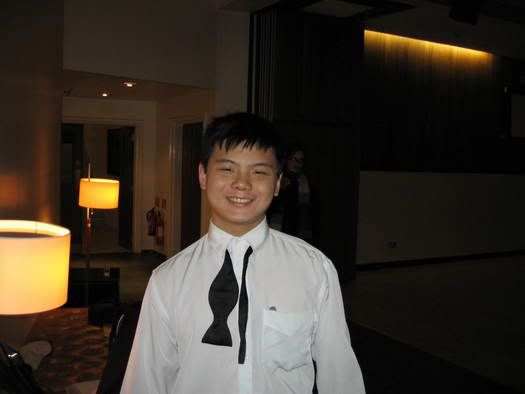 The bow tie looks cooler untied. I'm grinning so widely, obviously because I have just had a millstone removed from around my neck.
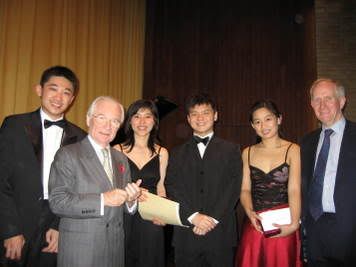 From left to right, Bobby Chen (piano), Datuk Neville Green, Jane Ng (violin), yours truly, Foo Mei Yi (piano, and Neil Pickering.
So that's it. I'm not going to touch my guitar for at least a couple of weeks, and I can now let other things stress me out totally.
Friday, November 11, 2005
Monday, November 07, 2005
My concert is tomorrow... I have been practising the pieces for the concert almost exclusively for the past 4-5 months, and guess what? I'm not ready.
Part of the reason is that I often give myself excuses not to practise. Even in the past couple of weeks, I doubt I managed to put in 12-13 hours per week, which considering that I haven't even finished memorising the pieces until 3 weeks ago, isn't a very wise idea.
This laziness contradicts squarely with my perfectionism, which means that when I do practise, it's extremely frustrating. To be fair, it is only 3 or 4 awkward bars in the entire programme which have been giving me problems, but passing through those bars brings a huge amount of tension into my fingers, which is detrimental to the rest of the music. A large portion of my practise time has been devoted to trying to iron out those few kinks, but it just hasn't worked.
After this morning's practise, I'm just decided to give up any hopes of playing perfectly, or even expressing the music the way I want it to. It's going to be every musician's nightmare: to play a half-baked concert.
Part of the reason is that I often give myself excuses not to practise. Even in the past couple of weeks, I doubt I managed to put in 12-13 hours per week, which considering that I haven't even finished memorising the pieces until 3 weeks ago, isn't a very wise idea.
This laziness contradicts squarely with my perfectionism, which means that when I do practise, it's extremely frustrating. To be fair, it is only 3 or 4 awkward bars in the entire programme which have been giving me problems, but passing through those bars brings a huge amount of tension into my fingers, which is detrimental to the rest of the music. A large portion of my practise time has been devoted to trying to iron out those few kinks, but it just hasn't worked.
After this morning's practise, I'm just decided to give up any hopes of playing perfectly, or even expressing the music the way I want it to. It's going to be every musician's nightmare: to play a half-baked concert.
Friday, October 28, 2005
| Some days ago, I met up with a few friends from my course last year who have now moved on to other things. Xinhui is now doing a Master's course in Physics in Oxford, while Raj is doing Material Science in Cambridge. Fahd and I were the two people still remaining in UCL. | ||
Subscribe to:
Posts (Atom)